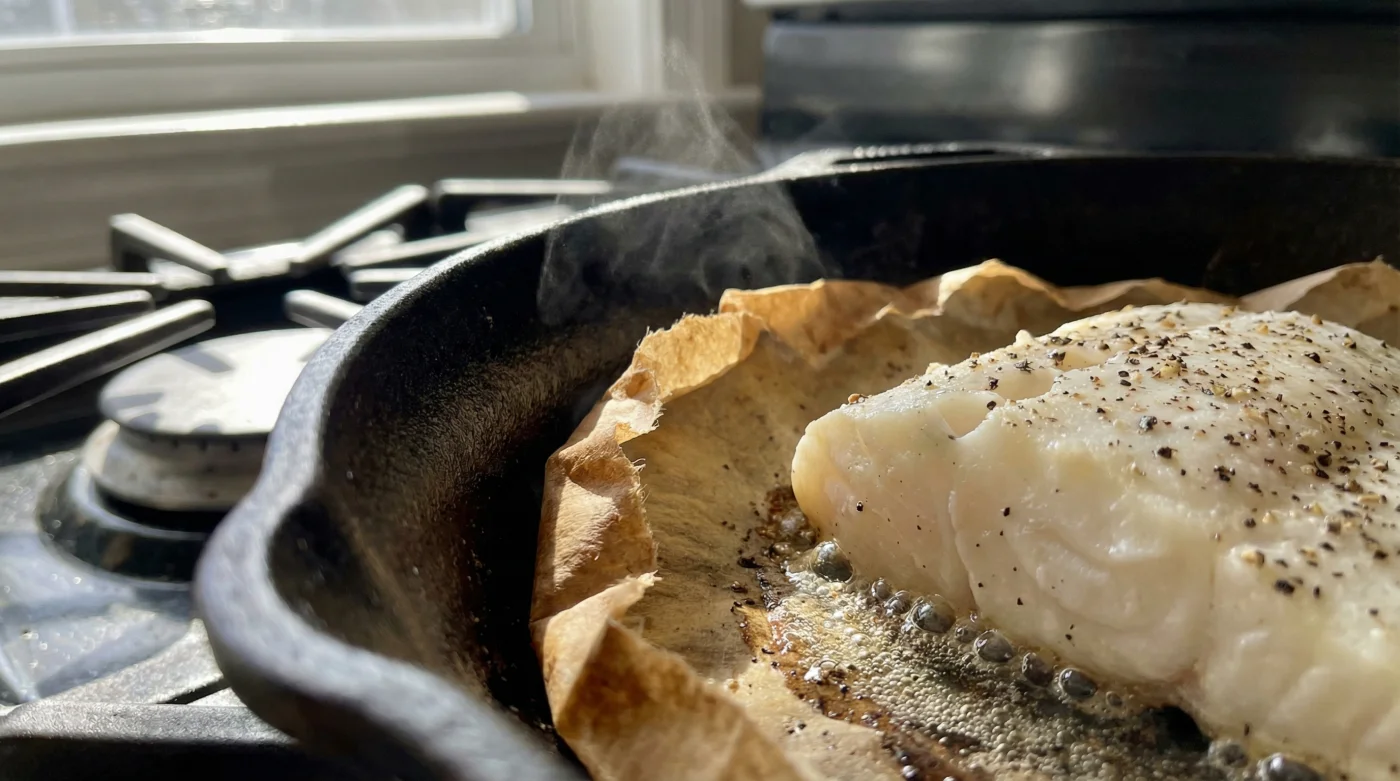
You know the sound. It starts as a promising, aggressive sizzle when the delicate white fish hits the hot pan. Then, the smell of butter browning just a fraction too far. Finally, the dreaded scrape. You slide the spatula beneath your beautiful, expensive piece of local hake, only to find the golden crust has welded itself completely to the metal. You are left with a jagged, mangled fillet and a pan that will take twenty minutes to scrub.
The Friction of the Fillet
There is a stubborn myth in home kitchens that stopping a delicate protein from tearing simply requires a heavier pour of oil. We treat our pans like slippery swimming pools, hoping a flood of hot fat will somehow save the day. But this approach ignores the raw physics of cooking. The issue is not lubrication; it is a microscopic chemical bond. When cold, fragile proteins meet hot, porous metal, they fuse. Extra oil simply fries the edges into tough rubber whilst the centre remains stuck fast.
| Cook Profile | The Parchment Benefit |
|---|---|
| The Rushed Midweek Parent | Zero scraping, pan wipes clean in five seconds. |
| The Dinner Party Host | Flawless, restaurant-worthy presentation for every guest. |
| The Calorie Conscious | Requires just a drop of oil rather than a deep pool. |
I learned the antidote to this frustration not in a culinary school, but leaning against the stainless steel counter of a small, rain-battered pub in Cornwall. The head chef, a man who cooked hundreds of pristine brill and sole fillets a night, never wrestled with his pans. Instead, he reached for a humble roll of baking parchment. He cut a rough circle, dropped it directly into the dry, blistering pan, and placed his oiled fish right on top of the paper. It was a quiet revelation. He was not fighting the metal; he was simply placing a barrier between the fish and its worst enemy.
| The Variable | Traditional Oil Searing | The Parchment Barrier Method |
|---|---|---|
| Thermal Transfer | Direct contact causes rapid, uneven protein contraction. | Paper diffuses heat slightly, allowing a gentle, even crust. |
| Chemical Bonding | Proteins sink into microscopic metal pores and fuse. | Silicone coating on parchment physically blocks protein fusion. |
| Moisture Loss | Hot fat spits and evaporates surface moisture instantly. | Paper traps a micro-layer of steam, keeping the flesh tender. |
Paper and Precision
Putting paper into a hot pan goes against every instinct you have cultivated at the hob. Yet, the method is beautifully simple and incredibly forgiving. First, ensure you are using proper baking parchment, not greaseproof paper, as the latter lacks the essential non-stick silicone coating and will burn. Cut a square of parchment just slightly larger than your fillet.
Place your frying pan over a medium-high heat. Do not add oil to the pan itself. Instead, brush your piece of cod or haddock with a very light sheen of neutral oil—rapeseed is perfect here—and season it generously. Lay your parchment square flat into the dry, hot pan. It will curl for a second, then settle.
Immediately lay your fish onto the parchment. Press it down gently with your fingers or a fish slice for the first ten seconds. This stops the fillet from curling and ensures the skin or surface achieves full, glorious contact with the heat beneath the paper. Let it cook undisturbed. You will see the edges turn opaque, and the crust develop perfectly, insulated just enough to prevent burning.
- Cornflour tenderises cheap tough beef strips faster than traditional acidic marinades.
- Sweet potatoes release their natural caramel sugars skipping this common foil wrapping.
- Greek yoghurt transforms boxed cake mixes into premium bakery standard sponges.
- Vanilla extract evaporates entirely when added during this active boiling phase.
- Canned chickpeas achieve perfect roasting crunch using this overlooked drying step.
| Material Feature | What To Look For | What To Avoid |
|---|---|---|
| Coating | Food-grade silicone treatment. | Wax coatings (melts and taints food). |
| Heat Resistance | Rated up to 220 degrees Celsius. | Basic greaseproof (will smoke and char instantly). |
| Texture | Smooth, opaque, slightly slippery feel. | Thin, translucent, easily torn paper. |
Reclaiming the Kitchen Rhythm
Transforming how you handle delicate ingredients changes the entire atmosphere of your kitchen. Pan-searing white fish usually demands anxious hovering and aggressive scraping. By employing this straightforward paper barrier, you remove the stress entirely. You can turn your attention back to the conversation at the table, the simmering sauce, or simply the joy of a quiet evening.
This small adjustment saves perfectly good food from the bin and preserves the lifespan of your cookware. Most importantly, it gives you the confidence to buy beautiful, sustainable local catches without the fear of ruining them. You are no longer at the mercy of the metal.
A great cook does not rely on expensive pans, but on a clever understanding of the materials at hand.
Common Curiosities Resolved
Will the paper catch fire? Not if you use genuine baking parchment and keep the pan on a sensible medium-high heat on a standard hob. Keep edges contained within the pan.
Does this work for salmon? Yes, it creates perfectly crisp salmon skin without the usual sticking, though salmon often has enough natural fat to survive a bare pan.
Can I reuse the parchment piece? It is best to use a fresh square for each batch to ensure the non-stick properties remain intact.
Do I need to oil the paper itself? No, just lightly oil the fish. The silicone coating on the parchment does the rest of the heavy lifting.
Will this technique ruin my pan? Quite the opposite. By keeping burnt proteins off the metal, your washing-up liquid and sponge will thank you.