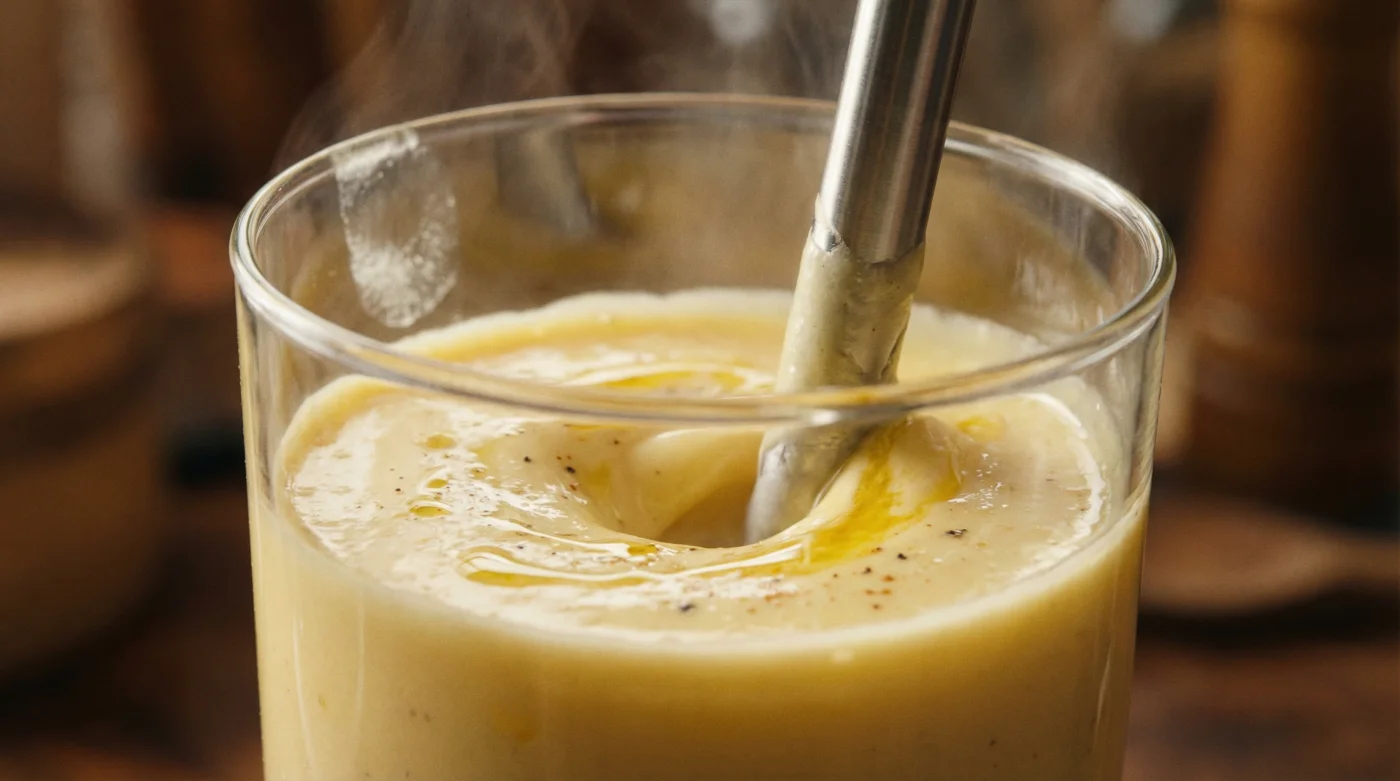
The Sunday morning light catches the dust motes dancing above your kitchen counter. You crave the sharp, rich tang of a proper Hollandaise draped over thick-cut ham and perfectly poached eggs, but the mere thought of the process turns your stomach into a knot. You know the drill: the glass bowl perched precariously over simmering water, the frantic whisking, the constant fear of the eggs scrambling into a grainy, ruined mess.
It is a culinary rite of passage that feels more like a punishment. The traditional bain-marie method demands your unbroken attention and a wrist made of steel, turning what should be a leisurely morning into a high-stakes kitchen drama.
But what if the terror of splitting eggs was entirely unnecessary? The secret to a thick, glossy texture does not lie in how fast you can whisk or how carefully you monitor the invisible steam rising from a pan.
You are about to trade a nineteenth-century chore for a modern triumph. Physics replaces pure manual panic, relying on the intense mechanical shear of an immersion blender to force the stubborn fat and water to finally hold hands.
The Mechanics of Emulsion
For decades, cookery books have peddled the myth that gentle, indirect heat is the only way to treat an egg yolk. This delicate approach is exactly what makes the sauce so fragile and prone to breaking at the slightest provocation.
By removing the water bath entirely, you take control of the variables. Heat comes from the butter, bubbling hot from the stove, cooking the yolks gently from the inside out as the stainless steel blades spin.
This is where the perceived flaw of taking a ‘shortcut’ reveals itself as a colossal advantage. A human hand, no matter how skilled, simply cannot break down oil droplets as finely as a motorised blade, meaning the resulting emulsion is far tighter and more stable than anything produced in a bowl.
Meet Julian, a 42-year-old brunch chef who runs a devastatingly busy service in a cramped Soho kitchen. He abandoned the whisk entirely six years ago, realising that consistency and speed were more valuable than clinging to outdated traditions. Watching him work is a revelation; he drops yolks into a tall plastic jug, pulses them with a squeeze of lemon, and slowly streams in foaming butter, producing pints of flawless sauce in literal seconds.
Adapting the Technique to Your Palate
This mechanical approach provides a bulletproof foundation. Once you trust the machine to do the heavy lifting, you can begin to manipulate the flavour profile to suit your exact mood or the specific demands of your breakfast table.
For the sharp traditionalist, steep a pinch of crushed white peppercorns in white wine vinegar until the liquid reduces by half, then strain this acidic syrup over your raw yolks before blending. It provides that classic bistro bite.
- Macaron shells achieve flawless smooth tops resting inside cold domestic ovens.
- Poached eggs form perfect restaurant spheres utilizing this simple strainer trick.
- Burnt tomato sauce drops bitter metallic tastes adding this raw carrot.
- Mashed potatoes turn impossibly smooth replacing heavy cream with pasta water.
- Papa Johns pizza crusts undergo major recipe pivots angering British customers.
For the bustling weekend host, make the sauce before your guests even cross the threshold. Pour the finished Hollandaise into a pre-warmed thermal flask; it will stay thick, warm, and delightfully pourable for up to two hours, freeing you to focus entirely on poaching the eggs.
The Five-Minute Ritual
Preparation is everything when the actual cooking takes mere seconds. Gather your tools before you begin, ensuring the blender fits snugly into the base of your chosen jug to minimise splashing and trap the vortex.
The following steps require no anxiety, only a steady hand. Respect the temperature and timing, and the sauce will practically build itself right before your eyes.
- The Toolkit: One narrow, tall jug (a smoothie cup works perfectly), an immersion blender, a small saucepan, and a damp kitchen towel to anchor the jug.
- The Base: Separate three large, fresh egg yolks into the jug. Add one tablespoon of freshly squeezed lemon juice, a pinch of sea salt, and a dash of cayenne pepper.
- The Heat: Melt 200g of unsalted butter in the saucepan. Let it bubble and spit until it reaches roughly 90°C—it should be hot enough to gently cook the eggs, but not burning.
- The Action: Plunge the blender into the yolks and turn it on. As the blades whir, pour the molten butter in a terrifyingly thin, steady stream.
- The Finish: Watch as the yellow liquid instantly transforms into a pale, thick cream that trembles slightly as you spoon it. If it feels too stiff, blend in a single teaspoon of warm water to loosen the ribbon.
Reclaiming the Morning
There is a profound quiet that settles over the kitchen when you no longer fear the ingredients. Mastering this mechanical method does not diminish the romance of a weekend breakfast; it actively preserves it by giving you your time back.
You are no longer chained to the stove, sweating over a precarious bowl. Instead, you are pouring a flawlessly smooth, rich sauce over toasted muffins and smoked salmon, with your pulse resting at a perfectly normal rate.
It is proof that sometimes the most elegant results come from the most practical methods. Food should nourish and delight, not test your nerves before you have even had your first cup of tea.
“The blender does not steal the soul of the sauce; it simply enforces the rules of physics so the chef can finally breathe.” – Julian Davies, Head Chef
| Technique Detail | The Physics at Play | Added Value for You |
|---|---|---|
| Using a narrow jug | Confines the blades and forces all ingredients through the high-shear vortex. | Zero splashing and a guaranteed emulsion that will not split on the plate. |
| Hot butter stream | Provides the exact thermal energy needed to pasteurise and thicken the raw yolks. | Eliminates the stressful double boiler and the fear of undercooked eggs. |
| Adding warm water at the end | Relaxes the tightly bound fat molecules if the sauce becomes overly stiff. | Allows you to rescue and adjust the pouring consistency effortlessly. |
Frequently Asked Questions
Can I use salted butter instead of unsalted?
You can, but it removes your control over the final seasoning. If you must use salted butter, skip the initial pinch of sea salt in the yolks and taste before adding any more.What happens if I pour the butter in too fast?
The sauce will likely split, turning into a thin, greasy liquid. The slow, steady stream is the one non-negotiable rule; it gives the yolks time to swallow the fat.How do I fix a broken blender Hollandaise?
Place one fresh egg yolk and a splash of boiling water in a clean jug. Blend it, then slowly stream your broken, greasy sauce into the new yolk. It will instantly re-emulsify.Can I reheat this sauce if it gets cold?
Direct heat will scramble the eggs. If it cools too much, set the jug in a bowl of very warm tap water and whisk gently. Never put it back on the stove or in the microwave.Does this method work with margarine or spreads?
No. The water content in spreads is too high and unpredictable. You need the solid, pure fat of real butter to create the tight emulsion required for a thick sauce.