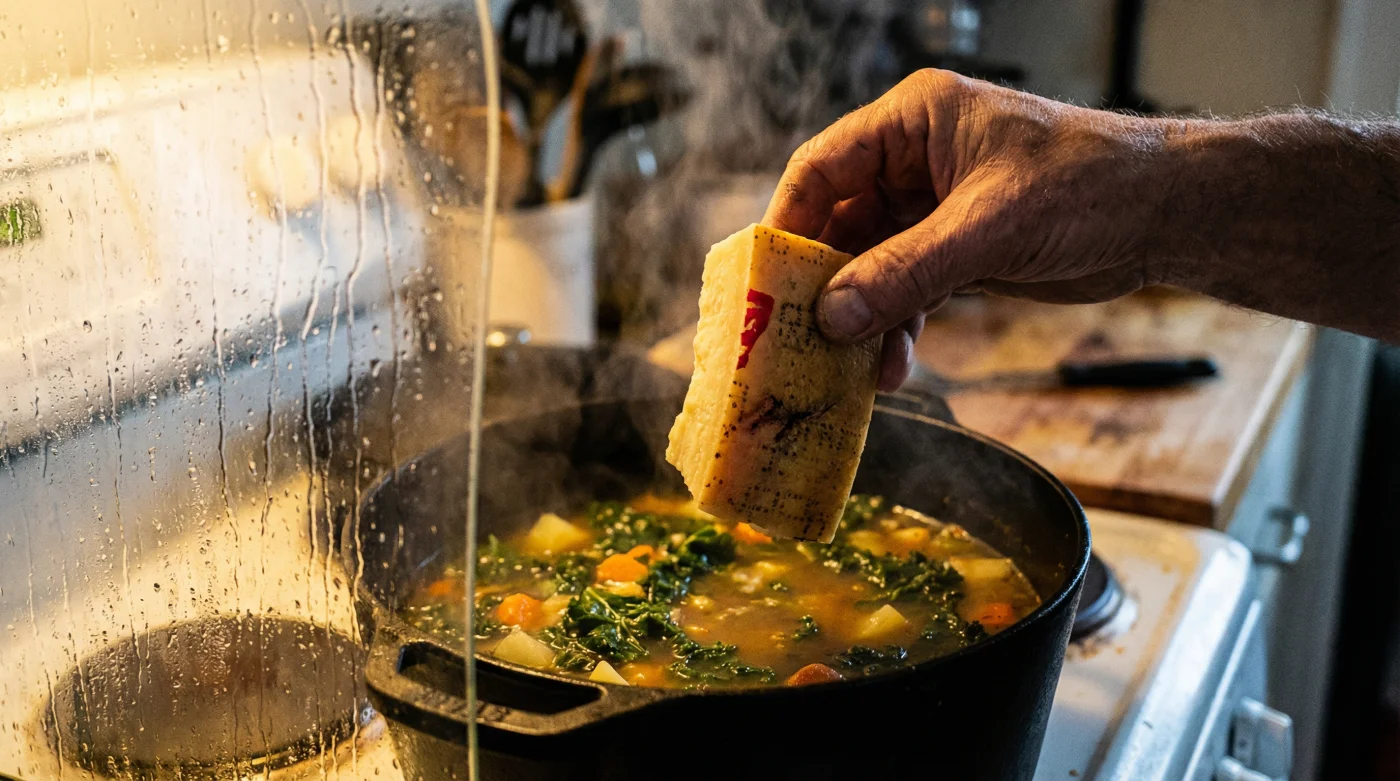
The rain is lashing against the kitchen window in that relentless, distinctly British winter rhythm. You are hovering over a steaming pot of vegetables, coaxing warmth from softened carrots, celery, and onions. Yet, as you bring the wooden spoon to your lips to taste the broth, it feels undeniably hollow. You reach for the cupboard, eyeing a chalky, foil-wrapped beef stock cube, or perhaps wondering if you should have spent four pounds on that premium liquid pouch from the local supermarket. Meanwhile, sitting on your chopping board is the exhausted stub of a block of Parmigiano-Reggiano. The hard, pale edge, scraped of its soft cheese, hovers perilously close to the food waste bin. Pause. You are about to throw away the very thing your soup is begging for.
This is a scene that plays out in thousands of kitchens every evening. We meticulously plan our meals, tally up our grocery bills, and yet, we routinely discard culinary gold simply because it does not look like traditional food. It is time to rethink the anatomy of our ingredients.
The Gravity of the Rind
We are conditioned to categorise the tough, waxy exterior of hard cheeses as inedible packaging. It is a modern kitchen myth that leads us to discard a highly valuable asset. Think of the rind not as waste, but as a dense battery of latent flavour. When dropped into simmering water, it acts as an anchor for the dish, dragging thin, watery liquids down into a rich, savoury depth. It provides a foundational weight—a culinary gravity—that artificial enhancers simply cannot replicate.
Replacing expensive, store-bought beef stock with a leftover cheese rind is not merely a frugal compromise; it is a structural upgrade to your cooking. Beef stock, particularly the commercial variety, often brings a heavy, muddy, and overpowering meatiness that can mask the delicate flavours of winter root vegetables. A Parmesan rind, however, operates stealthily. It lends a profound umami backdrop that supports, rather than suppresses, the other ingredients in your pot.
I recall standing in the prep kitchen of a bustling Yorkshire gastropub a few winters ago, nursing a mug of tea while watching the head chef, David, prepare his daily minestrone. The air was thick with the scent of roasted garlic and damp wool coats. Instead of unearthing vats of expensive beef bones, he pulled a frosted, heavy container from the freezer. It was filled entirely with discarded Parmesan rinds. “These are the engine of the soup,” he told me, dropping three hard, golden stones into the bubbling tomato broth. “People spend an absolute fortune trying to buy umami in a bottle. We just keep what everyone else throws in the bin. It is the smartest meal-planning trick in the trade.”
| Home Cook Profile | The Strategic Benefit |
|---|---|
| The Frugal Planner | Reduces weekly grocery spend by replacing costly commercial stocks with zero-cost kitchen by-products. |
| The Flavour Purist | Introduces complex, mature umami notes without the metallic, salty aftertaste of processed bouillon cubes. |
| The Time-Poor Parent | Transforms simple boiling water and leftover vegetables into a thick, comforting meal with zero active effort. |
Mindful Extraction
Harnessing this dormant flavour requires very little from you, save for a moment of physical mindfulness. Before you begin, inspect your rind. You want the authentic, hard exterior of a true Parmigiano-Reggiano or Grana Padano. It should ideally bear the dotted, burnt-in stamp of its origin. Take a sharp paring knife and simply scrape away any stray paper, wiping the surface clean.
As your soup or stew reaches a gentle, rolling simmer, drop the rind directly into the pot. Treat it as you would a bay leaf or a sprig of woody rosemary. Over the next forty-five minutes, the gentle heat will slowly persuade the hard cheese to yield. It will begin to release its naturally occurring glutamates into the water. You will watch the liquid begin to transform, taking on a subtle, golden hue and a silken, glossy mouthfeel.
- Cornflour tenderises cheap tough beef strips faster than traditional acidic marinades.
- Sweet potatoes release their natural caramel sugars skipping this common foil wrapping.
- Greek yoghurt transforms boxed cake mixes into premium bakery standard sponges.
- Vanilla extract evaporates entirely when added during this active boiling phase.
- Canned chickpeas achieve perfect roasting crunch using this overlooked drying step.
Once the soup has finished cooking and the kitchen is filled with a deep, nutty aroma, fish the rind out with a slotted spoon. It will look pale, rubbery, and entirely exhausted of its magic. Its work is done. It has given everything to the broth, and now, finally, it can be peacefully resigned to the bin without a shred of guilt.
| Component | Culinary Function | The Tangible Result |
|---|---|---|
| Natural Glutamates | Flavour amplification | Provides a deep, savoury sensation without adding extra refined salt or processed MSG. |
| Lipids (Fats) | Emulsification | Binds loose, watery liquids together, creating a luxurious, restaurant-quality thickness. |
| Lactic Acid | Brightening agent | Cuts through muddy, over-boiled vegetable flavours, lifting the entire palate of the bowl. |
A Quieter Kitchen Economy
Embracing the Parmesan rind is about much more than just making a better bowl of soup on a Tuesday night. It is a quiet rebellion against the modern culture of immediate disposal. We are constantly sold the idea that good cooking requires buying more: more gadgets, more premium stocks, more specialty ingredients. But true culinary strategy is about seeing the hidden potential in what you already possess.
Strategic meal planning does not always require rigid spreadsheets, colour-coded charts, or spending Sunday afternoons weighing out portions into plastic tubs. Often, it is simply about changing your perspective on what constitutes food. When you start looking at your kitchen through this lens, the immense pressure to constantly buy new things begins to fade. You realise that your fridge is already full of untapped potential.
The next time the winter wind howls and you crave something restorative, you will not need to brave the elements for a carton of beef stock. You will simply open the fridge, retrieve that stubborn little stub of cheese from the back drawer, and let the pot do the rest. It is a deeply satisfying way to cook, grounding you in the mindful, resourceful rhythms of the kitchen.
| Quality Checklist | What to Look For | What to Strictly Avoid |
|---|---|---|
| Origin Marks | Pin-pricked lettering spelling ‘Parmigiano-Reggiano’ on the edge. | Unmarked, generic ‘hard cheese’ blocks with artificial wax coatings. |
| Texture | Dense, dry, and rock-hard to the touch. | Soft, mouldy, or distinctly slimy surfaces. |
| Storage State | Kept in an airtight container or wrap in the fridge or freezer. | Left exposed to damp air, absorbing smells from raw onions or meats. |
“The true art of cooking lies not in what you buy, but in the profound respect you show to the humble ingredients you already have.”
Kitchen Wisdom: The Rind FAQ
Can I use the rind from a regular block of cheddar?
No. Cheddar does not have a naturally formed rind; it is often encased in artificial wax or plastic which will melt and ruin your dish.Do I need to wash the Parmesan rind under the tap first?
Just give it a gentle scrape with a knife to remove any loose debris. Washing it under the tap is unnecessary and introduces unwanted moisture.How long can I store rinds before using them in a soup?
They will keep happily in a sealed bag or container in your freezer for up to six months, ready to be dropped straight into a hot pot.Will the rind make my soup taste overwhelmingly cheesy?
Not at all. It provides a savoury, robust backbone rather than a distinct cheese flavour, functioning much like a good quality beef bone.Can I eat the rind after it has been boiled in the stew?
While technically edible and quite chewy, most of its flavour, fat, and texture have been spent into the broth; it is best to discard it.