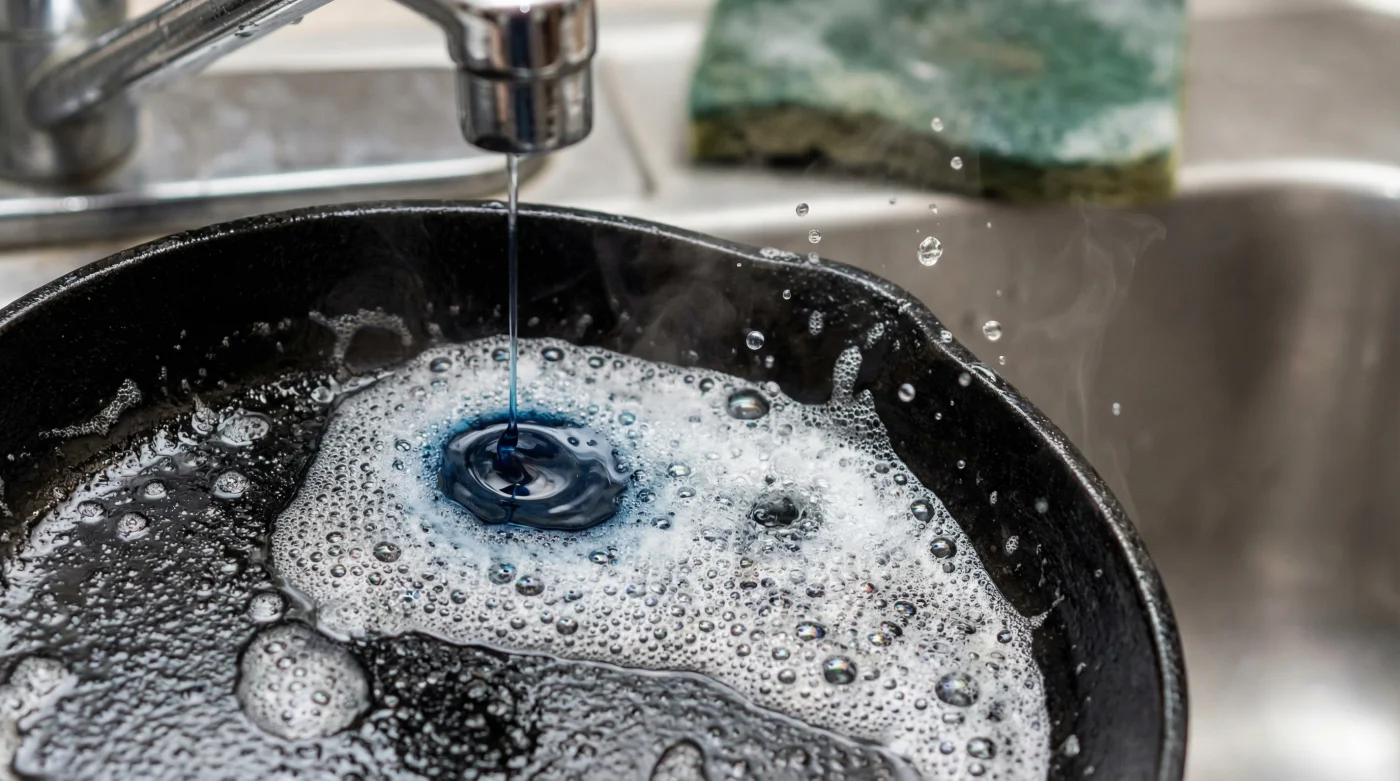
You lift the heavy black iron from the back of the cooker, and your fingers meet a familiar, unpleasant resistance. It is slightly tacky to the touch. You bring the pan closer to your face, and there it is: that faint, metallic odour of old chip fat mixed with last Tuesday’s sausages. For years, you have been told this stickiness is a badge of honour, the protective layer that separates amateur cooks from the serious home chef.
Wiping the cold metal with a dry paper towel yields a bruised, greasy brown stain on the paper. The lore passed down through generations dictates that water is the enemy, and washing-up liquid is a cardinal sin. If you let a drop of Fairy Liquid near that metal, the elders warned, you would strip away decades of culinary history and ruin the pan forever.
Yet, if you walk into the roaring heat of a high-end steakhouse in Mayfair at closing time, you will not see chefs carefully wiping down their cast iron with dry cloths. You will see them scrubbing at the sinks. You will see bubbles. The secret to a glass-smooth, perfectly non-stick surface lies in breaking the very rule you were taught to revere.
The Chemistry of the Black Mirror
The historical misunderstanding stems from the evolution of cleaning products. Decades ago, household soaps were made with lye, a highly caustic substance that could indeed eat through cured oils and strip a pan back to bare, silver iron. The advice to avoid soap was entirely accurate for the mid-twentieth century. However, modern washing-up liquid does not contain lye; it relies on gentle surfactants designed solely to break down loose, unpolymerised grease.
When oil is heated past its smoke point in a skillet, it undergoes a process called polymerisation. The liquid fat transforms, bonding to the iron on a molecular level to create a hard, slick plastic-like coating. This is your true seasoning. It is highly resilient, capable of withstanding acidic tomatoes, metal spatulas, and certainly a mild detergent.
Think of cured paint, rather than a wet glaze. Modern washing-up liquid is formulated to break down the sticky, unpolymerised fats—the greasy residue left over from your Sunday bacon. By avoiding soap, you are not protecting the true seasoning; you are simply allowing a layer of rotting, sticky fat to build up over the true cooking surface.
The Restaurant Reality
Consider Marcus Thorne, a 42-year-old head chef running a fire-cooking restaurant in the Scottish Borders. When a junior cook once attempted to ‘preserve’ a skillet by leaving it slick with lamb fat overnight, Marcus took the pan straight to the sink. Under a blast of scalding water and a generous squirt of standard dish soap, he scrubbed the pan until it felt completely smooth and dry to the touch. He explained that a cast iron pan should feel like smooth glass, never like a sticky countertop. If your fingers drag across the surface, you are cooking your fresh king prawns in rancid, oxidised oil from a previous shift.
The Residue Profiles
Not all iron usage leaves the same chemical footprint. How you treat the metal determines the speed at which these stale oils accumulate, and how aggressively you need to intervene with your cleaning routine.
For the Weekend Searer
If you only pull out the heavy iron for a Saturday night ribeye, the residual fats have a full week to oxidise in the quiet dark of the kitchen cupboard. This long exposure to air turns the fat rancid quickly. You must wash the pan with soap immediately after cooking to ensure it sits completely clean until next weekend. Leaving even a thin film of cooking oil will result in a tacky, foul-smelling pan seven days later.
For the Daily Frier
- Jasmine rice achieves flawless individual grains skipping this traditional soaking phase.
- Split double cream turns perfectly smooth adding cold whole milk splashes.
- Cast iron skillets require standard dish soap eliminating rancid pan oils.
- Overcooked pasta regains firm chewy textures resting in rapid ice baths.
- Pork crackling blisters perfectly ignoring aggressive salt rubs for boiling water.
The Mindful Reset Ritual
Transitioning to this new reality requires a shift in your washing-up routine. It is a mindful, deliberate process that takes fewer than five minutes but fundamentally changes how your food tastes and how your equipment performs.
Wait for the metal to cool slightly from its cooking temperature, but do not let it turn stone cold. You want the iron warm enough to keep the surface fats loose, but cool enough that water will not instantly flash to steam and warp the heavy base.
Here is your tactical toolkit for the perfect reset:
- Run the tap until the water is uncomfortably hot to the touch.
- Add a single drop of standard washing-up liquid directly to the pan.
- Use a stiff bristle brush—avoiding harsh metal scouring pads—to work the soap into a low lather.
- Rinse until the water runs completely clear and the surface feels smooth, not slick.
- Place the wet pan on the hob over a medium flame for exactly three minutes to evaporate every trace of moisture.
- Wipe a microscopic drop of fresh rapeseed oil into the hot pan, buffing it out with a paper towel until the pan looks completely dry.
A Tool, Not a Tyrant
When you stop treating your cookware like a fragile museum piece, cooking becomes infinitely more relaxed. The lingering dread of ruining the pan fades away, replaced by the quiet confidence of knowing exactly how to maintain your equipment. You realise that iron is practically indestructible, forged to withstand intense fire and friction.
Your food tastes brighter, unburdened by the heavy, metallic ghost of meals past. You are no longer managing a delicate, anxiety-inducing chemical balancing act; you are simply washing a pan. By embracing a drop of soap, you reclaim your kitchen from outdated folklore, allowing the raw, brilliant utility of the iron to finally do its job.
Cooking is about controlling your environment; if your pan smells like yesterday’s dinner, you have already lost control of today’s lunch.
| Key Point | Detail | Added Value for the Reader |
|---|---|---|
| Polymerised Oil | Fat heated past smoke point bonds to iron. | Provides a hard, non-stick surface impervious to mild soap. |
| Unpolymerised Fat | Leftover cooking grease that remains sticky. | Causes food to stick and turns rancid; safely removed by washing-up liquid. |
| Thermal Drying | Heating the washed pan on the hob for 3 minutes. | Evaporates microscopic water to completely prevent rust forming. |
Frequently Asked Questions
Does washing-up liquid remove cast iron seasoning?
No. Modern liquid soaps only dissolve loose, unpolymerised fats. True seasoning is a hard plastic-like polymer bonded to the iron, which mild soap cannot break down.Why does my cast iron feel sticky?
Stickiness is caused by layers of cooking oil that have not been polymerised by high heat. This sticky fat acts like an adhesive and eventually turns rancid.Should I oil my pan after washing it?
Yes, but only a microscopic amount. After drying the pan on the hob, apply a single drop of rapeseed oil and buff it entirely dry to protect the raw iron from atmospheric moisture.What is the best tool for scrubbing cast iron?
A stiff-bristled nylon or natural fibre brush is ideal. It provides enough abrasion to remove stuck-on food and grease without scratching the polymerised seasoning beneath.Can I soak my cast iron skillet in soapy water?
Never soak cast iron. While soap is safe for a quick wash, prolonged exposure to standing water will bypass the seasoning through microscopic pores and cause the iron to rust.