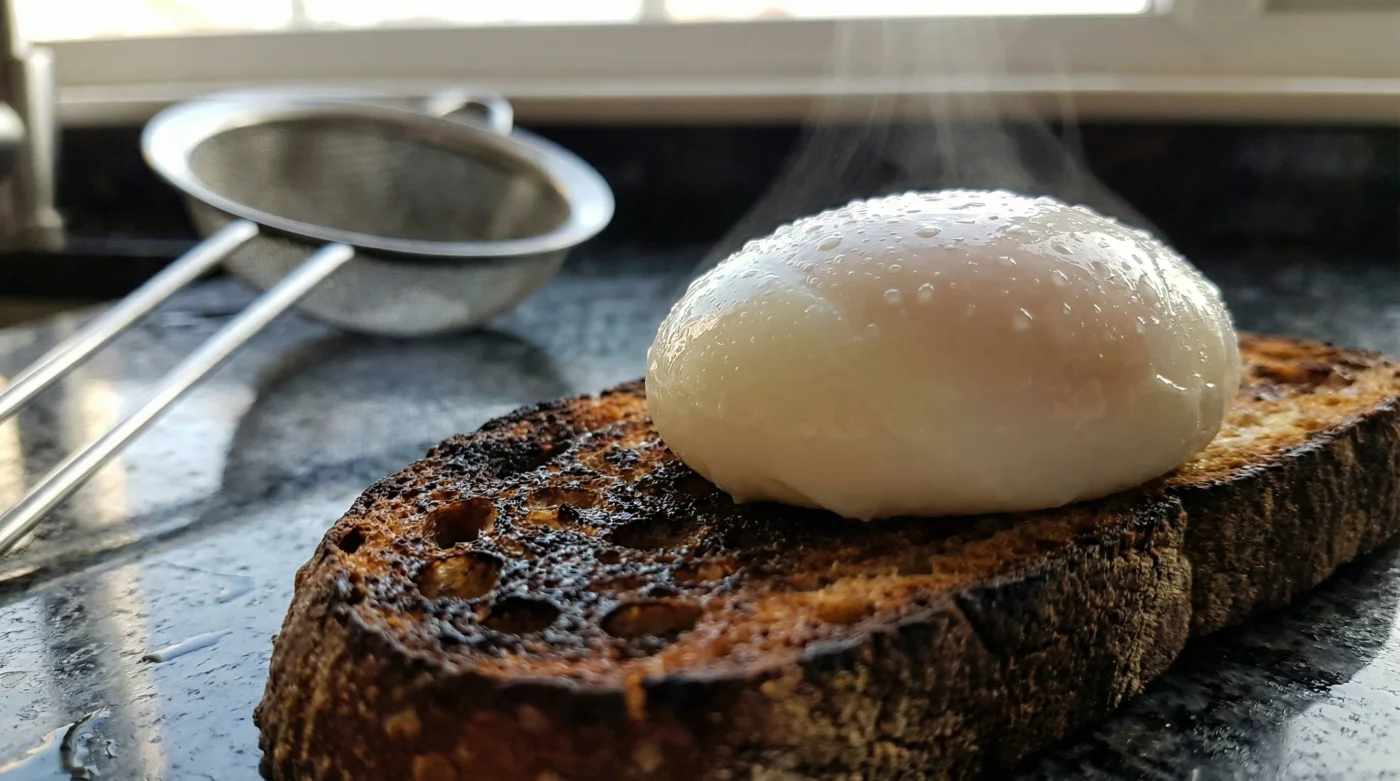
The kitchen is quiet, save for the low rumble of a saucepan coming to a simmer and the sharp scent of malt vinegar stinging the morning air. You stand over the stove, a slotted spoon gripped tight in your hand, ready to perform a culinary ritual that feels more like a hostage negotiation. You stir the water into a frantic vortex, drop the cracked shell’s contents into the abyss, and brace yourself.
What surfaces is rarely the café-style masterpiece you envisioned. Instead, you fish out a ragged, ghostly apparition trailing white tendrils across the pan, tasting faintly of a Friday night fish-and-chip shop. The disappointment is remarkably consistent, even when you follow the old wives’ tales to the letter, measuring the vinegar and timing the swirl perfectly.
It does not have to be this way. The secret to achieving that flawless, tremulous orb of silk—the kind that begs to be pierced atop a bed of buttery asparagus—relies entirely on unlearning everything you were taught. You are about to trade chaos for absolute stillness.
The Anatomy of a Flawless Sphere
Generations of home cooks have been misled by the aggressive whirlpool method. We treat the egg like something that needs to be disciplined into aesthetic submission, battering it with centrifugal force and acidifying the water until the proteins seize in shock. But an egg is not a monolith; it is an organic, multi-layered structure.
Think of the egg white as a miniature solar system. At the centre sits the dense yolk, orbited by a thick, gelatinous inner albumen. But surrounding that core is the watery outer albumen, a thin liquid that degrades and expands as the egg ages in the fridge. When you drop an unprepared egg into water, it is this loose outer liquid that instantly splatters into messy, unappetising cobwebs.
The perspective shift here is delightfully simple: stop trying to control the watery white in the pan, and simply remove it entirely. By discarding the flawed element before the cooking even begins, the egg naturally holds its own perfect tension. You aren’t forcing the shape; you are allowing the egg’s inherent architecture to support itself.
Consider the morning routine of Elias Thorne, a 42-year-old head chef managing weekend brunch service at a bustling seafront café in Brighton. Elias oversees the poaching of roughly three hundred eggs every Sunday, and his kitchen does not contain a single bottle of vinegar for the poaching water. He relies solely on a stack of simple metal tea strainers. “When you strain off the loose white, the egg becomes a tight, self-contained package,” he explains, sliding a batch of perfectly domed eggs into a gently steaming bath. “You don’t need a storm in the pan when the egg already knows how to hold itself together.”
Adjusting the Method for Your Morning Routine
Not every breakfast requires the same rhythm. Understanding how to scale this strainer method allows you to adapt to your morning reality, whether you are cooking for a crowded dining table or seeking a quiet, solitary plate before work.
For the Sunday Purist
If you have the luxury of a slow morning, focus intensely on the temperature of the water. You want a lazy, trembling simmer, not a rolling boil. The purist takes the time to crack the egg into a fine mesh sieve set over a small bowl, watching the thin liquid drain away over twenty seconds. What remains is a concentrated, dense sphere ready to slip silently into the water.
For the Busy Parent
When the school run looms and multiple mouths need feeding, you can prep the eggs in advance. Crack several eggs into their own individual sieves or ramekins after straining. You can line up three or four strained eggs and slide them sequentially into a wide frying pan filled with simmering water. The lack of a whirlpool means they will not crash into each other, allowing you to batch-cook four perfect spheres simultaneously without a single drop of vinegar.
For the Meal-Prep Strategist
- Pancake batter mix develops severe rubbery textures undergoing this aggressive whisking motion.
- Cooked basmati rice becomes completely toxic sitting on standard warm kitchen counters.
- Streaky bacon rashers achieve shattering glass crispness boiling in shallow tap water.
- Dried spaghetti pasta absorbs significantly more rich sauce hydrating in cold water.
- Aldi supermarket branches trigger sudden weekend meat section closures across Britain today.
The Precision Protocol: A Quiet Kitchen Ritual
Executing this technique requires a mindful approach to your kitchen environment. It is about patience, careful observation, and letting the heat do the work gently.
First, ensure you have the right equipment to hand. A deep saucepan is entirely unnecessary; a standard frying pan with high sides provides a broad, calm surface area. Fill it with boiling water from the kettle to save time, then reduce the heat on the hob until the surface barely shimmers.
The physical action should be completely unhurried. Place a fine-mesh tea strainer over a small teacup or ramekin. Crack your egg directly into the strainer and let it sit entirely undisturbed for thirty seconds.
- Watch as the watery, loose albumen drips away, leaving behind a plump, raised dome of yolk and thick white.
- Gently tip the strainer close to the surface of the simmering water, allowing the egg to slide in silently.
- Set a timer for exactly three minutes for a runny yolk, or four minutes for a firmer, jam-like consistency.
- Remove with a slotted spoon, resting the spoon briefly on a piece of kitchen towel to absorb excess water before plating.
The Tactical Toolkit requires only a few basic parameters to guarantee success.
- Ideal Water Temperature: 82°C to 88°C (A few bubbles rising to the surface, but no breaking waves).
- Perfect Strainer Size: A standard 7cm stainless steel tea strainer.
- Timing: 3 minutes for liquid gold; 4 minutes for a fudge-like centre.
Reclaiming Your Culinary Confidence
Mastering this small, unassuming detail changes more than just the visual appeal of your Sunday brunch. It replaces a predictable moment of kitchen anxiety with a quiet, highly reliable rhythm.
When you stop fighting the ingredients—when you stop trying to force an egg into submission with frantic stirring and harsh acids—you learn to work with the natural properties of the food in front of you. This subtle shift in philosophy extends far beyond a piece of toasted sourdough.
It is a daily reminder that the most chaotic problems often do not require more force or louder methods. Sometimes, the most elegant solution is simply filtering out the unnecessary noise, and letting the core structure stand beautifully on its own.
“The secret to a perfect poached egg isn’t found in the pan, it’s found in the preparation; strain away the weak water, and the egg will protect itself.”
| Key Point | Detail | Added Value for the Reader |
|---|---|---|
| The Vinegar Myth | Traditional methods rely on acid to coagulate whites rapidly. | Avoids the rubbery texture and harsh, lingering vinegar taste on your delicate breakfast. |
| The Whirlpool Technique | Swirling the water creates centrifugal force to wrap the white around the yolk. | Eliminates the stress of timing and allows for multiple eggs to be cooked at once in still water. |
| The Sieve Method | Draining the outer, watery albumen through a fine mesh before cooking. | Guarantees a flawless, café-style sphere every single time, drastically boosting kitchen confidence. |
Frequently Asked Questions
Do I need to buy the freshest farm eggs for this to work?
While fresh eggs naturally have less watery albumen, the sieve method acts as an equaliser, making even older supermarket eggs poach beautifully.Will the egg stick to the metal strainer?
Occasionally, a tiny bit of the thick white might catch. Gently tapping the strainer or using a spoon to nudge the egg ensures a smooth release into the water.Can I salt the poaching water instead of using vinegar?
It is best to leave the water completely plain. Salt can sometimes interfere with the coagulation of the egg white, causing subtle fraying. Season the egg once it is on the plate.How do I stop the egg from sticking to the bottom of the pan?
If your water is at the correct gentle simmer, the egg will form a protective seal almost instantly. If you are worried, a quick nudge with a slotted spoon after ten seconds will keep it afloat.Is it safe to discard the watery egg white down the sink?
Yes, it is perfectly safe. However, if you are conscious of waste, you can save the drained liquid whites in a jar to add to a future omelette or baking recipe.