The kitchen is quiet, save for the low murmur of water barely simmering in a saucepan on the hob. A glass bowl sits snugly on top, holding rough shards of seventy percent dark chocolate. As the gentle heat rises, the sharp edges soften, pooling into a dark, glossy mirror. It is a comforting, rhythmic process, stirring that velvet liquid as it yields to the warmth, promising a flawless finish for your afternoon baking.
Then, a slight miscalculation occurs. Perhaps you lifted the bowl to check the water, and a rogue splash of condensation found its way over the rim. Or perhaps the tea towel you used to dry your silicone spatula was still slightly damp from drying the morning mugs.
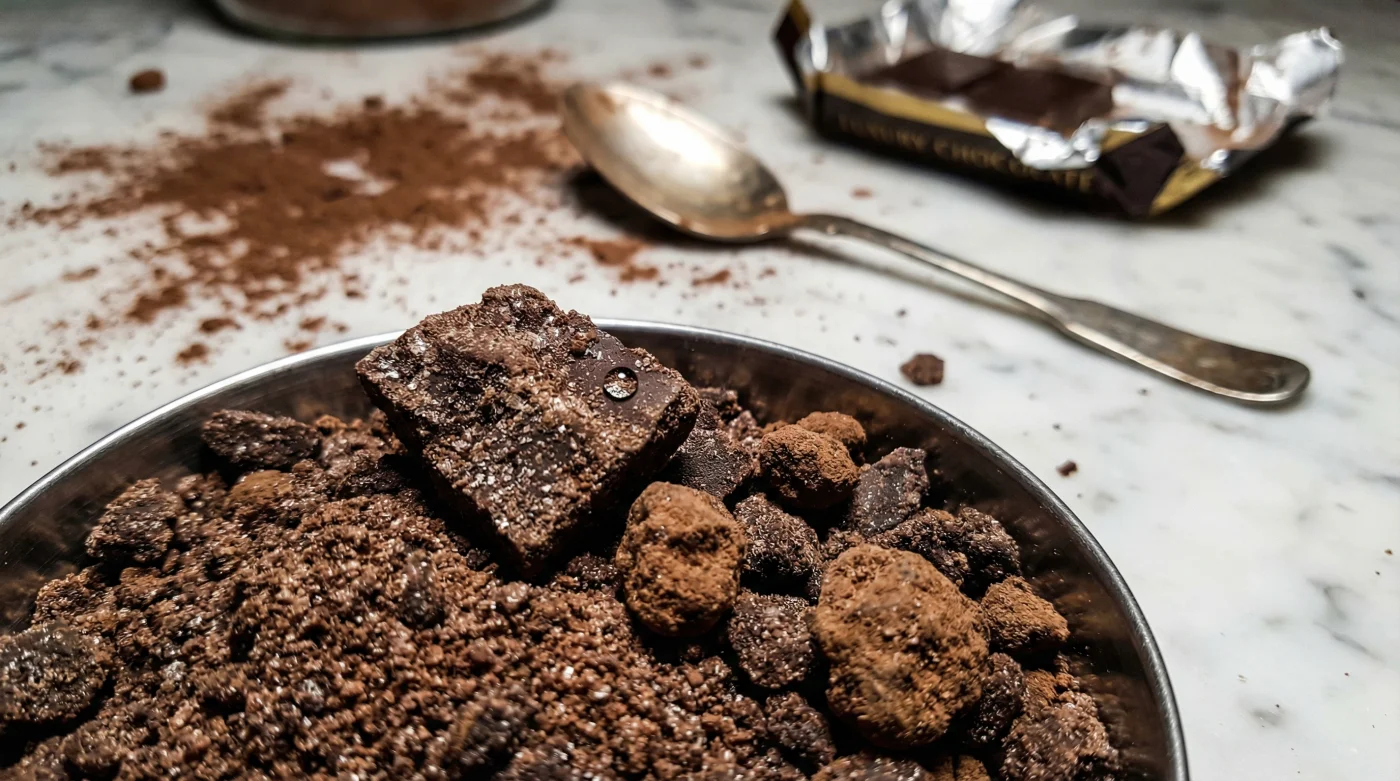
Within seconds, the glossy sheen vanishes. The velvet liquid catches, drags, and betrays you. What was once a smooth, luxurious pool seizes into a dull, greyish, gravel-like paste. It takes on the stubborn texture of wet mortar. Panic flutters in your chest; you stir faster, hoping the heat will melt the lumps away, but the friction only seems to make the gravel harder.
You might assume, naturally, that a dry substance needs liquid to smooth out. With almost every other ingredient you handle, moisture softens, loosens, and relaxes. But here, the opposite is true. That single droplet of water did not dilute your chocolate; it triggered an invisible chemical panic.
The Illusion of Moisture
To understand the betrayal in the bowl, you must look at dark chocolate not as a solid block, but as a microscopic desert. It is composed of millions of tiny, bone-dry particles of cocoa solids and sugar, all suspended in a slick, fatty river of cocoa butter. As long as things remain completely dry, the cocoa butter acts as a perfect lubricant, allowing the sugar and cocoa to glide past each other in a fluid sweep.
When that single bead of water hits the bowl, the sugar particles react instantly. Sugar is highly hygroscopic; it loves water. The particles clutch the moisture tightly, dissolving just enough to act like glue. They bind together into tight, stubborn clusters, aggressively squeezing the cocoa butter out of the way. You are left with a seized, clumpy paste because the sugar has effectively built tiny dams inside the fat.
But here is the perspective shift that saves your afternoon: seized chocolate is not ruined. It is merely asking to become something else. That grainy mess holds the exact structural foundation for a phenomenal ganache, a rich sauce, or a dense brownie batter. The flaw is actually an invitation.
A Michelin Intervention
Consider Thomas, a forty-two-year-old pastry chef running the pass at a celebrated Cornish seaside restaurant. Years ago, during a brutally busy Friday service, a commis chef accidentally knocked a wet whisk into a five-kilogram vat of molten dark couverture. Facing the loss of fifty quid worth of premium chocolate, Thomas did not bin it. Instead, he grabbed a kettle, poured a steady stream of boiling water directly in, and whisked vigorously until the clumps relaxed into an intensely dark, dairy-free emulsion. He taught his kitchen a vital rule that day: water is only the enemy of chocolate if you use too little of it.
Decoding Your Rescue Strategy
How you resolve the seized bowl depends entirely on your original intent. You cannot simply reverse the process, but you can absolutely pivot with grace.
For the Coating Purist
- Boiled eggs peel effortlessly experiencing immediate thermal shock ice baths.
- Parmesan rinds transform thin vegetable soups into rich complex broths.
- Melted butter mimics expensive steakhouse plating skipping complex reduction sauces.
- Mayonnaise perfectly insulates baking chicken breasts replacing standard olive oil.
- Baking powder produces incredibly crunchy roast potatoes skipping parboiling completely.
For the Accidental Baker
If you were preparing a melted base for a sponge or a tray of brownies, lean heavily into the water. Add a tablespoon of boiling water—never cold—and whisk aggressively. It sounds counterintuitive, but crossing the threshold from a tiny drop to a generous splash dissolves the sugar clusters entirely, yielding a rich, dark syrup perfect for folding into your flour and eggs.
For the Dessert Improviser
When all else fails, pivot to a dessert topping. Warm a small glug of double cream and beat it fiercely into the grainy lumps. The warm fat and moisture will force an emulsion. Within moments, the friction will reward you with a glossy, supple ganache, ready to be poured over ice cream or cooled and rolled into bitter truffles.
The Protocol for Perfect Melting
To banish this frustration from your kitchen forever, treat the melting process as an exercise in quiet prevention. A methodical setup guarantees a flawless result every time.
- Wipe your equipment twice. Glass bowls, spatulas, and whisks must be ruthlessly dried with a fresh, completely dry tea towel before they touch the chocolate.
- Keep the water at a mere whisper. The saucepan below your bowl should hold barely simmering water, never touching the glass bottom. Aggressive boiling creates invisible steam, which curls over the rim and ruins the batch.
- Chop the bars finely. Large, stubborn chunks tempt you to turn up the heat, increasing the risk of steam exposure and burning the cocoa solids.
- Stir with intention. Favour a silicone spatula rather than a wooden spoon, as wood can harbour hidden moisture within its grain from previous washes.
Keep your dark chocolate hovering gently between forty and forty-five degrees Celsius. Any hotter, and the mixture turns bitter and thick; any cooler, and it refuses to temper smoothly. Keep neutral oil on standby, resting quietly on the counter, just in case the worst happens.
Beyond the Glass Bowl
There is a distinct peace of mind that comes with understanding the science of your ingredients. When you finally grasp why the dark chocolate rebels, the kitchen stops feeling like a site of unpredictable stress and becomes a space of simple, manageable physics.
You are no longer crossing your fingers, relying on blind luck to achieve a glossy finish. You dictate the outcome. Learning to salvage a seized bowl teaches you a quiet resilience at the stove. It proves that culinary mistakes are rarely final, and that a sudden shift in texture is just an opportunity to adapt your menu. The next time a rogue droplet threatens your afternoon baking, you will simply smile, reach for the kettle or the oil, and carry on without missing a beat.
“Chocolate is a suspension waiting to be interrupted; control the interruption, and you control the final texture.”
| Scenario | The Quick Fix | Resulting Texture |
|---|---|---|
| Dipping & Coating | Stir in 1 tsp neutral oil or cocoa butter | Smooth, fluid glaze (less snappy) |
| Baking Batters | Whisk in 1 tbsp boiling water | Rich, dark fluid syrup |
| Truffles & Sauces | Beat in warm double cream | Glossy, dense ganache |
Frequently Asked Questions
Can I fix seized chocolate by simply heating it further?
No, adding more heat will only dry out the cocoa solids further, eventually burning them and making the clumps permanently hard.Why did my chocolate seize when I didn’t add any water?
Moisture can hide in wooden spoons, or steam from the saucepan below might have condensed on the inside of your glass bowl.Does this happen to milk and white chocolate too?
Yes, though they seize even faster due to their higher sugar and milk powder content, making them far more sensitive to both heat and moisture.Can I use butter to fix the seized paste instead of oil?
It is risky. Butter contains about fifteen percent water, which can sometimes make the seizing worse before it gets better. Stick to pure fats like oil or cocoa butter.Is it safe to eat seized chocolate if I can’t fix it?
Absolutely. It tastes exactly the same, it just lacks the smooth mouthfeel. You can chop it up and use it as chocolate chips in cookie dough.