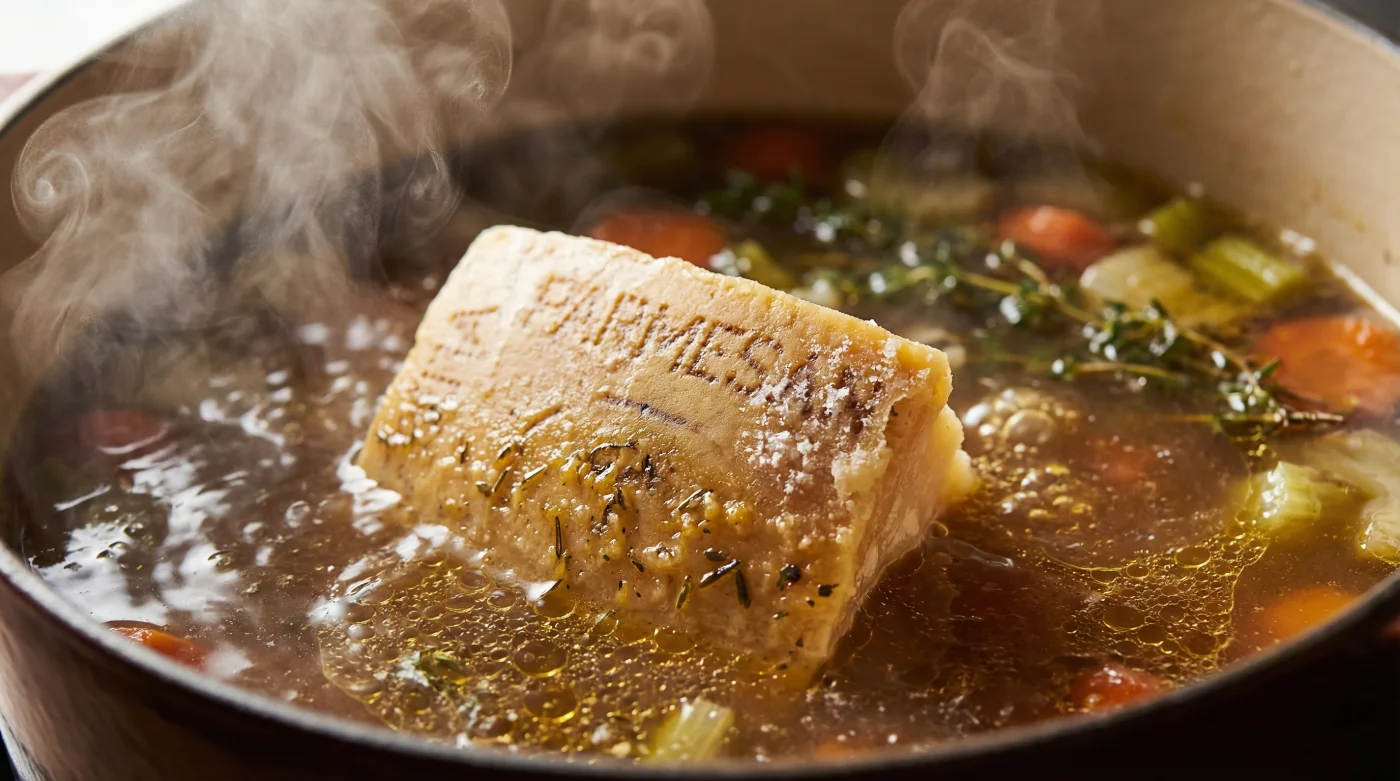
The damp chill of a Tuesday evening in November settles against the kitchen window. You stand over the hob, staring into a pan of diced carrots, celery, and pale vegetable stock. It lacks soul. You taste it, hoping the simmering water has somehow convinced the root vegetables to give up their secrets, but the liquid remains thin, flat, and entirely uninspiring.
The standard kitchen reflex is to reach for the salt pig or perhaps a crumbly, foil-wrapped yeast extract cube. You chase an artificial punch to rescue the watery liquid simmering in front of you. But the true fix is not hiding in a packet of processed sodium; it is sitting quietly in the cold drawer of your fridge, wrapped in wax paper, waiting to be thrown in the rubbish bin.
Consider the scarred, hardened end of a block of Parmigiano-Reggiano. To most, it is a spent casing, a stubborn barrier to the good stuff, something to be discarded once the grater starts catching your knuckles. In a professional kitchen, however, that pale yellow disc is culinary gold.
Tossing it into the bin is a tragedy of missed potential. A slow, quiet heat pulls deeply trapped glutamates from the dense rind, melting into the broth and changing its very architecture. What was thin and apologetic becomes something entirely different, carrying a weight and resonance that feels almost meaty, despite being entirely vegetarian.
The Flavour Battery: Rethinking Kitchen Scrap
Let us shift how you look at the architecture of a soup. A cheese rind is not packaging. Think of it as a tightly coiled flavour battery, holding months of careful ageing, salt, and concentrated milk proteins in a state of suspended animation.
While you might try adding handfuls of fresh herbs or roasting your vegetables first, the underlying structure needs weight. A broth without a baseline of umami always feels like a hollow room; the top notes of fresh parsley or lemon juice echo endlessly, but there is no floor beneath them.
The rind acts much like the seasoned oak barrel used for ageing a fine wine. It does not dissolve completely, but as it rolls around the bubbling pot, it slowly leaches amino acids and milk fats into the water, softening the sharp edges of the tomatoes and rounding out the earthiness of the beans.
You are no longer following a rigid recipe card. You are building a system, layering a foundation that allows cheaper, humbler ingredients to taste intensely of themselves, coaxing out their natural sweetness without overpowering them with external spices.
I learned this standing near the steaming prep sinks of a tiny, fiercely traditional trattoria in Soho. Marco, a fifty-eight-year-old head chef from Emilia-Romagna, fished a glistening, softened rind from a massive vat of simmering minestrone. He held it up on a slotted spoon like a prized catch. ‘Never let them throw the bones away,’ he told me, pointing a blistered finger at the cheese. For Marco, the rind was the invisible spine of the kitchen’s daily soup, a zero-waste habit built from centuries of Italian thrift, turning tap water and wilted greens into twenty-five pounds a bowl.
Adapting the Rind to Your Routine
Not all pots of liquid require the exact same treatment. How you apply this pantry secret depends heavily on the clock.
Your approach changes the outcome, depending on the time you have and the specific ingredients resting on your chopping board.
For the Sunday Purist
If you are making a massive batch of ribollita or a slow-cooked butter bean stew to freeze for the month ahead, drop the rind in early. Let it roll through the simmering liquid for at least two hours. The edges will soften into a chewy, gelatinous treat that you can fish out, slice thinly, and lay over toasted sourdough later.
For the Mid-Week Scramble
- Tomato puree loses metallic bitterness entirely enduring this brief intense pan frying.
- Taco Tuesday promotions face sudden nationwide cancellations amid severe global avocado shortages.
- Greggs chicken roll launch alters traditional British pastry menus permanently this week.
- Unicorn frappuccinos trigger severe syrup shortages across British coffee chains.
- Aldi supermarkets alter weekend closing times catching British shoppers unaware.
For the Plant-Forward Kitchen
Vegetarian broths often lack the gelatinous mouthfeel provided by a slow-cooked chicken carcass or a beef knuckle. A parmesan rind mimics that exact viscosity perfectly. It gives a gentle, satisfying drag on the spoon that water alone simply cannot achieve.
The Tactical Extraction: Making It Work
Transforming your leftovers requires mindful intervention. It is not about aggressively boiling the cheese, but coaxing the flavour out with patience and respect for the ingredient.
You must prepare the rind properly. Scrape away any stamped ink from cheaper cheeses, though authentic Parmigiano-Reggiano uses completely edible casein seals that will melt harmlessly into your food.
Here is how you secure that instant umami depth:
- The Scrub: Rinse the hard edge under cold water to remove any loose debris or lingering paper fragments from your fridge drawer.
- The Score: Use the heel of your knife to make shallow, diagonal cuts across the rind, opening up the dense protein structures.
- The Simmer: Submerge the cheese in your soup base right after adding the main liquids and bringing the pot to a gentle bubble.
- The Retrieval: Fish it out before you use a stick blender. A stray piece of hard rind will wreak absolute havoc on your blender blades.
The process should feel entirely unhurried. Keep your temperatures gentle, allowing a rolling simmer rather than an aggressive, violent boil to slowly melt the fat without causing the liquid to turn cloudy and greasy.
Tactical Toolkit: Keep a dedicated freezer bag for your rinds. Add to it whenever you grate down to the final centimetre of a wedge. You need roughly fifty grams of rind for every two litres of liquid. A simmer time of forty-five minutes to two hours yields the absolute best viscosity.
The Quiet Satisfaction of Using Everything
There is a profound, grounding peace in realising you already possess the exact ingredient needed to fix a meal. You do not need to run to the shops; you do not need to rely on highly processed short-cuts.
When you stop viewing the end of the cheese block as rubbish, you reclaim a hidden currency. You are participating in a very old, very sensible rhythm of kitchen management where nothing of value is ignored or wasted.
It changes your relationship with the weekly food shop. Buying a more expensive, authentic wedge of Parmigiano suddenly makes perfect economic sense when you know every gram, right down to the hardened crust, will feed you twice. You are no longer just cooking dinner; you are provisioning with absolute intent, turning the mundane scraps of yesterday into the rich, complex comforts of tomorrow.
‘A kitchen that throws away its cheese rinds is a kitchen that pays twice for flavour.’ – Sarah Jenkins, Culinary Director
| Key Point | Detail | Added Value for the Reader |
|---|---|---|
| Umami Extraction | Slow simmering releases trapped glutamates. | Instantly turns watery broth into a rich, restaurant-quality soup. |
| Zero-Waste Strategy | Freezing hard ends stops food waste. | Saves money and builds a reliable, free pantry asset. |
| Viscosity Boost | Melting milk fats mimic animal gelatine. | Gives vegetarian meals a satisfying, heavy mouthfeel. |
Frequently Asked Questions
Can I use any cheese rind?
Stick to hard, aged cheeses like Parmigiano-Reggiano, Pecorino, or Grana Padano. Soft cheese rinds will simply melt into a greasy puddle.Do I need to wash the rind first?
Yes, give it a quick scrub under cold water to remove any wax paper residue or fridge dust before dropping it into your pot.Is the ink on the rind safe to eat?
Genuine Parmigiano-Reggiano uses an edible casein pin-dot seal. If you are unsure about a cheaper brand, simply scrape the ink off with a knife.How long does a rind last in the freezer?
Wrapped tightly in a sealed bag, a hard cheese rind will keep its flavour profile in the freezer for up to six months.Can I eat the rind after boiling it?
Absolutely. It becomes soft and wonderfully chewy. Slice it thinly and serve it over bread or simply eat it straight from the spoon.