The kitchen windows are completely misted over. The scent of roasted beef fat and charred thyme hangs heavily in the air, creating a familiar Sunday afternoon fog. You pull the joint from the oven, transferring it to a wooden board where the resting meat juices begin to slowly pool. The Yorkshire puddings are rising furiously behind the glass door.
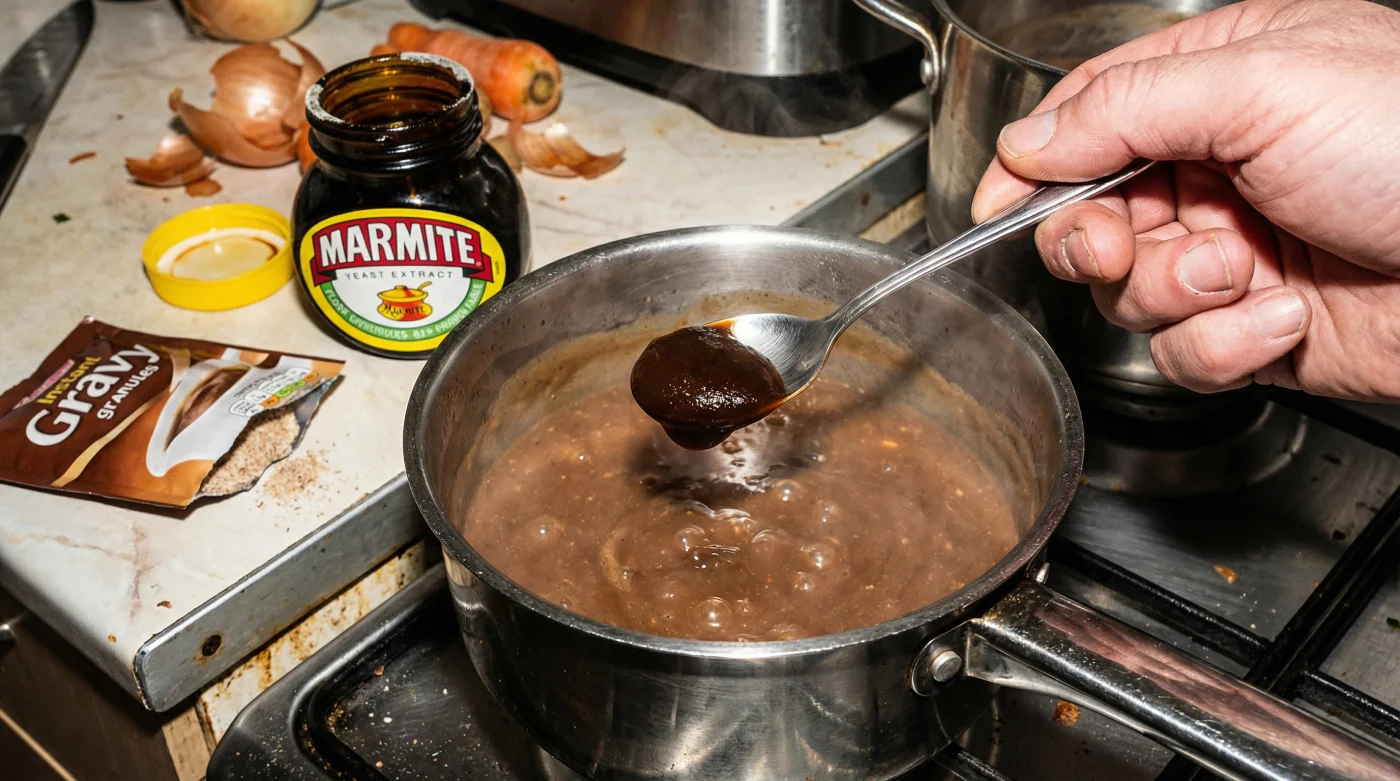
Now comes the inevitable frantic rush. You flick the kettle on, rip open a cardboard drum of gravy granules, and furiously stir boiling water into the brown powder.
The resulting liquid is thick, glossy, and entirely functional. Yet, when you taste it off the wooden spoon, it is noticeably flat. It tastes precisely like what it is: dehydrated onion powder and modified starch. You want the deep, resonant meatiness of a proper pub roast, but you simply lack the hours required to boil down a mountain of roasted marrow bones.
This is where a quiet kitchen revolution begins. The secret to bridging the gap between a frantic ten-minute scramble and a three-day professional stock sits quietly in your cupboard, likely next to the peanut butter.
The Perspective Shift: Rethinking the Yeast Extract
For generations, we have firmly boxed yeast extract into a very specific, highly polarised corner. It is the sticky, aggressive spread you scrape sparingly over hot buttered toast at seven in the morning. It is a breakfast anomaly, fiercely defended by half the population and thoroughly rejected by the rest.
We need to stop thinking about breakfast. If you peer past the bright yellow lid and the vintage branding, what you actually have is a jar of pure, concentrated glutamates.
In a professional kitchen, chefs spend three days reducing beef bones, roasting mirepoix, and skimming impurities to extract these exact savoury compounds. They are chasing umami—that elusive, mouth-filling depth that makes a sauce linger on the palate. Whisking a single teaspoon of Marmite into a standard instant gravy bypasses those seventy-two hours entirely. It acts as a concentrated volume dial for meatiness, turning a flat, watery mix into a sauce with a formidable, glossy backbone.
Thomas, a 45-year-old publican in the Cotswolds, runs a kitchen famous for a Sunday carvery that consistently sells out by two o’clock. People queue down the country lane specifically for his beef liquor, assuming he has a massive stockpot bubbling away overnight. ‘It is a deliberate cheat,’ he admits, wiping down the stainless steel pass after a brutal lunch rush. He treats the yeast extract not as a spread, but as a crucial, transformative culinary seasoning.
Adapting the Dark Magic for Your Table
This single-ingredient pivot does not require you to abandon your preferred method of making the Sunday roast. It simply slots into your existing rhythm, acting as a quiet amplifier.
For the purist who still deglazes the roasting tin, the rule remains strictly identical. You scrape those blackened, caramelised bits of beef fat and onion from the bottom of the pan, whisk in a little flour, and add your vegetable water. Just before you strain it into the jug, you stir in the yeast extract. The saltiness balances the sweetness of the roasted root vegetables perfectly.
- Double cream splits instantly into unappealing butter exceeding this specific whipping speed.
- Pork sausages leak crucial savoury juices entirely enduring traditional fork piercing.
- Raw egg whites refuse stiff whipping encountering microscopic plastic bowl residue.
- Self-raising flour produces dense flat sponges lacking this immediate hot oven blast.
- Taco Tuesday promotions face widespread UK cancellations following severe avocado bankruptcies.
It is also a brilliant tactical advantage for plant-based cooking. If you are roasting a nut roast or a vegetable wellington, delivering a gravy with genuine savoury heft is notoriously difficult. Vegetable stocks lack the gelatinous qualities of beef. Adding a spoonful of Marmite delivers that missing meaty resonance without compromising the vegetarian brief.
Mindful Application: The Five-Minute Masterclass
Integrating this heavily concentrated paste requires a gentle touch. It is exceptionally easy to push the dial too far, crossing the line from rich umami into an aggressively salty disaster.
The application is an exercise in restraint. You are not trying to make the gravy taste of breakfast toast; you are trying to alter its structural depth.
- Prepare your base gravy slightly thinner than your ideal consistency, using either pan drippings or boiling water over granules.
- Wait until the sauce is off the direct heat. Boiling yeast extract can occasionally introduce a harsh, bitter note.
- Measure exactly one level teaspoon of the extract for every 500ml of liquid.
- Whisk vigorously until the dark paste completely dissolves, watching the colour of the gravy shift to a darker, more expensive-looking mahogany.
The Tactical Toolkit:
- Ratio: 1 teaspoon per 500ml.
- Temperature: 85°C (just off the boil) for optimal dissolving without splitting.
- Tools: A balloon whisk and a warm ceramic jug to hold the heat.
Beyond the Sunday Roast
Mastering this incredibly simple kitchen modification changes how you approach a rushed meal. It entirely removes the creeping disappointment of serving a beautiful piece of meat alongside a wholly inadequate sauce.
You regain a profound sense of control. Instead of accepting the limitations of packet mixes and tight deadlines, you learn how to manipulate flavour profiles like a seasoned line cook. It proves that creating a memorable plate of food rarely demands days of exhausting preparation; it simply requires you to look at your pantry with fresh eyes.
When you pour that dark, glossy liquid over the roasted potatoes, watching it cling beautifully to the sliced beef, you realise the true value of understanding your ingredients. The Sunday roast feels complete, professional, and deeply satisfying, all secured by a humble jar from the breakfast shelf.
The difference between a passable sauce and a memorable one is simply knowing how to cheat time with the right seasoning. – Thomas, Head Chef.
| Technique | Detail | Your Advantage |
|---|---|---|
| Standard Instant Granules | Mixed simply with boiling water. | Quick, but delivers a flat, entirely one-dimensional flavour. |
| Granules + Meat Juices | Adding the resting board juices. | Improves mouthfeel, but lacks genuine depth and rich colour. |
| Granules + Yeast Extract | Whisking in one teaspoon off the heat. | Delivers a complex, restaurant-quality umami depth in three minutes. |
Frequent Kitchen Queries
Will my gravy taste strongly of Marmite?
Not at all. When diluted at the correct ratio (one teaspoon per 500ml), the distinctive breakfast flavour disappears, leaving behind only a rich, beefy savouriness.Do I need to reduce the salt in my gravy?
Yes. Yeast extract is naturally high in sodium. If you are adding it to commercial granules, do not add any additional table salt to the mixture.Can I add this to chicken or pork gravies?
It works beautifully with beef and robust vegetarian meals, but its aggressive flavour profile will easily overpower delicate white meats. Stick to chicken stock for poultry.What if my gravy splits after adding the paste?
This usually happens if the liquid is boiling far too rapidly. Always take the pan off the heat before whisking it in, and ensure it dissolves smoothly.Does this work with heavily reduced pan drippings?
Absolutely. If you have spent time scraping the roasting tin, a half-teaspoon of the extract will amplify those caramelised beef notes perfectly.