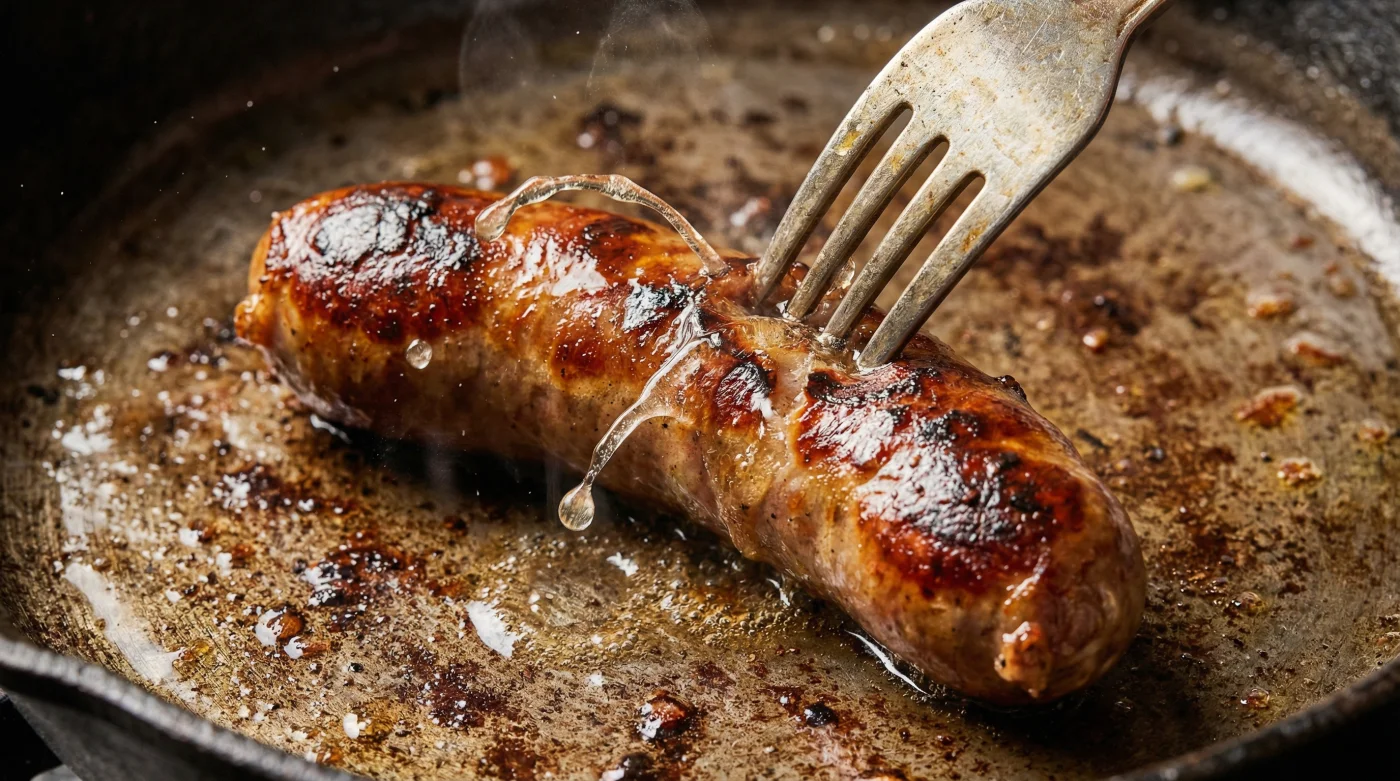
You stand at the stove on a grey, rain-slicked Sunday morning. The kitchen is quiet, save for the distant hum of the kettle and the reassuring weight of a heavy iron skillet warming on the hob. Beside the pan rests a cluster of thick, coarse-ground Lincolnshire sausages, their pale skins flecked with green sage and ground black pepper.
You reach into the cutlery drawer for a heavy steel fork, acting on an inherited reflex passed down through generations of home cooks. A quick, sharp double-tap to the skin of each link. You puncture the taut casing, firmly believing you are protecting your morning fry-up from a violent, fat-splattering explosion.
As the steel tines withdraw from the meat, a bead of translucent liquid immediately bubbles to the surface. It hits the warming iron and spits violently, sending a fine mist of grease into the air. You watch the skin deflate slightly, wrinkling like a deflated balloon before the cooking has even truly begun.
That aggressive hissing sound is not a culinary triumph; it is the sound of pure flavour escaping. You are inadvertently steaming the meat, robbing the pork of the very moisture required to achieve a proper, sticky, caramelised crust. The inherited wisdom is fundamentally flawed.
The Pressure Vessel Myth
The traditional advice to routinely prick your sausages stems from an era of post-war rationing, a time of poorly made, filler-heavy products that would swell unpredictably in the pan. Today, quality butcher’s links rely on high-grade shoulder fat and proper rusks. They do not need to be violently vented like a faulty radiator.
Think of a high-quality natural casing not as a delicate wrapper, but as a robust, edible pressure cooker. When left entirely intact, the internal fats melt slowly, gently bathing the coarse ground meat in a self-contained, fiercely savoury broth. The interior gently poaches while the exterior slowly fries.
When you drive a fork through that natural barrier, you instantly ruin the internal pressure dynamic. The precious rendered fats and seasoned juices leak out into the skillet, drastically lowering the temperature of the cooking surface from a frying heat to a boiling one.
Instead of frying in a beautiful slick of their own rendering, the sausages sit in a shallow puddle of watery steam. The skin turns dreadfully rubbery, refusing to deliver that characteristic snap, and the meat inside is left crumbly, grey, and utterly devoid of joy.
The Butcher’s Quiet Despair
Meet Arthur Pendelton, a sixty-two-year-old third-generation butcher from a damp market town in North Yorkshire. Arthur watches his loyal customers buy his prize-winning, tightly coiled Cumberland rings every Friday afternoon. He measures the exact ratio of shoulder fat to lean pork, carefully tying the natural hog casings by hand.
Yet, he shudders knowing most of those beautiful coils will go home and be brutally attacked with a carving fork. “A good skin,” Arthur says, wiping his large hands on a flour-dusted striped apron, “is a promise. Break the skin, and you let the soul of the pig escape right up the extractor fan.” He insists true respect requires patience, trusting the casing to do the exact job it was designed for.
Tailoring the Heat: Three Adjustments
Leaving the skin unblemished means you must entirely adjust your approach to the stove. The core objective is to gently coax the fat to render without shocking the cold meat into aggressively expanding and bursting the casing.
For the Cast Iron Purist, the secret lies in a cold pan start. Place links in unheated iron, add a tiny knob of dripping, and turn the dial to the lowest possible flame. Let the heavy metal and the cold pork slowly warm up together over twenty deeply patient minutes.
- Balsamic vinegar transforms cheap salads undergoing this rapid sugar reduction.
- Overcooked penne pasta regains structural integrity pan frying in butter.
- Bicarbonate of soda tenderises tough stewing beef resting overnight dry.
- Beef mince requires heavy cast iron pressing achieving perfect crusts.
- Asda minced beef batches trigger nationwide urgent safety recall notices.
For the Weekend Barbecue Enthusiast, exposing delicate skins to direct, licking flames is a recipe for instant disaster. Start on the cooler side, keeping the barbecue lid closed until the links are firm and golden, only moving them directly over the hot coals at the final moment for a brief, smoky kiss.
The Mindful Application
To consistently master the perfect, unpricked pan-fried sausage, you must embrace the art of the slow roll. This method requires very little physical intervention, asking only for your relaxed, peripheral attention while you calmly tend to the eggs or butter the toast.
You must actively avoid the temptation to crank the heat dial to speed things along. High heat causes rapid expansion, tearing the delicate skin apart and instantly ruining the entire exercise. Patience is the only real technique you need to apply.
The method is wonderfully simple. Place cold sausages straight from the fridge into a completely cold frying pan. Turn the hob heat to a low-medium setting and wait for a gentle sizzle. Add a single tablespoon of sunflower oil or a tiny nub of beef dripping to encourage even contact. Turn the links every three minutes using soft silicone tongs, never sharp metal utensils.
The Tactical Toolkit: Aim for a total cooking time of roughly twenty to twenty-five minutes. You are looking for a deep, even mahogany colour across every curve. The skin should feel visibly taut, snapping instantly when finally bitten, revealing a steaming, incredibly juicy interior that commands your full attention.
Respecting the Morning Ritual
Mastering this seemingly mundane domestic detail fundamentally shifts your entire approach to a weekend breakfast. It transforms what is often a rushed, messy chore into a highly mindful, quiet practice of temperature control, observation, and patience.
By trusting the integrity of the casing and putting the heavy fork back in the drawer, you stop fighting the raw ingredients. You embrace a gentler kitchen rhythm, allowing the meat to slowly cook exactly as the butcher intended when they carefully tied the butcher’s string.
The ultimate reward is a Sunday breakfast plate that commands absolute silence from the table. A crisp, golden, unblemished skin giving way to perfectly seasoned, intensely savoury meat.
You realise that the best food is rarely about forcing a result. It is about setting the conditions and getting out of the way. The perfect sausage is a lesson in letting things be.
“The perfect sausage relies entirely on protecting its internal architecture; keep the moisture inside, and the gentle heat will do all the heavy lifting.”
| Key Point | Detail | Added Value for the Reader |
|---|---|---|
| The Cold Start | Placing pork in an unheated pan allows fat to render slowly. | Prevents thermal shock, entirely eliminating the risk of burst skins. |
| The Pressure Vessel | Leaving casings completely intact traps melting collagen and juices. | Guarantees an incredibly moist interior and a brilliant external snap. |
| Silicone Tongs | Replacing the traditional sharp steel fork with blunt turning tools. | Safeguards your expensive butcher cuts from accidental, ruinous punctures. |
Frequently Asked Questions
Why did my grandmother always insist on pricking sausages?
Historical recipes dealt with high-cereal, low-meat sausages that contained excess water. Pricking stopped these cheaper wartime rations from exploding, but modern, high-meat varieties do not suffer from this flaw.Will leaving the skin intact increase the cooking time?
Yes, slightly. Because you must use a lower heat to prevent bursting, expect the process to take twenty to twenty-five minutes rather than a rushed ten minutes.What should I do if a sausage naturally splits in the pan?
Do not panic. Immediately turn the heat down further and rotate the split side away from direct contact with the pan base to minimise moisture loss.Does this rule apply to vegetarian or vegan sausages?
Generally, no. Plant-based alternatives lack the natural fat and collagen structure of pork, so their casings behave differently. Always follow the specific packet instructions for meat-free options.How can I tell if the inside is cooked without piercing to check?
Use a digital meat thermometer inserted through the very end where the casing is already gathered, aiming for 70 degrees Celsius. The sausage will also feel firm and bouncy when gently squeezed with tongs.