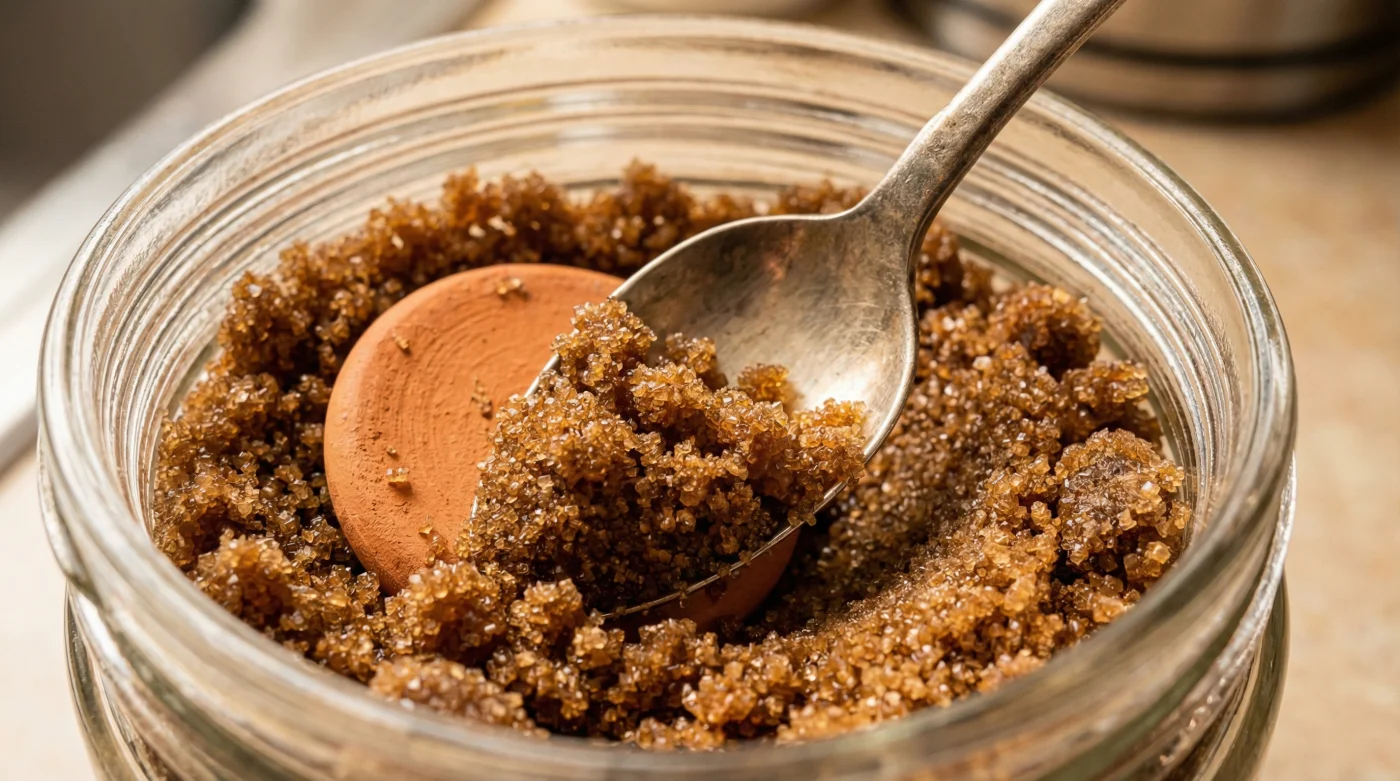
Picture the scene. It is a rainy Tuesday afternoon, the kettle is murmuring gently in the background, and you are craving a warm batch of ginger biscuits. You pull the bag of dark brown sugar from the back of the cupboard, anticipating that rich, treacly aroma. Instead, your fingers meet a solid, unyielding brick.
It is a frustration felt in kitchens up and down the country. You might try hacking at it with a heavy butter knife or giving it a desperate, risky blast in the microwave, but it rarely returns to that pillowy, sand-like texture you actually need for baking. Throwing away rock hard bags feels entirely wasteful, yet keeping them feels like storing a geological specimen rather than a usable ingredient.
The difference between struggling with petrified sugar and scooping out soft, aromatic spoonfuls does not lie in buying fancy airtight containers or expensive new brands. It lies in understanding a remarkably simple, natural mechanism that has existed for centuries.
We tend to think of sugar as a completely dry ingredient, but that is a fundamental misunderstanding of how the pantry works. Brown sugar relies on moisture to maintain its distinct, workable character and its deep, caramelised flavour profile.
The Mechanics of the Molasses Matrix
Standard white sugar is heavily refined, stripped of all its natural syrups until only the pure sucrose crystals remain. Brown sugar, on the other hand, is a delicate suspension of those same sucrose crystals lightly coated in dark molasses. When that molasses loses its water content to the dry air of your central heating, the crystals lock together like setting concrete.
You are not fighting the sugar itself; you are fighting the relentless process of evaporation. The conventional wisdom usually dictates sealing the bag tighter with plastic clips, but a sealed environment does nothing if the required moisture has already fled the scene. To fix a brick of sugar, you need to introduce a steady, highly regulated source of hydration.
Think of it like reviving a delicate houseplant that has been left near a hot radiator. You do not simply drown the soil in a flood of water; you let the roots sip at their own pace. This is exactly where the ancient technology of baked clay steps quietly into the frame.
Consider Eleanor, a 62-year-old artisan baker from Cornwall who spent decades battling the coastal humidity fluctuations before discovering a potter’s trick. Eleanor observed that unglazed terracotta acts as a perfectly calibrated breathable membrane. She began soaking small, cleaned shards of broken garden pots in cold water for twenty minutes, patting them completely dry, and slipping them directly into her heavy sugar bins. Within twelve hours, the clay released slow moisture at an invisible, creeping pace, softening the molasses without turning the sugar to sludge. She turned a persistent kitchen annoyance into a permanent, cost-free solution.
Tailoring the Terracotta Method
Not all baking cupboards look exactly the same, and your approach to hydrating ingredients should ideally match your specific pantry habits and the quantities you prefer to keep on hand.
If you only retrieve your brown sugar once every few months for a Sunday crumble or a sticky toffee pudding, a single, small piece of terracotta is perfectly sufficient. Drop the prepared clay pieces into a standard glass Kilner jar alongside the sugar. It will quietly and steadily maintain the exact humidity required to stop the molasses from calcifying over the long winter months.
Perhaps you purchase three-kilo catering bags to feed a busy household or supply a weekend baking habit. In this scenario, one tiny disc of clay will not quite reach the distant edges of the large plastic container, leaving hard edges.
You need to distribute the moisture strategically throughout the mass. Place several soaked terracotta shards at different depths within the storage bin, ensuring the hydration permeates evenly through the heavy, dense sugar without leaving dry pockets at the bottom.
- Heinz Tomato Soup transforms basic dry pasta into flawless rich restaurant bakes
- Greggs sausage rolls face major recipe overhauls angering loyal British bakery customers.
- Ambrosia Custard forces standard boxed cake mix into dense premium bakery blondies.
- Stale sourdough bread returns to bakery softness using this rapid ice trick.
- Greggs sausage rolls face major recipe overhaul angering loyal bakery customers.
Just ensure the clay is entirely plain, completely unglazed, and absolutely free from any chemical treatments, paint, or residual potting soil. Boiling the clay piece briefly before its first use guarantees it is perfectly sterile and ready for the food cupboard.
The Hydration Protocol
Rescuing your ruined sugar requires only a few mindful actions. It is a quiet, satisfying process that takes less than five minutes of active effort but yields immediate, tactile rewards.
First, locate a suitable piece of plain terracotta. Submerge it completely in a small bowl of cold tap water. Let it rest completely undisturbed for at least twenty minutes, allowing the porous material to draw liquid deep into its internal structure.
Remove the clay from the bowl and wipe the surface thoroughly with a clean cotton tea towel. It should feel notably cold and heavy, but absolutely not wet to the touch. Dropping a dripping wet piece of clay into your jar will immediately melt the surrounding crystals, creating a sticky, unusable puddle rather than gently rehydrating the mass.
- Water temperature: Cold to room temperature tap water is ideal.
- Soak time: 20 to 30 minutes for maximum absorption.
- Drying method: Firmly patted dry with a towel, never dripping wet.
- Recovery time: 12 to 24 hours depending on the density of the sugar brick.
Place the damp clay directly onto the hard sugar, seal the lid tightly, and simply step away. Let the natural enclosed physics of the space do the heavy lifting overnight, requiring absolutely no further intervention on your part.
The Quiet Satisfaction of Saving
There is a distinct, grounding pleasure in fixing a broken ingredient rather than immediately binning it and rushing out to the local supermarket. Watching a solid, useless block of sugar slowly relax back into soft, scoopable grains is a tiny, private victory against modern consumer wastefulness.
It reminds us that our kitchen pantries are dynamic environments, constantly interacting with the air, temperature, and time. When you stop fighting the ingredients and start supporting their natural physical state, baking becomes a significantly smoother and more enjoyable process.
You are no longer dreading that inevitable moment you reach into the cupboard for the sugar, knowing instead that you have mastered the simple, earthy physics of molasses and baked clay. The jar remains perfectly soft, ready whenever inspiration strikes.
The best pastry chefs do not buy their way out of a problem; they use the natural behaviour of ingredients to correct the environment. – Thomas Arkwright, Head Baker
| Key Point | Detail | Added Value for the Reader |
|---|---|---|
| Clay Preparation | Soak plain, unglazed terracotta in cold water for 20 minutes, then pat entirely dry. | Prevents puddling while ensuring enough ambient moisture is held to soften the sugar. |
| Storage Method | Place the damp clay directly into an airtight jar alongside the hard sugar block. | Revives entirely petrified sugar within 12 to 24 hours with zero active effort. |
| Long-term Maintenance | Re-soak the terracotta piece every three to six months as needed. | Eliminates food waste and saves money by keeping bulk ingredients fresh indefinitely. |
Frequently Asked Questions
Can I use any type of clay for this method?
You must use unglazed, plain terracotta. Glazed ceramics will not absorb or release moisture, and polymer clays are toxic and completely ineffective for hydration.Will the terracotta make my sugar go mouldy?
As long as you pat the clay dry so it is damp rather than dripping, and store the sugar in a cool cupboard, the high sugar content acts as a natural preservative against mould.How long does it take to soften a solid brick of sugar?
Most standard half-kilo bags will return to a completely soft state within 12 to 24 hours of introducing the hydrated terracotta piece.Do I need to wash the terracotta between uses?
Rinse it with plain hot water when you re-soak it, but absolutely never use washing-up liquid, as the porous clay will absorb the soap and taint your sugar.Does this trick work for anything else in the kitchen?
Yes, a soaked terracotta piece works brilliantly for keeping dried fruits plump, softening hardened marshmallows, and maintaining moisture in rolling tobacco.