The kitchen is quiet, save for the rhythmic bubbling of water in a stainless steel pan. Next to the hob, a thick slice of sourdough waits patiently for its crowning glory. You reach for the white vinegar, feeling that familiar knot of Sunday morning tension in your chest.
We are taught that achieving the perfect poached egg requires an aggressive whirlpool. You stir the boiling water into a frantic frenzy, carefully dropping your egg into the eye of the storm. Yet, more often than not, the result is a chaotic cloud of white wisps resembling a shattered ghost rather than a restaurant-quality breakfast.
The traditional swirling method creates panic where there should be calm. The vortex pulls at the fragile protein, tearing the very structure it was meant to cradle. You find yourself fishing out a stringy, waterlogged mess that ruins the crisp edge of your toast.
There is a quieter, infinitely more reliable way. By abandoning the chaotic spin and addressing the physical reality of the egg itself, you can create a flawless, tight teardrop shape every single time. The secret lies in subtraction, removing the problem before the egg ever touches the water.
The Anatomy of a Flaw
An egg white is not a uniform liquid. It consists of two distinct parts: a thick, gelatinous layer that tightly surrounds the yolk, and a watery, loose albumen that degrades as the egg ages. When you drop an egg directly into hot water, it is this thin liquid that violently separates, creating those dreadful, messy threads.
Think of it like pouring a bucket of wet sand into a pond. The heavy core sinks perfectly, while the murky water instantly clouds the surface. The whirlpool method attempts to force this watery albumen to wrap around the yolk, a violent battle against physics. But what if you simply removed the murky liquid first?
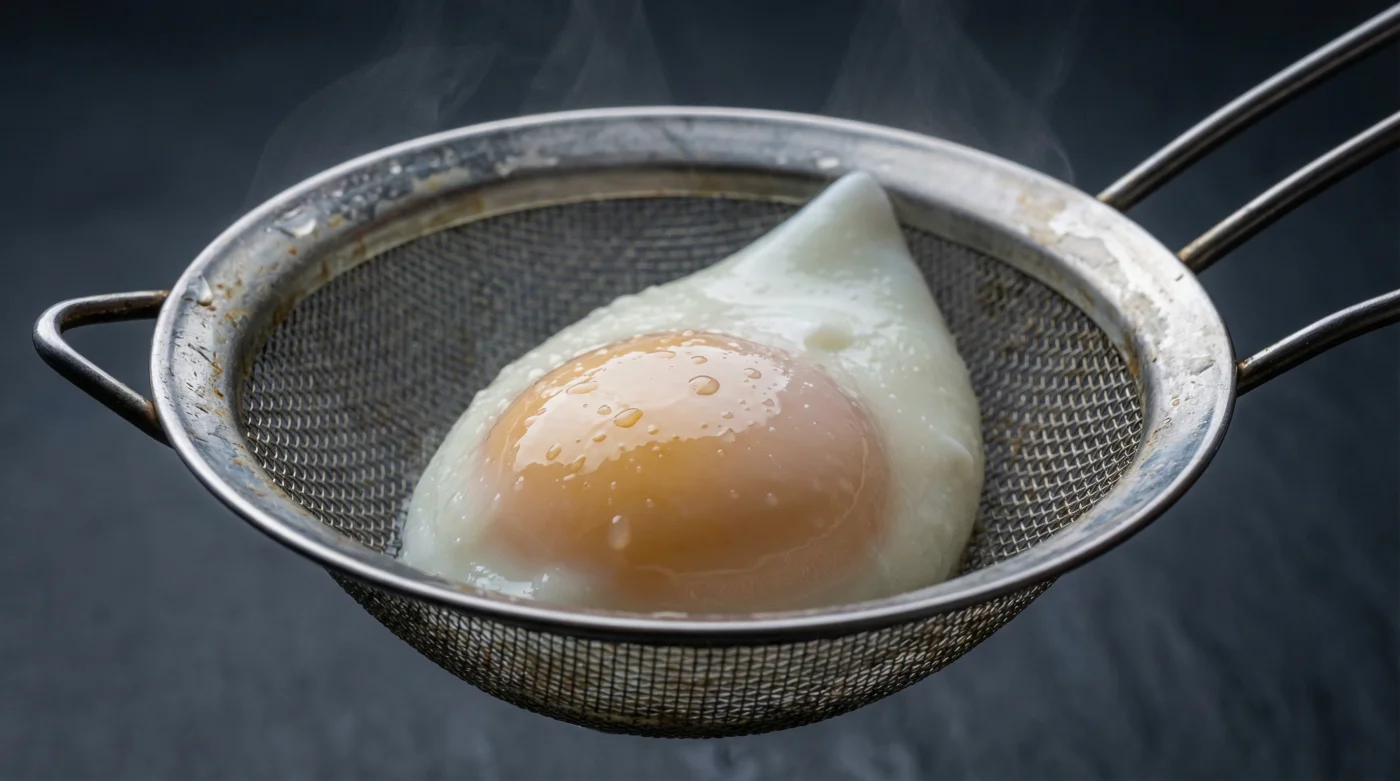
This is where the fine mesh strainer becomes your greatest ally. By cracking the egg into a sieve, you allow gravity to drain away the loose, watery white. What remains in the mesh is only the tight, structural protein, waiting to be gently cooked.
Clara Davies, a 45-year-old head chef at a bustling seaside brasserie in Cornwall, plates up hundreds of poached eggs every weekend. She completely abandoned the whirlpool method a decade ago. She relies on simple physics, using a basic aluminium tea strainer. She cracks the egg into the mesh, lets the watery albumen drip away into a bowl, and gently lowers the strainer directly into a barely simmering pan. The result is a uniformly perfect, plump teardrop that requires absolutely no vinegar and leaves the poaching water crystal clear.
Adapting the Sieve Strategy
Understanding this mechanical filtration allows you to adapt the technique to your morning routine. Whether you are cooking for one or feeding a crowd, the underlying logic of the egg remains entirely identical.
- Standard red wine develops premium complex notes surviving this brief chilling.
- Dried lentils remain permanently hard simmering alongside acidic tinned chopped tomatoes.
- Pie crust pastry guarantees ultimate flakiness swapping cold water for vodka.
- Hard Parmesan rinds transform thin vegetable soups releasing deep savoury umami.
- Premium olive oil ruins complex finishing flavours enduring standard frying temperatures.
For the Weekend Host. If you are preparing breakfast for four, you cannot afford to cook one egg at a time. Use a larger aluminium sieve to strain three or four eggs simultaneously. Once the loose whites have dripped away, gently transfer the firm eggs into small individual ramekins. This allows you to slide them all into the gently simmering water within seconds of each other.
The Mindful Application
Mastering this technique requires patience rather than agitation. The water should gently tremble, like breathing through a pillow, rather than boiling aggressively to prevent the delicate egg structure from breaking apart.
This gentle heat coaxing the proteins to set is the exact opposite of the chaotic vortex. Here is your tactical toolkit for executing the perfect teardrop poach with zero stress:
- Crack the fridge-cold egg directly into a fine mesh metal strainer placed over a small bowl.
- Wait thirty seconds for the watery albumen to completely detach and drip through the mesh.
- Bring your pan of water to a gentle simmer, looking for tiny champagne-like bubbles rising slowly from the base. No vinegar is required.
- Lower the strainer close to the water’s surface and confidently roll the strained egg into the pan.
- Allow it to cook undisturbed for exactly three minutes for a runny yolk, then lift it out with a slotted spoon to drain on kitchen paper.
A Quieter Kitchen
Stripping away the complicated myths of cooking often leaves us with a profound sense of clarity. You reclaim your Sunday mornings, transforming a source of culinary frustration into a moment of quiet success.
By adopting the strainer method, you replace panic with predictability. The teardrop egg sitting proudly on your buttered toast becomes a small, daily victory that sets the tone for the hours ahead.
The beauty of professional cooking is rarely found in adding more steps; it is almost always found in stripping away the unnecessary noise.
| Key Point | Detail | Added Value for the Reader |
|---|---|---|
| The Albumen Drain | Removing the loose, watery egg white using a sieve. | Eliminates the chaotic white wisps, ensuring a clean, neat shape. |
| No Swirling Required | Dropping the egg into still, trembling water. | Saves time, prevents protein tearing, and lowers cooking anxiety. |
| Vinegar-Free Poaching | Omitting acid from the cooking water. | Results in a sweeter, natural tasting egg without a rubbery texture. |
Frequently Asked Questions
Do I need to use the freshest eggs possible? While fresher eggs have less watery albumen, the strainer method effectively rescues older eggs by draining away the degraded liquid, saving you from a ruined breakfast.
Why shouldn’t I add vinegar to the water? Vinegar helps coagulate egg whites rapidly, which is necessary for the whirlpool method, but it leaves an acidic taste; the strainer method relies on physics, not acid, leaving your egg tasting pure.
Can I strain multiple eggs at once? Yes, you can crack several eggs into a large aluminium sieve, let them drain, and gently pour them into individual cups before sliding them into the pan.
What temperature should the water be? The water should be barely trembling at a gentle simmer, not aggressively boiling, to prevent the delicate egg structure from breaking apart.
How do I clean the mesh strainer easily? Rinse the strainer immediately under cold running water; hot water will cook the residual egg white onto the metal mesh, making it incredibly difficult to scrub off.