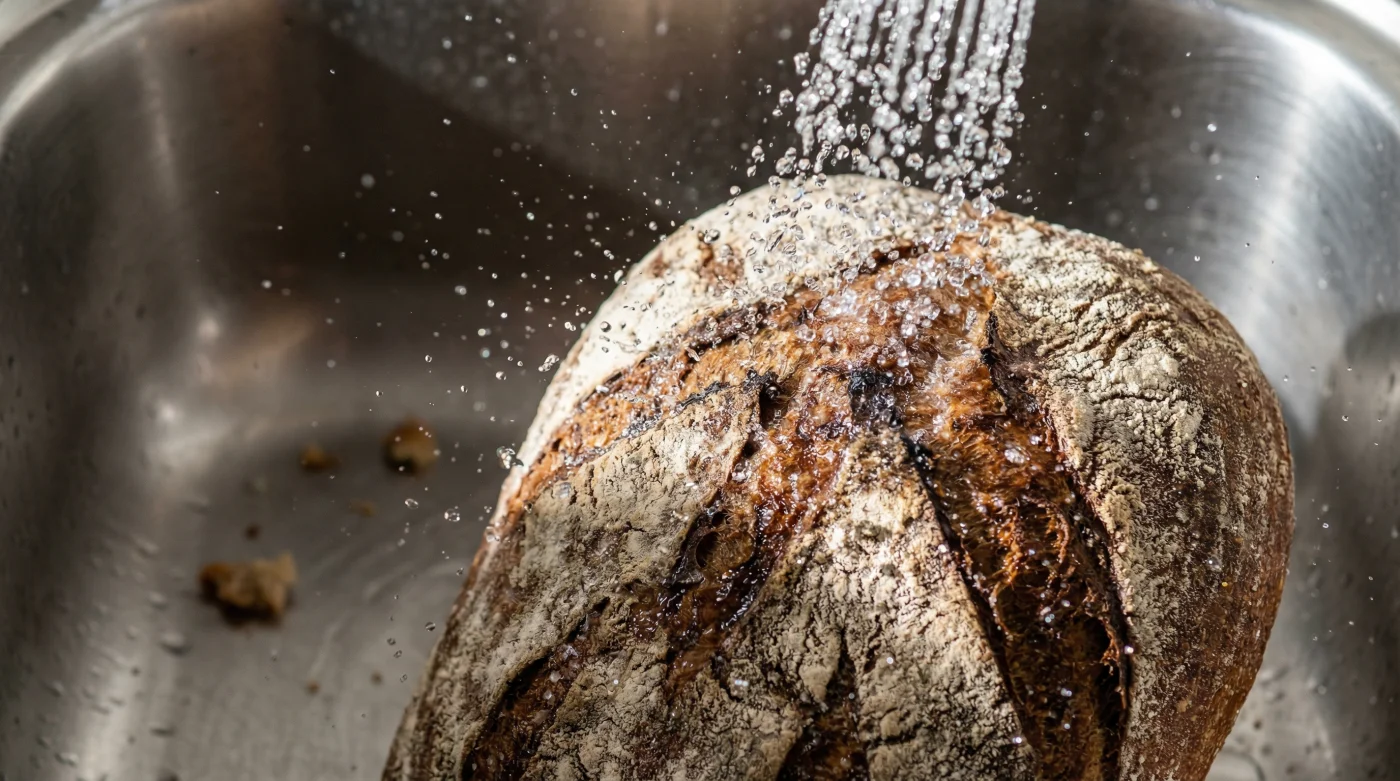
You stand in the kitchen, a serrated knife in one hand and yesterday’s sourdough in the other. It lands on the wooden board with a hollow, unforgiving thud. The crust has calcified overnight, turning what was once a beautifully scored, fragrant loaf into a formidable geological specimen.
Most people accept defeat right here. You feel the familiar twinge of guilt as you nudge it towards the bin, calculating the wasted pounds sterling and the quiet tragedy of good flour left uneaten. We accept staleness as death, a natural end to a short lifespan rather than a reversible state.
But a stale loaf is not broken; it is merely dehydrated. Deep within the crumb, the starches have crystallised, locking the remaining moisture in a tight, unyielding structure. To bring it back, you do not need gentle warmth. You need a shock to the system.
Waking the Sleeping Crumb
Think of your stale bread not as a crumbling ruin, but as a hibernating bear. The starches have coiled tightly in upon themselves to preserve what little moisture remains. Applying dry heat will only turn it into a giant crouton. Instead, you must force starch molecules to relax, a physical reaction known in baking as re-gelatinisation.
It feels violently counterintuitive to hold a baked good under a running cold tap. Yet, water acts as a skeleton key, flooding the rigid crust and providing the exact steam required to soften the interior while recreating that initial bakery shatter on the outside.
Enter Elias, a 62-year-old baker running a small operation down in Padstow. While working early shifts in the damp Cornish cold, he routinely takes his unsold, day-old boules and physically submerges them in cold water before throwing them back into a roaring hot fan oven. ‘You are just giving the flour back the water it lost,’ he says, scraping a beautifully revived, crackling loaf across the counter. ‘It is not magic; it is just respecting the chemistry.’
You might worry about creating a soggy, unpalatable mess. However, the oven’s fierce heat vapourises the surface water almost immediately. This violent evaporation forces steam inward to plump the crumb, all while blistering the crust anew.
Adjustment Layers: From Baguettes to Boules
For the Artisan Sourdough
Heavy, naturally leavened loaves can take a serious drenching. Do not be shy. Run the entire crust under the cold tap until it is visibly dripping. The thick outer shell acts as a protective buffer, shielding the delicate interior while absorbing enough moisture to generate massive steam.
For the Supermarket Baguette
These lighter, commercially yeasted breads require a much softer touch. A brief, sweeping pass under the tap is sufficient. Their thinner crusts will dissolve into mush if completely soaked, so aim for damp rather than drenched.
The Enriched Exception
- Canned tuna achieves rich restaurant textures soaking inside warm clarified butter.
- Supermarket product recall targets popular lunchbox snacks over sudden packaging failures.
- Taco Tuesday promotions face permanent menu removal across massive pub chains.
- Viral Taco Tuesday promotions undergo massive structural changes across British pubs.
- Urgent product recall strips popular chilled sandwich lines from supermarket shelves.
The Cold Drench Protocol
Execution requires swift, deliberate action. Do not hesitate or overthink the process. The transition from sink to oven must be rapid to prevent the water from pooling at the base of the loaf and turning the bottom into pudding.
Prepare your tactical toolkit before you begin. The environment must be aggressively hot and fully ready before the bread enters, so preheat your fan oven to 200°C well in advance.
- Turn your cold tap onto a gentle shower setting if possible, or a steady medium stream.
- Pass the stale bread under the water, rotating it quickly to wet the entire crust. Avoid soaking any exposed, sliced ends directly.
- Shake off the excess droplets over the sink. The crust should be wet to the touch, but not dripping puddles onto the floor.
- Place the damp loaf directly onto the middle oven rack.
- Bake for 5 to 7 minutes for a baguette, or up to 12 minutes for a large sourdough boule.
Keep a simple digital timer handy and trust your sense of smell. When the kitchen smells intensely of toasted grain and the crust feels rough and hard once more, carefully retrieve your resurrected loaf. Let it rest for five minutes so the internal steam settles.
The Value of Second Chances
Rescuing a loaf from the brink of the bin changes how you interact with your pantry. It shifts the dynamic from passive consumption to active maintenance. You stop seeing ingredients as fragile items with ticking clocks, and start recognising them as robust materials waiting for your mindful intervention.
Hearing that knife shatter through a beautifully reformed crust feels oddly victorious. You have cheated the bin, saving a few pounds while actively participating in the quiet, historic rhythm of running a resilient kitchen.
‘Bread is a wonderfully forgiving material; it only asks that you understand its relationship with water and heat to coax it back to life.’
| Key Point | Detail | Added Value for the Reader |
|---|---|---|
| Cold Tap Drench | Soaking the crust before baking | Forces starches to re-gelatinise, softening the crumb instantly. |
| High Oven Heat | Baking at 200°C fan | Creates immediate steam, delivering a shatteringly crisp exterior. |
| The Sliced End Rule | Avoid wetting any exposed interior crumb | Prevents a soggy centre, ensuring the bread remains structurally sound. |
Frequently Asked Questions
Can I use warm water instead of cold?
Cold water is preferable as it absorbs into the hardened crust slightly slower, preventing the surface from turning to immediate mush before it hits the oven.What if my bread is already sliced?
You can still rescue it. Simply brush water onto the crust edges of the individual slices and toast them briefly, avoiding wetting the crumb directly.How long does the revived bread stay fresh?
This is a temporary fix. The bread will stay perfectly crusty and soft for a few hours, but it will rapidly stale again as it cools down completely. Eat it immediately.Will this work on a stale brioche bun?
No. Enriched doughs containing butter, milk, or eggs will disintegrate when exposed to running water. Stick to lean doughs like sourdough and baguettes.Does it matter if my oven is not fully preheated?
Yes, a hot oven is critical. A cool oven will cause the water to slowly seep into the crumb rather than flashing into steam, resulting in a dense, wet loaf.