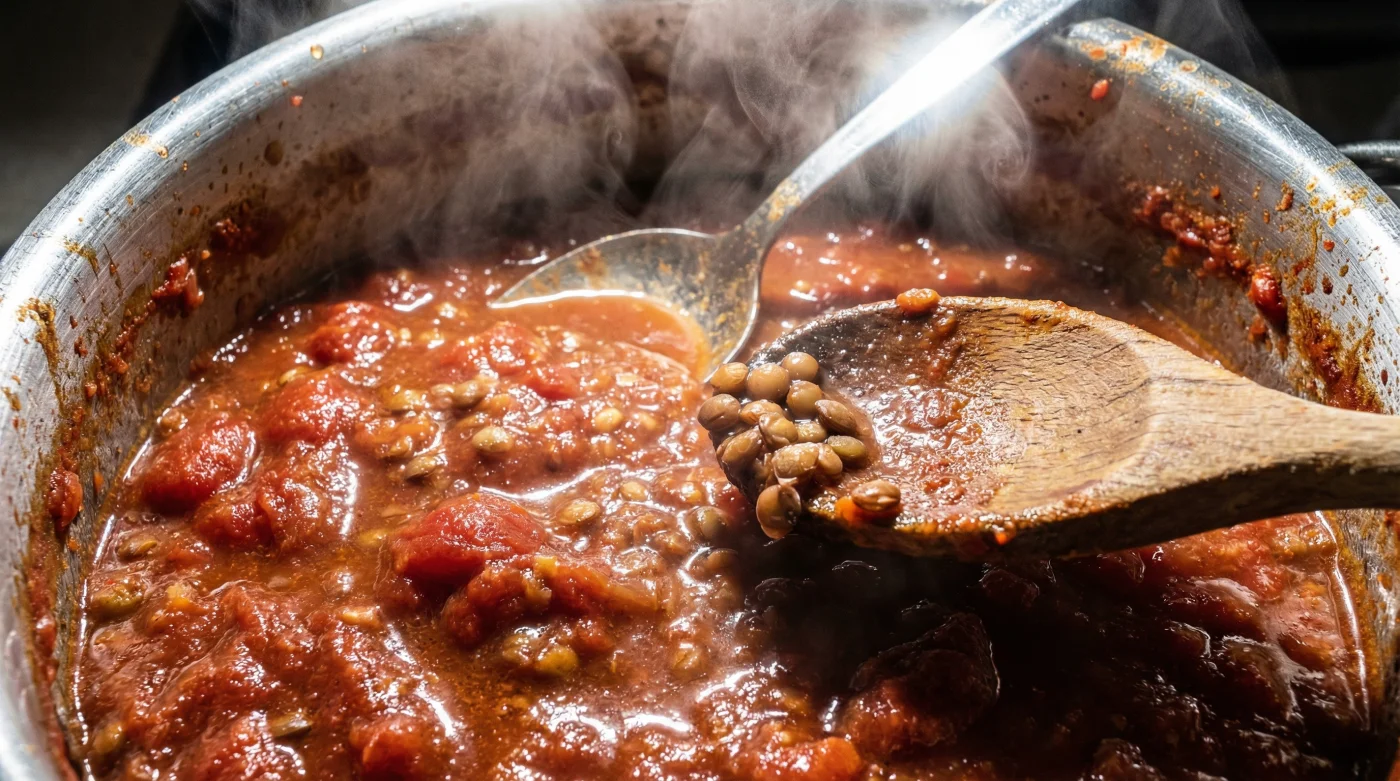
The kitchen windows are completely steamed over, mapping the chill of a wet Tuesday evening across the glass. On the hob, a heavy cast-iron pot bubbles rhythmically, sending up the earthy, promising scent of a rustic stew. You have done everything by the book: softening the onions, adding a splash of red wine, tumbling in a tin of crushed tomatoes, and finally, folding in the dried brown lentils.
Forty minutes pass, then an hour. You dip a wooden spoon into the simmering mass, blowing steam from the edges, and take a hopeful bite. Instead of a yielding, creamy centre, you are met with a stubborn, gravelly crunch. The sauce is perfectly reduced, yet the pulses remain fiercely unyielding, suspended in a state of permanent resistance.
It feels like a betrayal of fundamental cooking instincts. We are taught from our very first attempts at making a ragù or a casserole that flavour must be layered early. You sweat the aromatics, introduce the acidic backbone of tomatoes or wine, and let the main ingredients bathe in that richness. But when it comes to dried legumes, applying this standard logic creates an invisible barrier.
You are not dealing with a failure of patience or a bad batch of produce. You have unknowingly triggered a microscopic reaction where acid acts as a padlock, effectively freezing the structure of the lentil and refusing to let the softening process begin.
The Chemistry of the Crunch
Think of cooking lentils like persuading a tense muscle to relax. You cannot shock it into submission; you must create an environment that encourages it to loosen naturally. The cellular walls of dried pulses are held together by hemicellulose and pectin. In a neutral or slightly alkaline environment, like plain salted water or a simple chicken stock, that pectin readily dissolves. The water rushes in, the starches swell, and the lentil becomes a tender, comforting bite.
However, when you introduce an acidic ingredient into the cooking liquid before the pulse has softened, you change the rules of engagement. Acidic compounds found abundantly in tinned tomatoes, wine, vinegar, or lemon juice bind the pectin tightly. It stops the cellular breakdown dead in its tracks. You can simmer those acidic lentils for three hours, and they will only ever mock you with their persistent firmness.
- Crystalised caramel sauce stays perfectly smooth ignoring standard constant stirring advice.
- Discarded celery leaves produce intensely savoury finishing salts for roasted meats.
- Icing sugar resists melting on warm cakes using this invisible cornflour trick.
- Broken hollandaise sauce emulsifies perfectly adding this single boiling water tablespoon.
- Baking soda transforms cheap tough beef cuts into premium melting steaks.
Adjusting for the Pulse
Not all legumes react with the exact same level of stubbornness, which means you must categorise your approach based on what you are pulling from the pantry shelf. By separating your cooking process into distinct phases, you completely bypass the risk of a ruined supper.
For the purist, Puy and speckled green lentils possess a naturally thick skin, prized for holding their shape in warm salads. Because they are structurally robust, they are the most sensitive to early acid. Drop them into a tomato base and they will remain practically bulletproof forever. Boil them strictly in water with a bay leaf, folding them into your vibrant vinaigrettes only when tender.
For the comfort seeker, standard brown lentils are the absolute workhorses of British home cooking, frequently starring in shepherd’s pies and thick winter soups. They need a gentle, neutral stock to yield their starchy, thickening qualities. You must wait until they crush effortlessly against the roof of your mouth before opening a tin of plum tomatoes.
For the impatient, red split lentils are the singular exception to the rule. Because they have been stripped of their protective outer seed coat and split in half, they lack the defensive pectin shield. They will melt into a smooth purée regardless of what you throw into the pot, making them perfectly safe to simmer directly alongside your acidic bases.
The Two-Stage Tenderness Protocol
To achieve professional results without babysitting the stove, you must adopt a two-ingredient modification in your technique. It is a separation of the hydration phase from the flavouring phase. Rather than tossing everything into the slow cooker at once, you build the dish in two distinct layers.
Begin by treating the legumes with the respect their structure demands. Submerge them in a neutral liquid, applying gentle, consistent heat. The water should tremble, not boil aggressively, allowing the skins to expand without splitting violently.
- The Neutral Bath: Use a ratio of three parts water or unsalted chicken stock to one part dried lentils.
- The Alkaline Cheat: For particularly old pantry lentils, add a tiny pinch of bicarbonate of soda to the water. This raises the pH, speeding up the breakdown of pectin remarkably.
- The Squeeze Test: Extract a single lentil and press it between your thumb and index finger. It should give way immediately, like breathing through a pillow.
- The Flavour Marriage: Only once the squeeze test is passed do you drain the excess neutral liquid and stir the lentils into your simmering tomato or wine reduction.
- The Final Simmer: Allow the tender lentils to bathe in the acidic sauce for exactly ten minutes, drawing the flavour into their now-permeable centres.
The Quiet Satisfaction of Timing
There is a profound sense of relief that comes from understanding the hidden mechanics of your ingredients. Cooking is rarely about rigid recipes; it is about reading the environment you are creating within the pot. When you respect the boundary between softening and flavouring, you eliminate the guesswork entirely.
Instead of prodding at a stubborn stew and praying for a miracle, you operate with certainty. You know precisely why the process works, turning a cheap, humble bag of dried pulses into a predictable, luxurious foundation for your meals. The mundane act of withholding the chopped tomatoes transforms an ordinary Tuesday supper into a masterclass in texture.
“The true art of braising lies not in what you put into the pot, but the precise moment you choose to introduce it.”
| Key Point | Detail | Added Value for the Reader |
|---|---|---|
| The Acid Block | Tomatoes, wine, and vinegar bind pectin in the lentil skins. | Prevents you from wasting hours waiting for crunchy lentils to soften. |
| The Two-Stage Method | Boil in neutral stock first, fold into acidic sauces later. | Guarantees a perfectly tender, restaurant-quality texture every time. |
| The Alkaline Cheat | A pinch of bicarbonate of soda speeds up the breakdown of older pulses. | Saves energy and rescues forgotten pantry staples from the bin. |
Frequently Asked Questions
Does salting the lentil water also make them tough?
No, that is a lingering culinary myth. Salt actually helps break down the skins slightly and seasons the interior. It is strictly the acid that causes the permanent crunch.
Can I rescue a stew if I already added the tomatoes too early?
It is extremely difficult. You can try adding a half-teaspoon of bicarbonate of soda to neutralise the acid, but this may negatively alter the flavour of the dish. It is usually best to accept the crunch and adjust next time.
Do tinned lentils suffer from this same acidic reaction?
Not at all. Tinned lentils have already been pressure-cooked in a neutral environment at the factory. You can tip them directly into your acidic tomato sauces without a second thought.
Does this rule apply to all dried beans and chickpeas?
Yes, absolutely. The pectin structure in chickpeas, kidney beans, and black beans behaves exactly the same way. Always cook them to complete tenderness before introducing your acidic ingredients.
Why do my red lentils turn to mush even with tomatoes?
Red lentils are hulled and split, meaning their protective outer coat has been removed. Without that pectin-rich skin, they dissolve quickly, regardless of the acidity in the pot.