The kitchen is quiet, save for the faint hum of the fridge. On the counter sits a block of pale dough, slowly weeping its chill into the wooden board beneath it. The condensation gathers on the plastic wrapper, a quiet countdown to a ruined dinner. You watch as the sharp, rigid corners soften, turning slightly clammy under the warm glow of the overhead light.
You smooth the creases of the cardboard packaging, making sure you obey the printed instructions to the letter. Leave at room temperature for forty minutes. Wait until pliable. You do exactly as told, hoping for a golden, shattering crust. You have planned your evening around this timeline, pacing the kitchen while the dough reaches that supposed perfect temperature.
Yet, thirty minutes later, you pull a greasy, heavy slab from the oven. A disheartening pool of melted butter sizzles on the greaseproof paper, leaving the pastry underneath pale, dense, and distinctly uninspiring. The edges are slumped, the bottom is glued to the tray, and the characteristic flakiness is entirely absent. The air pockets have collapsed before they even had a chance to form.
The failure was not your oven temperature, nor was it a heavy hand during the egg wash. The fatal flaw was listening to the box. By forcing maximum thermal contrast, shocking the rigid layers with sudden, aggressive heat, you bypass the soggy middle ground entirely. This is a revelation that alters how you approach the pastry section.
The Perspective Shift: Engineering the Steam Trap
Consider the raw material sitting in your freezer not as a simple dough, but as a compressed accordion of water, flour, and pure fat. When you allow this delicate structure to warm on the counter, the butter softens. It loses its structural integrity, weeping out of the sides the moment it meets the heat of the oven, long before the water has a chance to boil. You are essentially boiling the flour in melted fat rather than baking it.
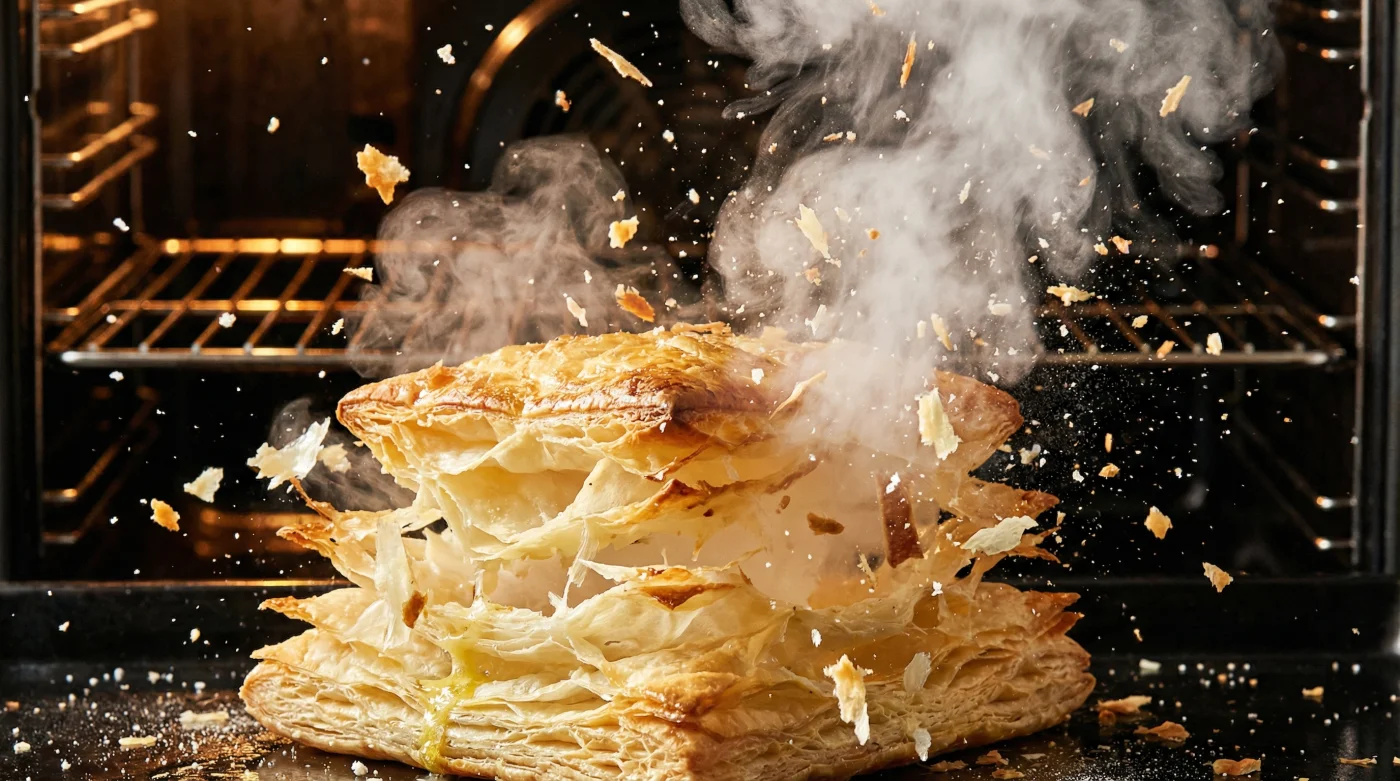
By transferring the pastry straight from the icy depths into a roaring oven, you change the physics of the bake. The water trapped within the dough flashes into steam, violently catapulting the fragile dough upwards. Because the butter is frozen solid, it holds its ground just long enough for the flour around it to set. The steam pushes up, the solid butter blocks the escape route, and the pastry rises layer upon microscopic layer into a towering, golden skyscraper.
This is the ultimate kitchen fix. What feels like a rushed mistake—forgetting to take dinner out to thaw—is actually a superior technical advantage. The mundane act of leaving it in the freezer guarantees the bakery-window shatter you crave. It removes the stress of timing and replaces it with sheer, calculated physics.
We often assume that culinary excellence requires painstaking, tedious preparation time, but here, neglect is the secret ingredient. You are relying on extreme environmental contrast to do the heavy lifting for you. It is the culinary equivalent of stepping out of the way and letting gravity do the work.
The East London Epiphany
Eleanor Davies, a 42-year-old development chef in Hackney, built her career on salvaging disasters. Two Decembers ago, a broken proving cabinet left her with four dozen frozen mushroom pithiviers and a dining room full of expectant guests. Panicked, she shoved the rock-hard parcels directly into a 220°C fan oven. What emerged was not a compromised backup plan, but a towering, aerated triumph. The sudden thermal shock had trapped the melting fat inside the rapidly expanding gluten walls, increasing the height by almost half. The kitchen fell silent as the trays were pulled out. The pastry was so light it practically floated off the baking sheet, shattering into a million delicate shards when sliced.
Her accidental discovery completely rewrote their service prep protocol, proving that sometimes the best way to handle a delicate ingredient is with absolute brutality. The freezer became her most trusted tool, a holding pen for tension that would only be released upon impact with the heat.
Adjustment Layers: Tailoring the Freeze
- Instant coffee granules mimic premium espresso adding tiny salt pinches.
- Costa Coffee milk choices undergo massive structural changes across Britain.
- Supermarket chicken nuggets trigger nationwide product recall over plastic fragments.
- Bagged salad leaves trigger massive product recall across major British supermarkets.
- Cheddar cheese blocks face urgent nationwide supermarket product recall tomorrow morning.
For the Quick Supper: When making an open-faced savoury tart, score your border into the frozen sheet with a heavy knife, pressing hard enough to snap the top fibres. Spread your chilled toppings directly onto the icy middle and bake immediately. The edges will explode upwards while the centre stays weighted down. The contrast between the heavy, moist filling and the violently expanding edges creates a perfect, rustic border that holds its shape beautifully.
For the Centrepiece: Wrapping a Wellington requires pliable dough, which creates a paradox. The solution is hybrid working. Thaw the pastry just enough to wrap your chilled meat, then return the entire assembled parcel to the freezer for a strict thirty minutes before baking. This ensures the butter in the pastry is rock solid, protecting it from the moisture of the meat while giving the exterior the structural integrity it needs to rise around the heavy filling.
For the Delicate Purist: If you are cutting discs for a mille-feuille, cut them while semi-frozen, stack them between sheets of greaseproof paper, and freeze them completely solid again. Bake under a heavy tray straight from the freezer to force an intensely compressed, shatteringly crisp flake. The heavy tray prevents the dough from rising, but the frozen butter forces the layers to separate laterally, resulting in a dense, caramelised wafer that holds up perfectly under heavy vanilla cream.
The Tactical Toolkit: A Mindful Application
Implementing this technique requires abandoning your previous habits and embracing a new rhythm. It is a mindful shift from waiting passively to acting decisively. It is about understanding that heat is an active ingredient, and you must control its introduction with absolute strictness.
Prepare your station completely before the pastry ever leaves the freezer. Heat is your absolute enemy until the exact second the oven door closes. Have your egg wash ready, your knife sharpened, and your toppings weighed out.
The transition requires minimal but deliberate actions:
- Preheat your oven to 220°C (200°C Fan) for a full twenty minutes before baking. A lukewarm oven is a death sentence for structure.
- Keep your baking trays inside the oven while it heats. Sliding cold pastry onto a blistering hot tray sears the base immediately, preventing soggy bottoms.
- Use a razor-sharp paring knife to score. Dragging a dull blade presses the layers together, sealing the edges and preventing the steam from pushing upwards.
- Apply egg wash only to the top surfaces, taking care not to let it drip down the cut sides, which glues the delicate layers shut.
The entire transition from freezer to roaring heat should take no more than three minutes. Speed and precision dictate the final height. Any lingering on the counter, any hesitation while applying the wash, allows the ambient room temperature to rob the dough of its potential energy.
The Bigger Picture: Rethinking the Rules
There is a profound satisfaction in discovering that an instruction manual is wrong. It changes how you view your time in the kitchen, shifting your role from a blind follower to an active participant who understands the mechanics of their food. You are no longer at the mercy of arbitrary rules written by someone who has never stood in your kitchen.
When you learn to trust the violent chemistry of cold fat and boiling water, you reclaim a fraction of your evening. You no longer plan your meals around arbitrary thawing schedules. You are free to make spontaneous decisions, turning a humble Tuesday supper into an event.
Instead, you keep a block of potential in the freezer, knowing that at a moment’s notice, you can produce something visually spectacular and texturally flawless. A simple slice of cheese and a smear of mustard transformed into a culinary masterpiece, simply because you understood how to manipulate the temperature.
It is a reminder that sometimes the most sophisticated culinary results come not from endless hovering and fussing, but from knowing exactly when to let the extreme forces of nature take over. It is a masterclass in culinary restraint, proving that doing less, but doing it with absolute precision, yields the most extraordinary rewards.
The pastry doesn’t want your patience; it wants your conviction. Shock the structure, and it will reward you with air.
| Key Point | Detail | Added Value for the Reader |
|---|---|---|
| Thermal Shock | Baking straight from -18°C into a 220°C oven. | Forces immediate steam creation before butter melts, doubling the final height. |
| Hot Tray Searing | Pre-heating the baking tray inside the oven. | Instantly crisps the base, entirely eliminating the risk of a soggy bottom. |
| Clean Scoring | Using a razor-sharp blade without dragging. | Keeps the delicate butter layers open, allowing the sides to rise evenly and straight. |
Essential Knowledge
Why is my pastry shrinking when baked from frozen? If it shrinks, it was likely stretched too tightly during shaping before being frozen. Always handle the dough gently and allow it to rest if you have rolled it thinner. Can I cut the block while it is frozen solid? You will need a heavy chef’s knife and a firm hand, but scoring the surface is perfectly safe. For intricate shapes, semi-thaw for ten minutes, cut, and re-freeze. Does this work for pre-rolled sheets as well as blocks? Yes, pre-rolled sheets are actually easier to handle. Unroll them carefully if they are semi-thawed, lay them flat, and freeze them solid on a tray before baking. How much longer does it take to bake from frozen? Typically, you only need to add four to six minutes to your standard baking time, keeping a close eye on the colour of the crust. What if my filling is hot? Never put hot filling on frozen pastry. It will melt the butter instantly. Always chill your fillings completely before assembling.