It is a quiet Sunday morning, rain softly blurring the windowpane. You reach into the linen bag for the remainder of that beautiful artisanal sourdough you bought on Friday. Your hand meets a surface that feels more like a defensive weapon than food. The crust, once a delicate, blistered shell of flour and fire, has hardened into something utterly unyielding. Tapping your knuckles against it produces a hollow, wooden knock. The anticipation of melted butter on a warm slice immediately dissolves.
The standard expectation here is to surrender. You might sigh and toss the loaf into the food waste bin, or perhaps begrudgingly attempt to saw it into jagged, mouth-lacerating croutons. It feels like a sad, expensive defeat after paying almost six pounds for proper, slowly fermented dough. Wasting good bread carries a strangely heavy guilt, a quiet admission that modern life simply moved too fast for you to appreciate what you bought.
Yet, in a working professional bakery, stale bread is not considered dead; it is merely dormant. The moisture that made the crumb so gloriously springy has not vanished into the kitchen air. It has simply retreated, trapped within the complex chemistry of the flour. The bakers know that throwing away a slightly aged loaf is a tragic misunderstanding of how baking actually works.
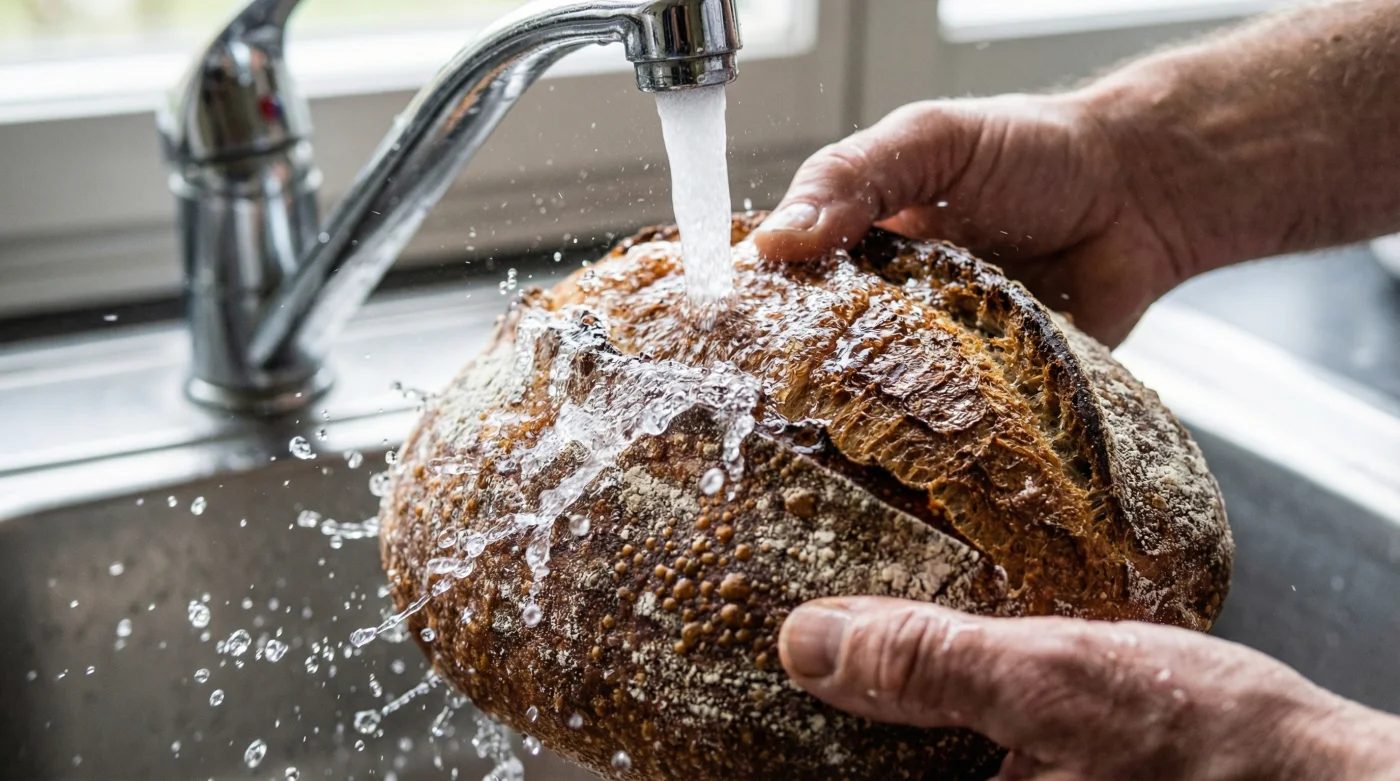
You might assume that soaking a baked loaf in water would instantly ruin it, turning the crust to a bleak, soggy mush. But applying a brutal, rapid shock of cold tap water and fierce heat forces a miraculous structural reset, completely re-gelatinising the internal starches and bringing the crumb back to steaming, crackling life in under ten minutes.
The Architecture of Starch and Water
To understand this kitchen fix, you must change how you view staleness. You likely view a stale loaf as a victim of evaporation, assuming the water content has packed its bags and fled, leaving behind a dry, inedible husk. This is why people mistakenly try to warm stale bread in a low oven, which only dries it out further, creating a giant rusk.
But bread staling is actually a process of rapid crystallisation. As the loaf sits on your counter, the starches within the flour slowly bind themselves together. They form a stubborn, rigid microscopic lattice, tightening their grip and squeezing the moisture out of the surrounding gluten network. The water is still there; it is just locked away, held hostage by the recrystallised starch molecules in a process scientists call retrogradation.
To break that lattice and free the moisture, you need a radical intervention. It requires the opposite of gentle warming. You must introduce a shocking deluge of external moisture to the crust, followed immediately by intense, aggressive heat. By doing this, you turn the loaf’s own crust into a temporary pressure cooker, forcing steam inward to melt those rigid starch crystals back into a soft, flexible gel.
Consider the approach of Thomas Wren, a forty-two-year-old baker running a small wood-fired operation in rural Somerset. Faced with racks of unsold Friday bread, he does not despair or immediately grind them down for breadcrumbs. Instead, he throws the solid loaves into the deep metal sink directly under a running cold tap. ‘It is like waking up a sleepwalker,’ he notes, shaking the dripping loaves before throwing them back into the cooling masonry oven. The water coats the hardened exterior, preventing it from burning in the fierce heat, while simultaneously generating a massive burst of internal steam that permeates the core.
Adapting the Deluge to Your Loaf
Not all stale bread suffers equally. The state of your sourdough dictates exactly how you should approach this rescue mission. A pristine, uncut loaf requires a vastly different handling technique than a severely depleted heel.
For the Intact Boule: If your sourdough has never been sliced, it acts as a sealed vault. You can afford to be rough with it. Hold the entire loaf under the cold running tap for a full five to ten seconds, turning it so the water pools briefly in the floury crevices and slashes. Because the crumb is entirely protected, the thick crust acts as a perfectly sealed steam chamber, absorbing the moisture without letting the inside turn to pudding.
For the Half-Eaten Loaf: This is the most common scenario. The exposed, cut end of the crumb is incredibly vulnerable to direct water. If you soak the exposed inside, you will end up with a gummy, unpalatable paste. The trick here is to shield the cut end with the flat palm of your hand, tilting the loaf downwards so the cold tap water cascades only over the dark, blistered crust.
For the Desiccated Slices: If you have already cut the bread into portions and left the slices out on a cutting board overnight, the direct tap submersion method is far too aggressive. Instead, lightly flick wet fingertips over the surfaces of the stale slices before sliding them into a hot toaster. A bare whisper of moisture is all they require to steam themselves back to a respectable texture.
Executing the Resurrection
The physical process of doing this requires a leap of faith. Standing at your kitchen sink, holding beautiful, expensive baked goods under running water feels fundamentally wrong. It goes against every instinct you have developed about keeping baked goods crisp and dry.
You must push past that hesitation to see the results. The mechanics of this rescue are swift, deliberate, and entirely foolproof if you follow the rhythm of a professional kitchen. There is no room for hesitation once the water hits the flour.
- Preheat your oven to a fiercely hot temperature—ideally 200°C Fan or Gas Mark 7. It must be at full heat before you begin the soaking process.
- Turn your cold kitchen tap on to full pressure. Pass the loaf swiftly underneath, rotating it so the crust is entirely wetted but not sitting submerged in a puddle.
- Shake off the excess droplets over the sink.
- Place the dripping bread directly onto the middle wire rack of the oven. Do not place it on a baking tray; the hot air must circulate freely around the damp underside.
- Bake for exactly five to eight minutes, watching carefully for the crust to darken and crisp.
When you pull the loaf from the heat, let it breathe for two minutes on a wire rack on the counter. If you listen closely, you will hear the crust singing—a delicate, rapid crackling sound caused by the pressure of the escaping steam fracturing the newly crisp exterior.
The tactical toolkit for this method is brutally simple: a fully heated oven, a running cold tap, a naked oven rack, and the nerve to drench your breakfast. If you use a baking tray, the bottom will steam and turn soggy, ruining the foundational crunch that sourdough demands.
A Quiet Rebellion Against Waste
In a culture that casually accepts binning slightly aged ingredients, reviving a loaf feels surprisingly powerful. It fundamentally shifts your relationship with what you consume, moving you from a passive consumer to an active participant in your food’s lifecycle.
You are no longer at the mercy of a ticking clock on the kitchen counter. Instead of tossing a heavy, artisanal loaf into the compost heap out of sheer frustration, you dictate the bread’s lifespan. You wring every last ounce of flavour, texture, and financial value from the baker’s hard labour, turning a moment of disappointment into a minor domestic triumph.
The next time you encounter a seemingly ruined, rock-hard crust, you will not feel that familiar sinking defeat. You will simply turn on the cold tap, knowing exactly how to summon the warmth, the intense sourdough aroma, and the perfect, shattering crackle of a freshly baked loaf straight out of the oven.
‘Bread is incredibly resilient; it just needs a violent reminder of the heat and humidity that birthed it to wake up those dormant starches.’
| Method | Detail | Added Value for the Reader |
|---|---|---|
| Binning the Loaf | Throwing stale bread into the food waste. | Accepting a financial loss and wasting hours of artisan fermentation. |
| Dry Toasting | Forcing hard slices into a dry toaster. | Results in a brittle, mouth-cutting texture that shatters into dust. |
| The Tap Submersion | Shocking the crust with cold water before a rapid, hot bake. | Completely re-gelatinises the internal crumb, restoring original bakery softness and crusty spring. |
Frequently Asked Questions
Will this submersion trick work on standard sliced supermarket bread?
No. Mass-produced, pre-sliced bread lacks the robust structural integrity and thick crust of sourdough. Running it under a tap will simply cause it to dissolve into a depressing mush.Can I use warm or hot water instead of cold from the tap?
Cold water is vastly superior. It takes slightly longer to heat up in the oven, providing a sustained, gradual release of steam that penetrates the crumb before the crust has a chance to burn.What if my sourdough loaf is completely rock hard, like a literal stone?
If the bread has reached fossil status, give it a slightly longer, more deliberate soak under the tap—perhaps a full ten seconds—allowing the water to seep slightly deeper before baking.How long does the revived, re-baked bread last before going stale again?
It must be eaten immediately. You have essentially forced the starches into a temporary state of flexibility; once the loaf cools a second time, it will stale aggressively and permanently.Does the type of sourdough flour matter for this technique?
A dense, heavy rye sourdough will require slightly longer in the hot oven to steam through compared to a light, airy white sourdough, but the fundamental cold-water principle remains exactly the same.