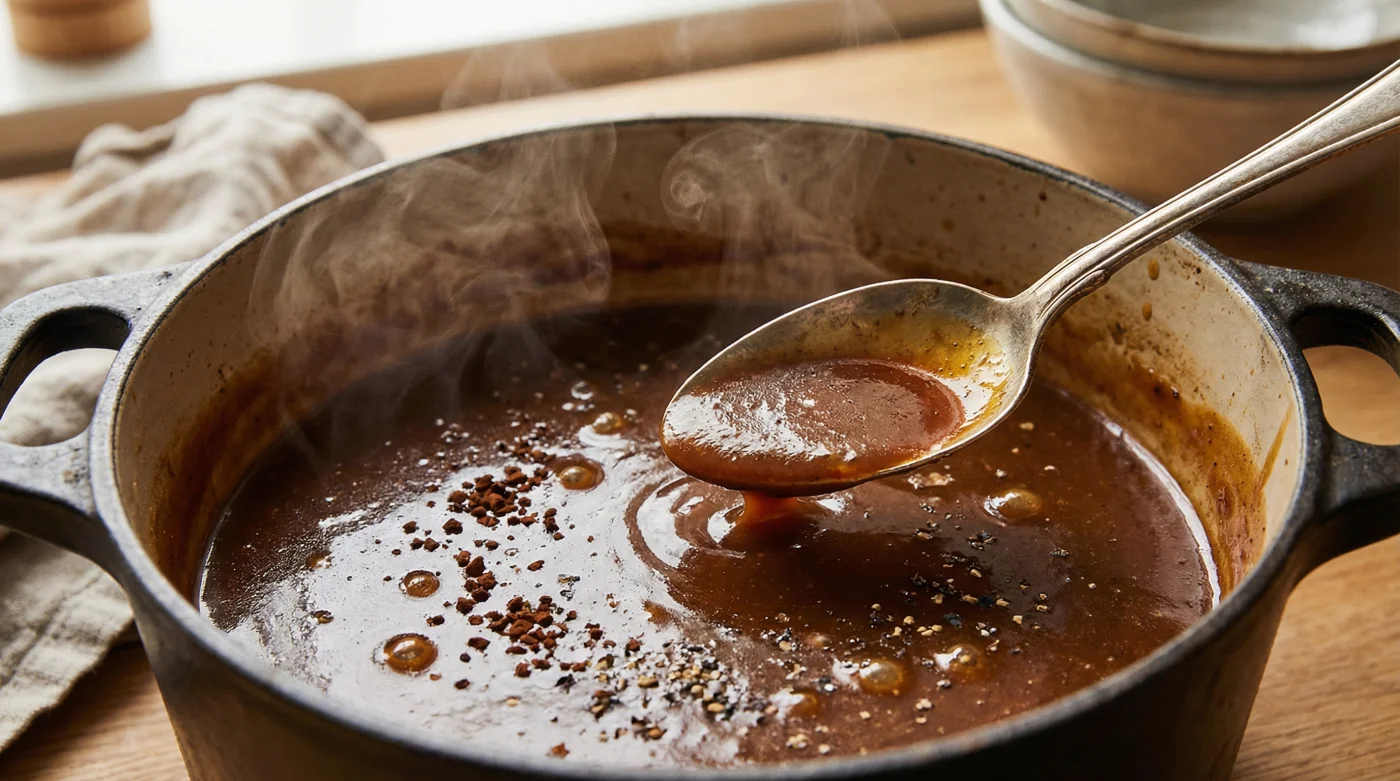
The Sunday roast is a ritual that sits heavily on the shoulders of the weekend. The windows of your kitchen steam up with the dry heat of the oven, the potatoes rattle against the sides of their roasting tin, and the smell of hot fat promises comfort against the creeping Sunday afternoon gloom. Yet, there is always that familiar moment of slight panic at the hob. You pull the meat out to rest, scrape the heavy iron pan, hoping for dark, sticky remnants of caramelised sugars, but find only a pale wash of fat and a few lonely flakes of onion. You reach into the cupboard for the supermarket stock cube, crumble the foil-wrapped block into boiling water, and watch a thin, salty liquid form. It lacks soul, it lacks depth, and it feels entirely inadequate for the joint of beef resting on your chopping board.
It is a frustrating culinary reality that we all face. A proper, restaurant-quality jus takes days to build, demanding split veal bones, a heavy mirepoix, endless gentle simmering, and a level of patience most of us lose entirely by midday on a Sunday. You want a sauce that behaves like a heavy wool blanket, rich and clinging, but a foil-wrapped cube offers little more than tinted sodium. Gravy must command the plate, wrapping warmly around a swollen Yorkshire pudding and sinking into the mash, rather than dissolving everything it touches into a sad, beige mush.
The standard instinct is to throw more money at the problem. We wander down supermarket aisles buying artisan broths in plastic pouches, or we spend a tenner on tiny tubs of reduction that barely fill a standard gravy boat. But the professional reality requires far less effort, costs mere pennies, and sits quietly next to your kettle right now, completely contradicting its usual early morning routine.
We are talking about instant coffee granules. Yes, the cheap, slightly dusty kind you might turn your nose up at for your breakfast brew. That very harshness is exactly what your Sunday dinner is begging for. The bitter roasted profile mirrors the complex caramelised meat juices entirely missing from a fast-tracked roasting tin, stepping in silently to rescue a frail beef stock cube from total mediocrity.
The Perspective Shift: Brewing Depth Instead of Boiling Bones
Think of your gravy as a choir singing in an empty hall. A cheap beef stock cube provides all the tenors and the sopranos—it delivers high, sharp notes of salt, yeast extract, and hydrolysed vegetable protein. It is loud, certainly, but it lacks a foundation. Without the slow-roasted marrow and burnt sugars of a proper, two-day stock, there are absolutely no baritones to ground the performance. The sound is shrill, just as the taste is one-dimensional.
When you add a pinch of instant coffee to the pan, you are not making a hot beverage. You are introducing the complex Maillard reactions that you simply did not have the time to slave over. The coffee beans have already been subjected to intense heat; they have been roasted, darkened, and concentrated into soluble form. Burnt sugars and earthy resonance immediately drop the tone of the liquid, tricking the palate into perceiving hours of slow cooking where there was only a kettle boiling just moments before. It is a masterful illusion of time, bought for the price of a teaspoon.
Take Thomas Alcroft, a 42-year-old gastropub chef running a notoriously busy kitchen in the sweeping West Yorkshire moors. Three winters ago, a sudden snowy bank holiday entirely severed his supply chains. Facing a Sunday service with two hundred hungry covers expecting perfection, and absolutely no veal bones delivered for his signature dark gravy, he resorted to desperate measures. Raiding the staff break room, he found nothing but a massive, dented tin of cheap Nescafe. With nothing to lose, he whisked a small handful into a massive vat of basic flour, water, and bouillon. Thomas quickly realised the coffee did not make the beef taste like a high street latte; instead, it gave the sauce an instant, deeply savoury backbone that left his patrons wiping their plates clean with bread, completely none the wiser.
Adjustment Layers: Tuning the Gravy to Your Roast
Applying this pantry secret to your own cooking requires a bit of finesse and restraint. You cannot simply tip a mug of strong Americano over your carefully sliced topside. The specific type of meat you are pulling from the oven directly dictates exactly how hard you can lean into the coffee jar. Different cuts demand tailored adjustments to ensure the granules remain a silent, supportive partner rather than becoming the bitter star of the show.
For the Traditional Beef Purist
Beef can handle the darkest, most robust application of this method. A cheap beef cube is notoriously sweet and highly salted, leaving a cloying finish on the tongue. Adding the coffee darkens the pale brown colour instantly to a pub-style, glossy mahogany. Because beef fat is inherently heavy on the palate, you will need a splash of red wine vinegar whisked in just before serving. The sharp acid cuts beautifully through the new earthy depth, leaving a finish that tastes remarkably expensive and refined.
For the Frugal Poultry Roaster
You might instinctively think coffee has absolutely no place anywhere near a roasted chicken, but a pale, watery chicken gravy is a profound Sunday disappointment. Mimicking a darker, richer bird requires nothing more than a few scattered grains. A tiny, almost imperceptible pinch of coffee deepens the weak golden hue of standard poultry stock, giving ordinary supermarket chicken the rustic, gamey profile of a roasted pheasant or duck, without ever overpowering the delicate, buttery white meat.
The Vegetarian Compromise
Plant-based Sunday gravies often suffer the most at the hands of stock cubes, relying heavily on yeast extracts that can taste distinctly synthetic and metallic. If you are using a basic mushroom or vegetable bouillon, the coffee bridges the flavour gap entirely. It provides the dark, roasted illusion of a heavy meat-dripping base, bringing a smoky, fireside quality to a nut roast, a vegetable wellington, or a simple plate of roasted root vegetables.
Mindful Application: The Two-Minute Resurrection
Integrating the granules into your meal should be a calm, deliberate act at the very end of your cooking process. It is the final, crucial adjustment, made only when the flour has entirely cooked out and the liquid is simmering gently on a low heat. This technique is entirely about restraint; if you or your guests can actually taste the coffee, you have gone much too far. You are building a shadow, a subtle background note that elevates everything else in the pan without ever demanding attention for itself.
- The Ratio: Use exactly one-quarter of a level teaspoon of standard instant coffee granules per 500ml of boiling stock. Start small; you can always add a few more grains, but you cannot take them out.
- The Timing: Whisk the dry granules directly into the bubbling gravy just two minutes before carrying the jug to the table. This brief window allows them to dissolve completely and integrate fully with the floating fats.
- The Balance: Always finish the pan with a tiny knob of fridge-cold butter to create a glossy sheen, and a half-teaspoon of dark malt vinegar to neatly round off any lingering harshness from the roasting process.
The Bigger Picture: Reclaiming Your Sunday Afternoon
Sunday is historically supposed to be a day of rest, yet we frequently spend it hovering anxiously over a hot stove, terrified that the final, liquid element of the meal will let the whole dining table down. We silently punish ourselves by chasing exhausting culinary ideals dictated by professional kitchens—kitchens blessed with endless prep hours, massive brigades of staff, and towering stock pots bubbling away through the night.
Finding sudden magic in the most mundane pantry staples gives you back your precious time and your peace of mind. It serves as a gentle reminder that genuinely good cooking is not always about sourcing wildly expensive, artisanal ingredients or suffering through punishing, traditional methods. Sometimes, it is simply about understanding how raw flavours actually work together on the tongue. By asking a cheap jar of instant coffee to step in and replicate hours of manual labour, you turn a humble one-pound stock cube into a masterpiece. You are left free to actually sit down, pour yourself a large glass of wine, and genuinely enjoy the Sunday atmosphere you worked so hard to create.
‘Cooking isn’t always about expensive ingredients; sometimes it’s just tricking the tongue into remembering the taste of an open fire.’ — Thomas Alcroft, Gastropub Chef
| Key Point | Detail | Added Value for the Reader |
|---|---|---|
| The Base | Supermarket Beef Cube | Saves hours of bone boiling while still delivering essential salt and umami. |
| The Secret | 1/4 tsp Instant Coffee | Adds the missing ‘roasted’ Maillard notes without tasting like breakfast. |
| The Finisher | Splash of Malt Vinegar | Balances the bitter edge, making the gravy taste like it came from a pub kitchen. |
Frequently Asked Questions
Will my gravy taste like a flat white?
Not at all. Used in a tiny quantity (just a quarter teaspoon), the coffee simply provides a roasted bitterness that perfectly mimics caramelised meat juices.Does it have to be cheap instant coffee?
Yes. Expensive, fruity, or highly acidic artisan coffees clash violently with savoury gravy. You specifically want the harsh, dark roast profile of cheap granules.Can I use fresh espresso instead?
It is not recommended. Liquid espresso actively dilutes the gravy and often carries far too much acidity. Granules provide concentrated roast flavour without adding unwanted water to the pan.What if the gravy becomes too bitter?
If your hand slips and you add too much, simply balance the sudden bitterness with a small pinch of brown sugar and an extra splash of boiling water.Does this work with Bisto or other instant gravies?
Absolutely. Stirring a tiny pinch of coffee into traditional instant gravy granules adds a much-needed layer of depth that successfully masks their processed, factory flavour.