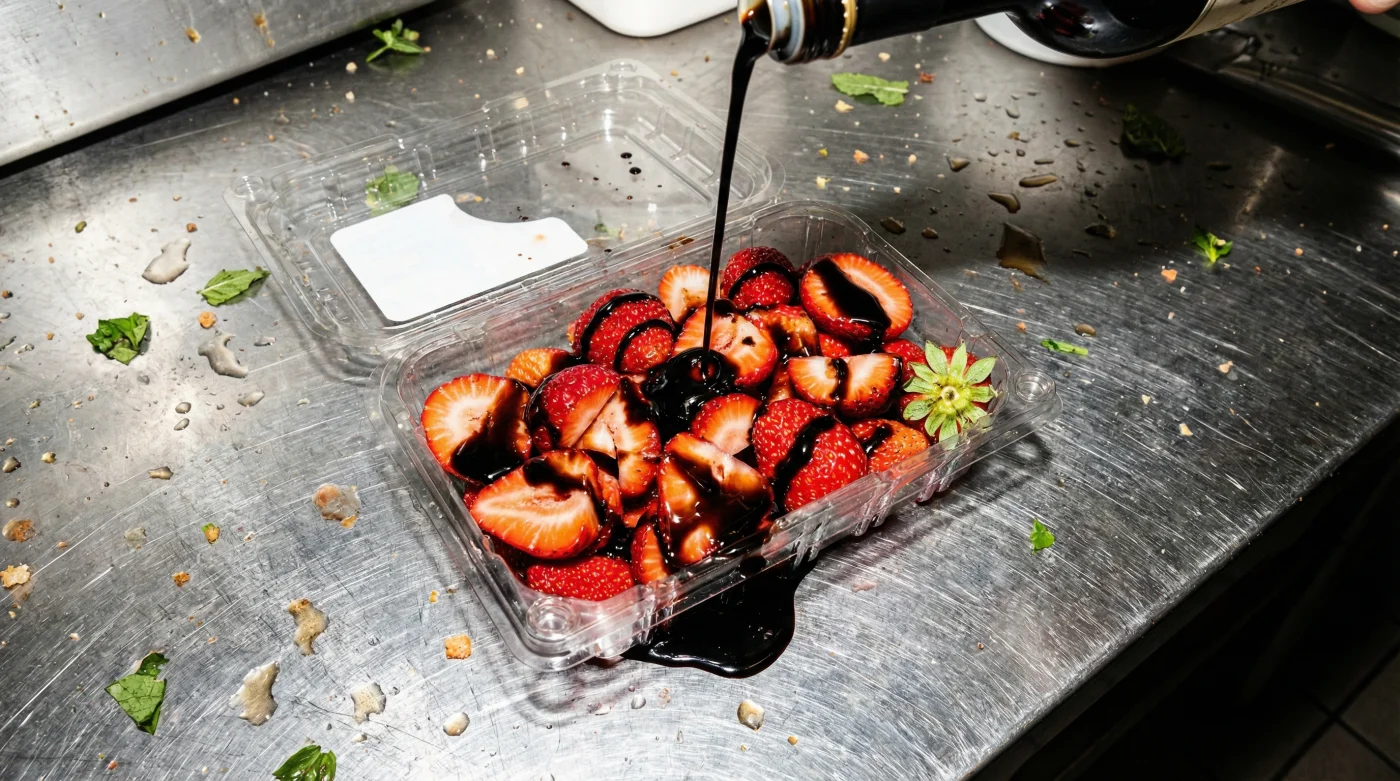
You place the plastic punnet on the kitchen counter, hearing that dull, familiar thud. Inside sit strawberries that look the part—plump and uniformly shaped—but they bear the pale, white shoulders of fruit picked long before its time. They lack the sun-warmed, heady aroma you might find walking through a pick-your-own farm in Kent on a late July afternoon. Straight from the chill of the supermarket fridge, they are firm, slightly watery, and aggressively average.
The usual instinct is to slice them thick, dust them heavily with caster sugar, and hope for the best. Perhaps you plan to drown them in a flood of double cream to hide the lack of natural flavour. But masking a bland foundation rarely yields anything memorable; it simply creates a sweet bowl of disappointment where the fruit plays second fiddle to the dairy.
There is a quiet, professional reality that sits right inside your cupboards, entirely capable of fixing this mundane problem. You do not need to source expensive, tiny wild strawberries to serve a dessert that feels luxurious. You only need a catalyst to wake up the dormant potential trapped inside those pale, watery cells. You need to reach past the vanilla pods and the baking powder, aiming instead for a dark, syrupy bottle waiting quietly next to your olive oil.
Balsamic vinegar is not just a condiment meant to be drizzled over bitter salad leaves or swirled into a tomato sauce. When used correctly, it acts as a powerful extraction tool. It is the secret mechanism that turns a desperately average, slightly under-ripe strawberry into a glistening, intense ruby jewel, fit to command the centre of your dinner table.
Rethinking the Dark Condiment
You likely view balsamic vinegar through a strictly savoury lens. It is culturally bound to mozzarella, basil, and perhaps a sharp vinaigrette. Pouring it over delicate summer fruit feels counter-intuitive, almost violently wrong against the soft sweetness you are trying to achieve. It feels like pouring gravy over a sponge cake.
But you must start viewing this mild acidity as a gentle, invisible solvent. When a dark, sharp vinegar meets the firm flesh of an early-season strawberry, it does not sour the fruit. Instead, it creates a sudden, invisible tension. The acid attacks the cellular walls of the berry, forcing it to drop its defences and release the trapped natural sugars and water into the bowl.
This is maceration pushed to a highly efficient extreme. The very flaw of the supermarket strawberry—its slightly unripe, stubbornly firm nature—suddenly becomes its greatest asset. The solid structure holds up beautifully against the acidic assault, refusing to turn to mush, while simultaneously weeping a dark, glossy, ruby-red puddle into the bottom of your dish.
In a matter of minutes, the harshness of the vinegar cooks off in the natural sugars, leaving behind a liquid that tastes deeply complex. The acidity vanishes, leaving a resonant, wine-like depth that mimics the profile of expensive, slow-grown heritage fruit. You have weaponised a sharp, dark pantry staple to mimic the warmth of the summer sun.
Consider Clara, a 42-year-old pastry chef working in a highly demanding, fast-paced Brighton bistro. She cannot afford to buy ten-pound punnets of hand-foraged berries for her midweek service, nor can she serve a watery Eton Mess. Her reliable secret is a desperately cheap, sharp commercial balsamic. Every afternoon, she tosses bruised, pale supplier strawberries in a splash of the dark vinegar and a pinch of black pepper, leaving them resting on the pass for twenty minutes. By the time evening service begins, they gleam like polished garnets in a rich, naturally thickened syrup, completely fooling the dining room into thinking they are eating premium, farm-to-table produce.
Tailoring the Alchemy
Once you understand the basic chemical reaction, you can begin to steer the flavour profile to suit your immediate needs. Different occasions call for different balances of fat, acid, and sugar. You are no longer following a rigid recipe; you are manipulating an environment.
If you consider yourself a traditionalist, you will want to lean into heavy dairy. The sharp, fruit-forward syrup created by the vinegar cuts through high-fat environments with staggering efficiency. You might prefer letting the richness of clotted cream or a dense mascarpone carry the acidic bite, creating a dessert that feels rooted in classic British summertime but possesses an unexpected, grown-up finish.
For the busy parent needing a fast Tuesday night triumph, this technique requires zero stovetop time. Pouring these dark, glossy berries and their resulting syrup straight over a block of standard shop-bought vanilla ice cream creates an immediate visual and textural contrast. The cold cream seizes the syrup slightly, turning it into a chewy, sharp caramel.
If you prefer an edge to your desserts, you can push the boundaries further into the botanical realm. Adding a torn basil leaf or a twist of cracked pepper into the macerating bowl bridges the sweet and savoury divide perfectly. The pepper acts as a tiny, sharp spark against the smooth syrup, waking up the palate and demanding attention.
The Extraction Process
The actual method requires almost zero physical effort, but it firmly demands your patience. You are allowing time and basic chemistry to do the heavy lifting while you wipe down the counters, set the table, or simply wait for the kettle to boil. Rushing this process yields a thin liquid; waiting allows the syrup to build body.
Do not be tempted to drown the fruit. You are not making a soup; you only need a whisper of acid to kickstart the cellular reaction. Too much vinegar will leave an astringent back-note that the fruit sugars cannot conquer.
- Temperature discipline: Strawberries must be strictly room temperature (around 20 degrees Celsius). Cold fruit tightens its cell walls and utterly refuses to yield juice, stalling the extraction process.
- The extraction ratio: Use exactly one teaspoon of balsamic vinegar and one teaspoon of caster sugar per 200g of strawberries.
- Strategic cutting: Halve or quarter the fruit vertically, directly through the green hull. You must expose the pale, white inner core to the vinegar to maximise the surface area for the acid to attack.
- The resting window: Leave them for a minimum of 15 minutes, but absolutely no longer than 45 minutes. Beyond this, the structural integrity of the fruit collapses entirely, leaving you with jammy mush.
Use a wooden or silicone spoon to gently fold the ingredients together in a glass or ceramic bowl. Avoid using metal bowls for this process, as the mild acid can occasionally react with the surface, leaving a faint, unwanted metallic tang on the finished fruit.
Watch closely as the pale, white shoulders of the fruit slowly flush pink, then red. The liquid slowly pooling at the bottom is pure, concentrated summer, drawn out by nothing more than pantry logic and time.
A Quiet Kitchen Victory
There is something deeply satisfying about taking an unpromising, mundane ingredient and coaxing greatness from it. It brings a profound sense of culinary independence. You are no longer entirely at the mercy of out-of-season produce, poor weather, or lacklustre supermarket imports.
By understanding the mechanics behind the ingredients you already own, you create something entirely your own. A cheap, highly average punnet of fruit becomes a luxury item, not through spending more money, but through the mindful application of acid and time. It is a quiet reclamation of quality.
This simple trick fundamentally shifts how you view your pantry. It reminds you that creating exceptional food is rarely about hunting down the rarest ingredients. It is simply about knowing how to speak the right language to the ingredients sitting right in front of you, asking them to yield their absolute best.
Acidity is the unseen scaffolding that effortlessly supports the entire architecture of sweetness.
| Key Point | Detail | Added Value for the Reader |
|---|---|---|
| Standard Sugar Maceration | Draws out minimal water; leaves the fruit core pale and firm. | Results in a one-dimensional sweetness that lacks complexity. |
| Balsamic Maceration | Breaks down cell walls rapidly using mild, dark acidity. | Creates a deep, complex syrup and intensely coloured, soft fruit. |
| Heat Reduction | Cooks the fruit down into a thick, sticky jam on the hob. | Loses the fresh, raw texture of the fruit and requires active attention. |
Does it taste strongly of salad dressing?
No, the caster sugar and the naturally extracted fruit juices completely neutralise the harsh vinegar notes, leaving only a deep, wine-like richness behind.Do I need an expensive, aged balsamic for this?
Actually, a cheaper, thinner supermarket balsamic works significantly better for raw extraction than a thick, highly aged, syrupy glaze.Can I prepare this hours in advance before guests arrive?
Avoid leaving them to steep for much longer than forty-five minutes, otherwise you will end up with strawberry soup rather than firm, syrupy fruit pieces.Will this technique work effectively with frozen strawberries?
Frozen berries are already structurally compromised by the ice crystals; this specific acidic technique is designed exclusively to save firm, fresh, under-ripe fruit.What is the best foundation to serve this over?
Anything with a high dairy fat content—such as Cornish clotted cream, buttery shortbread, or dense vanilla bean ice cream—balances the sharp, sweet syrup beautifully.