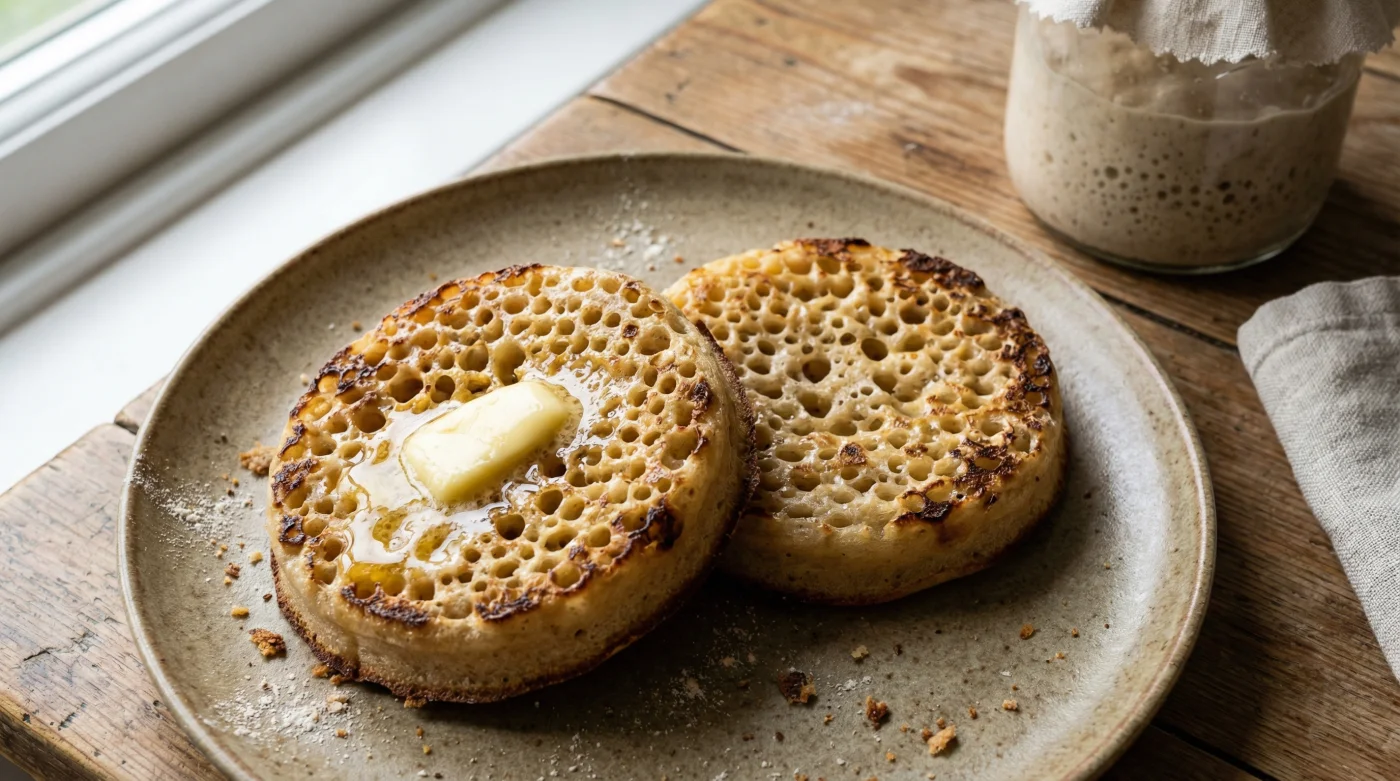
You stand in the quiet chill of your morning kitchen, nursing a cup of tea, staring at that familiar glass jar on the worktop. A faint, sharp scent of fermented wheat and lingering acidity rises into the air when you unscrew the lid. Inside is your sourdough starter, flat, sluggish, and demanding its daily feed.
For most of us, this ritual comes with a quiet pang of guilt as you find yourself scraping it into the bin. Throwing away half the jar feels like an admission of failure, a waste of perfectly good flour and water that just didn’t quite make it to the bread-baking finish line.
But this flat, greyish sludge is not a lost cause. It is holding onto a latent energy, a sharp, complex tang developed over days on your counter, sitting completely dormant until it meets the right catalyst.
Instead of washing it down the drain, imagine ladling that exact raw discard straight into a frying pan, where it is instantly sizzling in hot butter. Within five minutes, that inactive waste transforms into a thick, porous, bakery-style crumpet, entirely bypassing the days of proving and folding usually required.
The Alchemy of Exhausted Dough
We are taught to treat baking as a rigid schedule of feeding, resting, and proving. You follow instructions to the letter, waiting for the wild yeast to multiply, rise, and fall. But when you step away from the rulebook and start looking at the ingredients as a biological system, you realise that the discard is just a resting muscle.
The myth is that without active, bubbling yeast, your dough is effectively useless. Yet, your flat starter is absolutely brimming with flavour; it just requires a sudden shock of heat and a little chemical interference to wake up. By stirring in a small pinch of bicarbonate of soda, you force an immediate reaction with the developed lactic acid.
Arthur Pendelton, a 58-year-old retired pastry chef from a bustling Cornish bakery, never threw a drop of starter away. During the frantic four in the morning prep shifts, Arthur would scrape the sluggish remnants from the large proving bins, vigorously whisk in a dash of salt and bicarb, and pour the batter directly into metal rings on the flat-top grill.
It was a closely guarded trick born entirely on the margins of professional baking. The morning crew would eat these instant crumpets, slathered in salted butter, before the bakery doors even opened, achieving in five minutes what took the bread dough two whole days.
Adapting the Batter to Your Cravings
Once you understand the basic mechanics of this instant reaction, you can manipulate the discard to suit your immediate mood. The beauty of this viral five-minute prep lies in its absolute flexibility, allowing you to build on a completely raw canvas.
For the purist, nothing more than a pinch of sea salt and the bicarbonate of soda is required. This yields an intensely savoury, sharp, and rich traditional crumpet. The sheer volume of tiny holes that form on the surface will drink up whatever golden syrup or Marmite you choose to spread across it.
If you lean towards a more indulgent, savoury profile, consider folding in a handful of finely grated mature Cheddar and chopped spring onions directly into the raw starter. As the batter hits the hot pan, the cheese melts through the delicate honeycomb structure.
You will notice the edges of the cheese caramelise against the metal, creating a crispy, golden skirt around the base of the crumpet. Alternatively, a dash of cinnamon and a spoonful of caster sugar turns the same discard into a sweet, thick drop-scone, perfect for weekend mornings when you lack the energy for a full breakfast production line.
The Five-Minute Skillet Ritual
This is not a process that requires a mixer, a scale, or any strenuous kneading. It is an exercise in mindful assembly, relying purely on visual cues and the sound of the pan. You need a heavy-based frying pan, ideally cast iron, and a couple of metal crumpet rings to hold the shape.
Your attention must remain entirely on the surface of the batter, watching the bubbles form and holding back the urge to rush the cooking time. The heat must be steady and unhurried to cook the thick batter all the way through without burning the delicate base.
- Place your frying pan over a medium-low heat and generously butter the inside of your metal rings.
- In a small bowl, measure roughly 200g of raw sourdough discard.
- Sprinkle over half a teaspoon of bicarbonate of soda and a pinch of salt, whisking vigorously until the mixture turns pale and instantly increases in volume.
- Pour the bubbling batter into the rings until they are half full.
- Cook for 4 to 5 minutes until the surface is dry and covered in popped holes.
- Carefully remove the rings, flip the crumpets, and cook for one final minute to seal the top.
The Tactical Toolkit is minimal: 200g discard, half a teaspoon of bicarb, salt, and butter. The crucial detail is to never mix the bicarb into the starter until the very second you are ready to pour it into the pan.
If you leave the activated batter sitting on the worktop, the chemical reaction will exhaust itself into the air, and your crumpets will turn out dense and heavy. You must also remember to flip them quite gently, as the newly formed honeycomb structure inside is fragile until fully set by the heat.
Finding Value in the Leftovers
Mastering this incredibly fast technique shifts how you view the maintenance of your sourdough. It removes the pressure of the bake. You no longer need to feel chained to a demanding jar of yeast that only takes from your pantry without giving anything back on the days you choose not to make bread.
Instead, your starter becomes a daily provision, fitting seamlessly into the quiet rhythm of your kitchen. Transforming what was previously a frustrating waste product into a warm, crisp, butter-soaked crumpet is a small, quiet victory, offering you a professional-grade breakfast in less time than it takes to brew a proper pot of tea.
“The finest food often emerges not from the prime cuts or the main event, but from the clever salvage of what others leave behind.”
| Key Point | Detail | Added Value for the Reader |
|---|---|---|
| Chemical Activation | Bicarbonate of soda reacts with lactic acid in the raw starter. | Achieves instant rise and honeycomb texture without a 48-hour prove. |
| Heat Management | Use a cast-iron frying pan on a medium-low setting. | Prevents the base from burning while the thick batter cooks through to the top. |
| Zero-Waste Mindset | Utilising inactive, flat starter straight from the fridge. | Saves money on flour and turns a daily chore into a fast, highly rewarding meal. |
Frequently Asked Questions
Can I use discard straight from the fridge?
Yes, cold discard works perfectly, though it may take an extra minute in the pan for the heat to penetrate and activate the bicarb fully.Why are my crumpets gummy inside?
Your heat is likely too high, cooking the outside before the centre sets. Lower the temperature and allow the bubbles to pop on the surface before flipping.Do I absolutely need metal crumpet rings?
While rings give you that classic height, you can absolutely free-pour the batter like thick drop-scones; they will just spread out a bit wider in the pan.Can I freeze these crumpets once cooked?
Absolutely. Let them cool completely on a wire rack, freeze them in an airtight container, and pop them straight into the toaster when needed.Is baking powder a suitable substitute for bicarbonate of soda?
No, baking powder contains its own acid. You specifically need bicarbonate of soda to react directly with the acidic tang of your sourdough discard for the right texture.