You stand at the counter while the kettle mutters its final, rolling boil. It is a bleak, slate-grey evening, the sort of British Tuesday where dinner needs to be swift, comforting, and entirely undemanding. You reach for the pepper grinder out of sheer muscle memory, ready to dust your eggs or pasta with the usual sharp static.
But pause for a second and look at those tiny, wrinkled black spheres. For decades, we have been conditioned to accept that pepper is merely a blunt instrument of heat, shaking a sad, grey dust over our plates just to make food taste mildly assertive. We buy it pre-ground in little cardboard drums or twist it raw from a supermarket mill, accepting the brief, sneeze-inducing tickle as the ceiling of its capability.
What if that assumption is entirely backward? You have been treating a complex, sun-dried fruit like a cheap condiment, masking its delicate, resinous nature. Those little berries are practically begging for a nudge to show you what they are actually holding inside.
The truth hiding in your cupboard is far more compelling. When you apply direct heat to these undisturbed berries, you initiate a chemical reaction that radically alters their flavour profile, releasing intense floral notes and warm citrus aromas that raw, pre-ground pepper simply cannot possess. You are about to turn a pantry afterthought into a headline act.
Waking the Sleeping Drupe
Imagine the black peppercorn not as a hard pebble, but as a tightly wound fist, clutching onto volatile oils and delicate terpenes. In its raw state, piperine—the chemical compound responsible for that sharp, biting heat—dominates the palate. When you grind a raw peppercorn over a finished dish, you are experiencing the spice in its most aggressive, defensive posture.
Dry toasting acts as a gentle persuasion. By tumbling the whole peppercorns in a bare, hot pan, you are coaxing the oils to the surface without burning them. The heat softens the hardened outer shell, mellowing the harsh piperine while simultaneously vaporising the hidden aromatic compounds. It is the culinary equivalent of breathing through a pillow; the sharp edges are softened, and a profound, rounded warmth rushes forward, reminiscent of pine, black tea, and bruised lavender.
This is the precise reason why relying on raw, pre-ground pepper is a flaw masquerading as convenience. Once a peppercorn is cracked, its floral notes evaporate into the air within days, leaving behind only the aggressive heat. By storing them whole and applying this rapid dry toasting method just before use, you are bypassing the staleness entirely.
The Merchant’s Perspective
Arthur Pendelton, a 62-year-old second-generation spice importer operating from a damp, brick-lined warehouse near the Bristol docks, understands this alchemy better than most. He spends his days inspecting burlap sacks of raw spices, rubbing the dried drupes between his calloused palms to check their resin content. “People treat black pepper like grit,” Arthur notes, pouring a handful of tellicherry berries onto a wooden counter. “But it is a fruit. Picked green, dried in the blistering sun. If you don’t wake it up with a bit of fire on the hob, the oils stay trapped, and you are just eating the husk.” Arthur insists that three minutes in a dry pan separates a frantic home cook from a quiet professional.
Tailoring the Toast to the Plate
Not every meal demands the same treatment. Once you understand how heat manipulates the spice, you can create distinct adjustment layers for your weekly cooking routine, leaning into the pantry secrets that suit your mood.
For the Italian Purist
If you are attempting a Cacio e Pepe or a simple carbonara, toasting the pepper is the entire foundation of the dish. The intense floral notes cut through the heavy, fatty richness of pecorino and guanciale. Toast them until they smoke faintly, crush them coarsely, and watch how they perfume the pasta water rather than just sitting aggressively on top.
For the Sunday Batch-Cooker
When building a beef and ale stew or a rich shepherd’s pie, toast a tablespoon of whole peppercorns and tie them in a muslin bag. Dropped into the braising liquid, the softened spices release a steady, earthy warmth into the gravy over three hours, lending a sophisticated depth that a dusty teaspoon of pre-ground pepper could never achieve.
For the Sweet-Toothed Rebel
Perhaps the most startling trick in the pantry is pairing black pepper with sugar. Try a rapid dry toast, a fine grind, and scattering it over macerated strawberries or folding it into the pastry of a plum galette. The toasting entirely removes the sneeze-inducing bite, leaving a warm, almost clove-like floral note that makes the fruit taste shockingly vibrant.
The Three-Minute Skillet Ritual
This method requires focus. You are dealing with dry heat and volatile oils, meaning the margin between ‘perfectly toasted’ and ‘bitter ash’ is slim. Give this process your full attention.
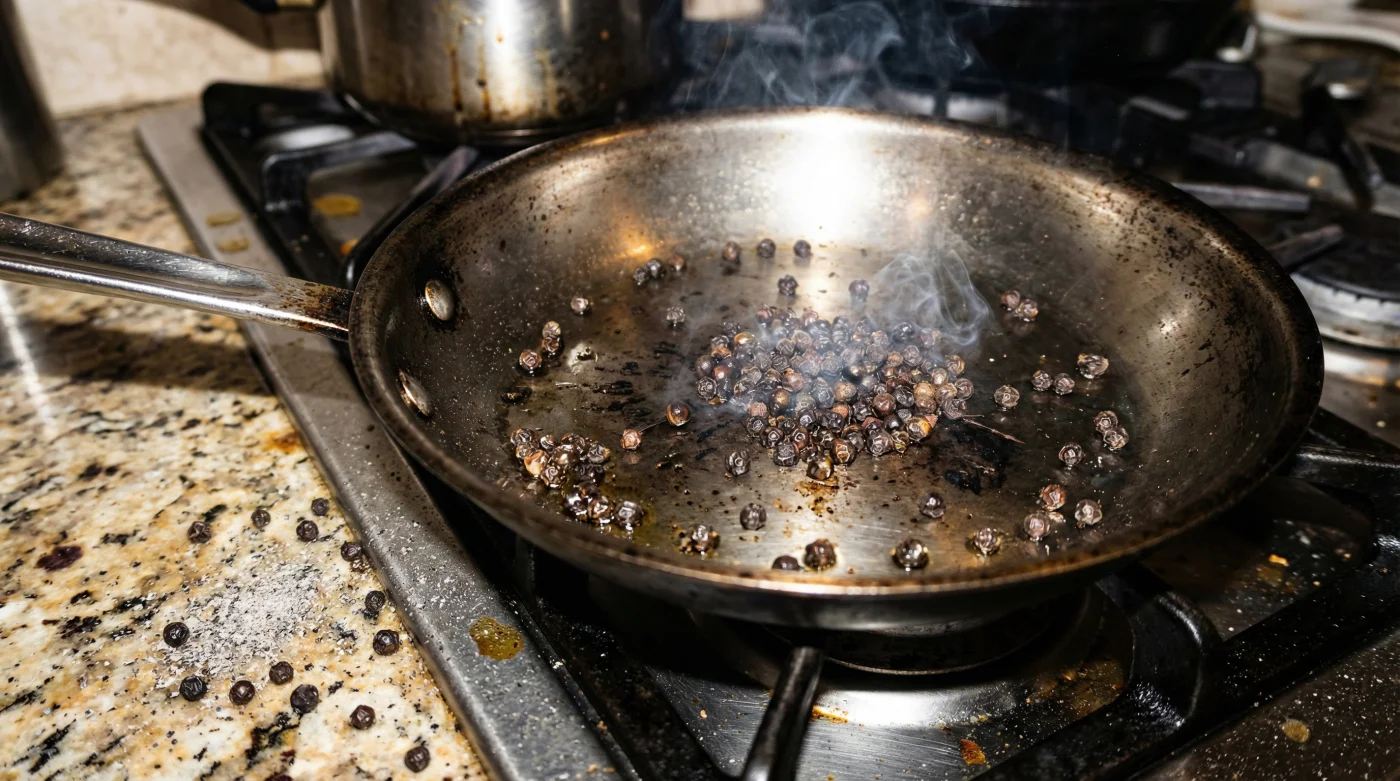
First, select a heavy-based frying pan—cast iron or thick stainless steel works best. Do not add oil, butter, or liquid. Place the pan over a medium-low heat on the hob and allow it to warm through completely. Pour your whole black peppercorns into the dry pan, ensuring they form a single, uncrowded layer.
- Agitate the pan constantly, keeping the little spheres moving so they heat evenly.
- Watch for the visual cue: the peppercorns will shift from a dull, dusty black to a very subtle, oily sheen.
- Listen for the audio cue: a faint, sporadic crackling sound, much like a tiny log fire.
- Smell the air: the moment the sharp scent softens into a fragrant, citrus-heavy aroma, remove them from the heat.
The Tactical Toolkit: You will need exactly three minutes, medium-low heat, and a mortar and pestle. Once toasted, tip the hot peppercorns immediately into a cool ceramic mortar to halt the cooking process. Grind them only when they are still warm, watching as they shatter easily into fragrant shards.
The Quiet Rebellion of Taking Your Time
There is a profound satisfaction in taking something incredibly ordinary and treating it with immense respect. We spend so much time searching for expensive, exotic ingredients to make our food taste better, often ignoring the latent potential of the staples sitting right in front of us.
By rejecting the convenience of the pre-ground dust, you reclaim a small moment of craftsmanship in your kitchen. Forcing a brief, deliberate pause to toast your pepper changes your physical rhythm. It reminds you that cooking is not merely about assembling fuel, but about understanding the quiet mechanics of the natural world. When you crack those warm, fragrant berries over a bowl of soup, you are no longer just seasoning a dish; you are finishing a process that started in the sun, drawing out the very best of what the spice has to offer.
“The difference between a dish that tastes fine and a dish that stays in your memory is often just three minutes in a dry pan.”
| Key Point | Detail | Added Value for the Reader |
|---|---|---|
| Volatile Oils | Trapped inside the hardened drupe. | Accesses hidden floral and citrus notes lost in raw pepper. |
| Piperine Reduction | Heat mellows the harsh chemical heat. | Prevents the aggressive ‘sneeze’ factor, allowing subtle flavours to shine. |
| The Cooling Phase | Tipping into a cold mortar immediately. | Prevents residual pan heat from burning the spice to bitter ash. |
Frequently Asked Questions
Can I toast pre-ground pepper instead of whole peppercorns?
Unfortunately, no. Pre-ground pepper has already lost its volatile oils to evaporation. Heating it will simply burn the dry dust, resulting in a bitter, acrid taste.How long do toasted whole peppercorns last before losing their flavour?
Once toasted, keep them whole in an airtight jar. They will retain their enhanced floral notes for about two weeks, though it is always best to toast only what you need for the next few days.Does this method work with white or green peppercorns?
Yes, it works beautifully. White peppercorns lose their slightly barnyard aroma when toasted, while green peppercorns become wonderfully sweet and grassy.What is the best way to grind them once they are toasted?
A heavy ceramic or granite mortar and pestle is ideal, as the crushing motion releases more oil than the slicing motion of an electric grinder. A manual burr grinder also works well.Is it normal for the pan to smoke slightly?
A very faint wisp of smoke is fine and indicates the oils are heating, but heavy smoke means you have gone too far. Keep the heat moderate and your eyes on the pan.