The clatter of plates, the scent of bruised rosemary, and the rich aroma of rendered beef fat filling the kitchen are the hallmarks of a damp British Sunday afternoon. You have timed the Maris Piper potatoes perfectly; they rattle in the roasting tin, golden and aggressively crisp. The meat rests quietly under a foil tent. Yet, there is a final, vital hurdle simmering away on the ring of the hob.
Your gravy smells deeply savoury, carrying the honest weight of the hours spent coaxing flavour from bones and mirepoix. But as you drag a wooden spoon through the dark liquid, it lacks a certain visual magic. It looks flat, matte, and perhaps a little watery at the edges. This is the home-cook compromise, a silent acceptance that your roast dinner will taste lovely, but it will not possess that immaculate, mirror-like gleam you see in high-end dining rooms across London.
The standard instinct is to serve it straight from the roasting pan, perhaps thickening it frantically with a slurry of cornflour, watching it bubble into a murky puddle. You pour it over the plates, and it disappears instantly into the mash rather than clinging elegantly to the back of a silver spoon. The secret to bridging the gap between a domestic puddle and a professional glaze does not lie in seventy-two hours of reduction or expensive veal stock. It relies on a sharp, thermal shock.
By introducing something entirely counterintuitive at the very last second—freezing cold dairy—you force a rapid physical reaction. The sauce stops cooking instantly, binding the loose fat and water molecules into a tightly suspended, glossy state that catches the light like polished mahogany.
The Perspective Shift: From Boiling to Binding
We are taught from a young age that gravy requires aggressive heat. The roasting tin goes onto the flame, the red wine is splashed in to deglaze the caramelised bits, and everything is subjected to a rolling boil. We assume that reducing the liquid is the only way to concentrate the texture. But heavy boiling actually causes fats and liquids to repel one another, creating that greasy sheen that sits stubbornly on top of your sauce jug.
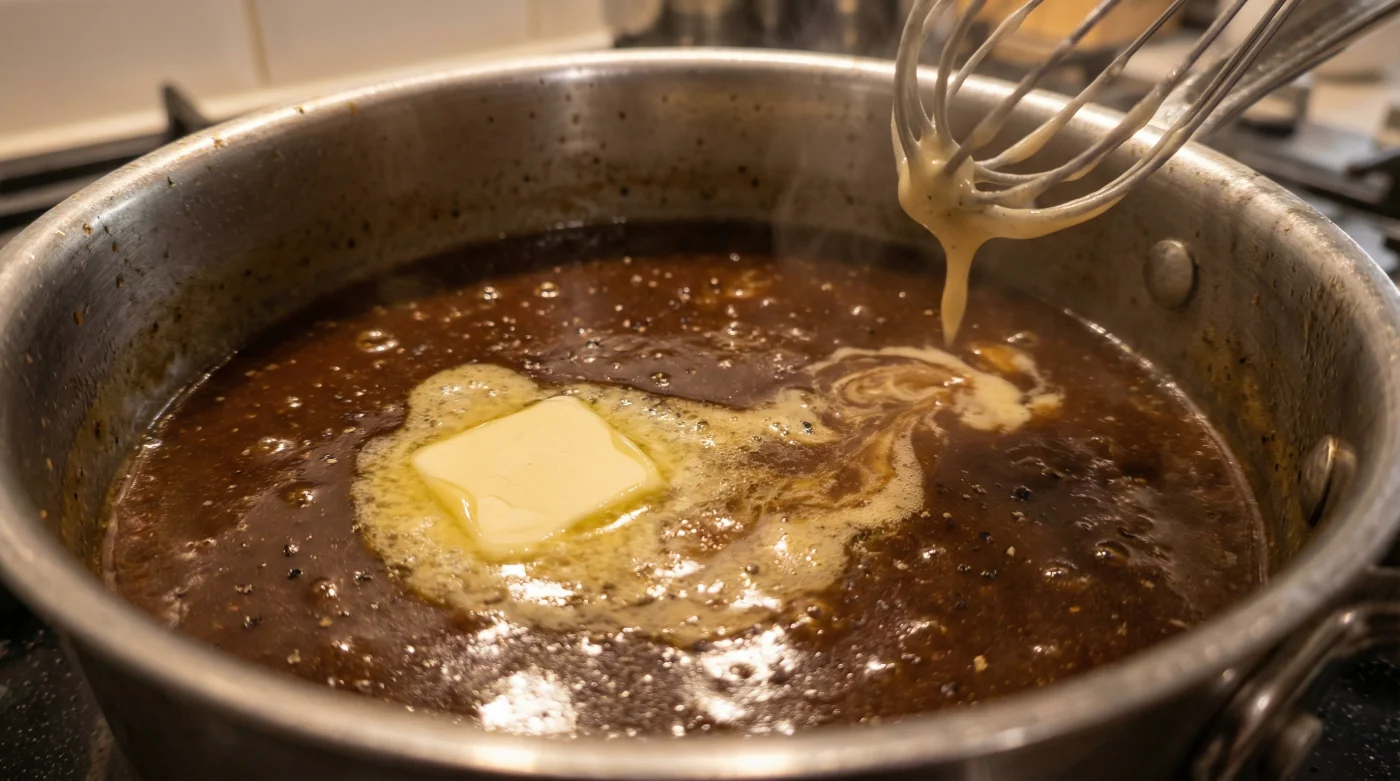
Think of a boiling gravy as a chaotic, crowded room. Applying more heat just moves the frantic energy around faster. By whisking in freezing cold butter entirely off the heat, you act as the calming architect. You are building a tight suspension, forcing the water and fat to hold hands rather than fight for space. This is the traditional French kitchen practice of ‘monter au beurre’, adapted for the Great British roast.
Meet Arthur Pendelton, a 46-year-old head chef at a Michelin-recommended gastropub in rural Somerset. Arthur oversees hundreds of Sunday services a month, serving a notoriously demanding local crowd. He never panics over a thin or split gravy during the rush. Instead, he keeps a small, frosted plastic tub of diced, unsalted butter in the blast chiller. When a sauce needs to go to the pass, he pulls the pan from the heat, drops in two frozen cubes, and whisks in tight, rigorous circles. ‘The butter melts slowly because it is freezing,’ he explains. ‘That slow melt releases milk solids gradually, wrapping around the meat juices to create a glaze so shiny you can check your reflection in it.’
Tailoring the Emulsion: Variations for Every Roast
Not all roasting juices behave identically in the pan. A rib of beef leaves behind a drastically different environment to a crown of turkey, and your cold-butter strategy must adapt accordingly.
For the Beef Traditionalist
Beef fat is heavy, distinct, and prone to separating if left unattended. When deglazing your roasting tin with red wine and beef stock, you want a robust, commanding finish. A single frozen cube of unsalted butter dropped into the resting liquid tames the aggressive irony tang of the red meat. The fat rounds out the harsh tannins of the wine, leaving a velvet texture that coats a Yorkshire pudding without turning it to immediate mush.
For the Poultry Purist
Chicken and turkey gravies are delicate by nature. They often turn out a pale, anaemic yellow if relying solely on the roasting juices. Here, the technique offers a different kind of salvation. Before taking the gravy off the heat, ensure you have reduced it by at least a third to concentrate the pale juices. Whisking the cold butter into this lighter base thickens it artificially, giving the illusion of a sauce that has been simmering for days. It provides a creamy opacity that turns a simple chicken dinner into a luxurious event.
For the Plant-Based Plate
Vegetarian or vegan gravies often lack body entirely, as they miss the natural gelatine provided by animal bones. You can achieve the exact same mirrored finish using a high-quality, plant-based block butter. Use a firm vegan block straight from the freezer. Whisk it aggressively into your hot mushroom and onion reduction. Because plant fats melt differently, you must agitate the pan constantly until the liquid transforms into a rich, glossy syrup.
Mindful Application: The Three-Minute Finish
The execution of this technique requires focus, not panic. It is a moment of quiet chemistry at the very end of a chaotic cooking session.
You must step away from the roaring heat of the hob. Take a deep breath and clear a small space on your worktop. This is where you transform the mundane into the exceptional.
- Ensure your gravy is fully strained of any lumps, onions, or herb stalks. You want a smooth canvas.
- Take the pan completely off the heat source. Do not attempt this while the liquid is bubbling, or the butter will simply melt into a greasy slick.
- Drop in your freezing cold, diced butter (roughly 20g per 500ml of liquid).
- Whisk continuously in a figure-of-eight motion until the butter has completely vanished and the surface trembles perfectly.
- Serve immediately in a warmed jug. Do not reheat it, or the emulsion will break.
The Tactical Toolkit: You will need a heavy-bottomed saucepan (which holds ambient heat well), a balloon whisk, and unsalted butter diced into 1-inch cubes and left in the freezer for at least thirty minutes prior to serving.
The Bigger Picture: Quiet Confidence at the Table
There is a profound, quiet satisfaction in placing a jug of flawlessly glossy sauce in the centre of the dining table. It is the final signature on a meal that took hours to curate. Mastering this one physical reaction shifts your relationship with the kitchen.
It moves your role from someone frantically managing timers and scraping burnt bits from a roasting tin, to someone who quietly commands the ingredients. You control the final texture, ensuring that every slice of meat and roasted root vegetable is coated beautifully. It is a reminder that professional results do not always require professional equipment; they merely require an understanding of how temperature and fat dance together in the pan.
The mark of a seasoned cook is not the complexity of their recipe, but their ability to rescue a sauce with nothing more than temperature and timing.
| Key Point | Detail | Added Value for the Reader |
|---|---|---|
| The Thermal Shock | Adding freezing butter to off-heat gravy. | Prevents the sauce from splitting into an oily mess. |
| The Visual Glaze | Milk solids act as an emulsifier to bind water and fat. | Produces a restaurant-quality mirrored shine on the plate. |
| The Flavor Smoothing | Unsalted butter rounds out harsh tannins or salty stock. | Creates a perfectly balanced, velvety mouthfeel. |
Common Gravy Queries Resolved
Why must the butter be freezing cold?
Cold butter melts slowly, releasing its milk solids gradually to build a stable emulsion. Room temperature butter will melt instantly and separate into a greasy layer.Can I use salted butter instead?
It is highly recommended to use unsalted. Roasting juices and stock are already heavily seasoned; adding salted butter at the end risks ruining the salt balance of the entire dish.What if my gravy breaks and separates anyway?
If it splits, you applied too much heat. Add a teaspoon of boiling water and whisk furiously off the heat to coax the fat and water back together.Does this work with granules or instant gravy?
Yes. Even a basic instant gravy can be vastly improved by whisking in a cold knob of butter at the very end to give it a fresh, glossy finish.How long will this emulsion hold?
It will hold beautifully for the duration of a meal if kept in a warm (not boiling) jug. If it cools completely, it will solidify slightly due to the butter content.