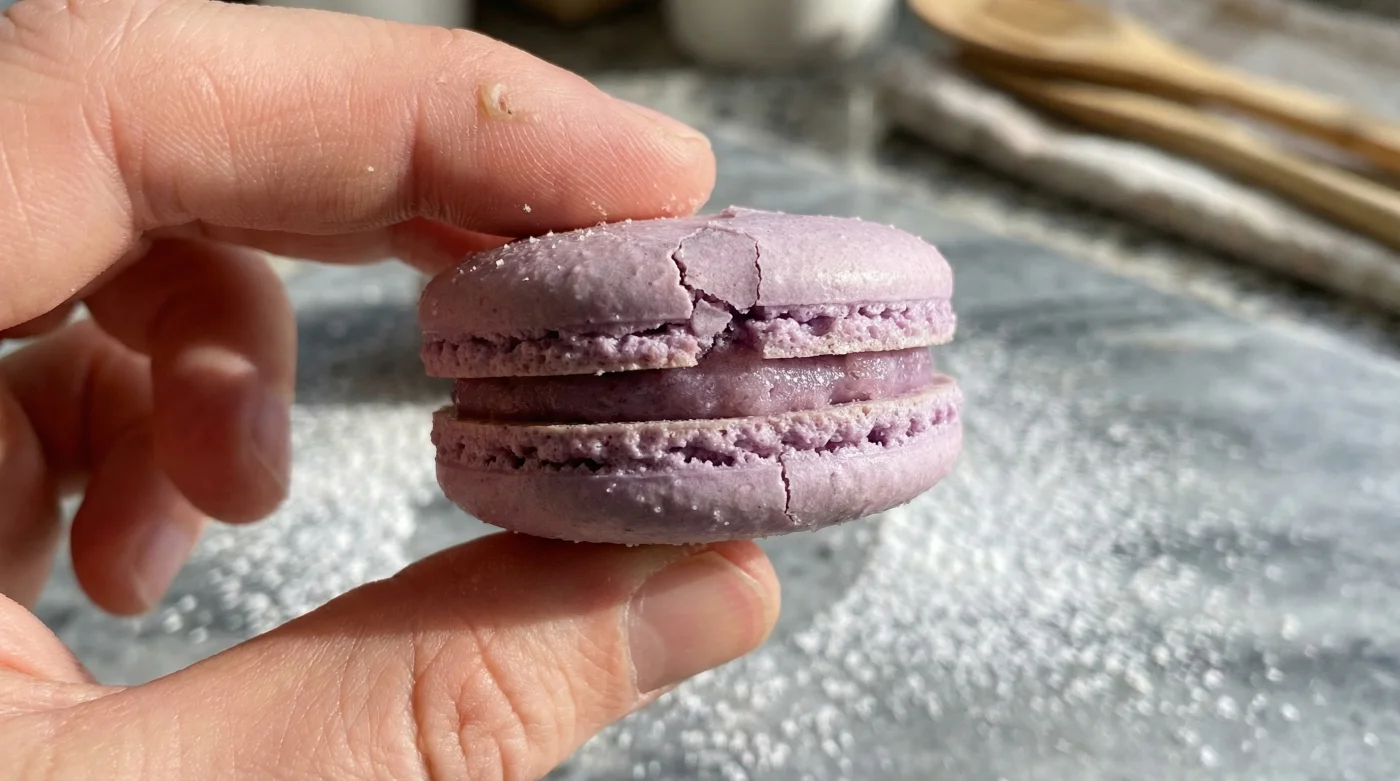
You stand in your kitchen, the scent of toasted almonds hanging warmly in the air. You rhythmically tap the heavy metal baking sheet against the worktop, listening to the sharp, echoing clatter. This simple action is designed to coax trapped air bubbles out of those tiny, pale circles of batter resting on the parchment. You watch them intently, holding your breath, already anticipating the anxiety of the oven.
The French macaron carries a formidable, almost intimidating reputation across the culinary world. It demands an absolute, unwavering precision, from the aggressive sifting of your almond flour to the exact folding technique known as macaronage. Yet, despite following every recipe to the gram, you often pull out a tray of shattered, footless biscuit shells.
The natural instinct is to fiercely blame your own technique. You suspect your oven temperature is lying to you, or perhaps you folded the batter three times too many. So, you start over. You buy the absolute freshest, free-range eggs from the local farm shop, operating under the logical assumption that premium, freshly laid quality equals a flawless bake.
This is exactly where the quiet heartbreak begins. The secret to those perfectly domed, crinkled-edged bases is deeply counterintuitive, lying entirely in the deliberate neglect of ingredients.
The Science of Neglect: Why Stale is Superior
Think of a completely fresh egg white like a tightly wound, highly tensioned spring. It is incredibly plump, heavily laden with water, and bound by rigid, stubborn proteins. When you whip this fresh white immediately into a meringue, the resulting structure is brittle and fragile. As the macaron bakes, the trapped water turns to steam. Because the fresh protein structure cannot stretch, that steam violently escapes, ripping right through the delicate, glossy top crust of your hard work.
The elegant solution is an old patisserie technique widely known as liquefaction. By carefully separating your eggs and leaving the whites in a pristine glass bowl, entirely uncovered in the back of the fridge overnight, you allow vital water to evaporate. The whites relax, concentrate, and subtly dehydrate.
This evaporation is exactly what ensures stability. The proteins lose their stubborn rigidity and become deeply flexible. They form an elastic net that captures the air from your whisk and holds it tight. When this aged meringue meets the heat of the oven, it expands gently, pushing upward to form that iconic ruffled base—the feet—without ever breaking the smooth surface above.
Julien, a 54-year-old pastry chef running a flour-dusted, wildly popular basement bakery in Soho, treats this resting phase as a strict religion. He often prepares his whites up to three days in advance, storing them in vast metal bowls near the cold fans. ‘A fresh egg white wants to fight you,’ Julien explains, gently swirling a bowl of slightly yellowed, watery whites. ‘You want the proteins to completely lose their fighting spirit before you even introduce the sugar.’ By starving the whites of their water content, Julien guarantees a flexible meringue that reliably stretches under the aggressive heat of commercial ovens.
Adjustment Layers for Every Kitchen Environment
Because no two home kitchens share the exact same microclimate, understanding how to handle your aged whites requires a little thoughtful nuance. The baseline rule remains absolute: never use eggs straight away. How you approach the resting phase, however, depends entirely on your specific circumstances.
For the Traditional Purist
You prefer the classic French meringue method, which relies solely on whipping cold, granulated sugar directly into the raw whites. Aged whites are entirely non-negotiable for this method. After a strict 24-hour resting period uncovered in the fridge, you must bring them back to room temperature for exactly two hours before a whisk ever touches them. The resulting meringue will behave beautifully, feeling remarkably like dense shaving foam—matte, stable, and incredibly resilient against almond flour.
For the Damp British Kitchen
The UK weather rarely cooperates with delicate continental baking. If the air feels thick, humid, and rainy outside, your dry almond flour will passively absorb moisture from the room. To successfully counter this environmental sabotage, age your egg whites for a full 48 hours. This aggressive dehydration acts as an insurance policy against ambient humidity, ensuring your piped batter forms a dry, protective skin quickly, regardless of the dampness outside your window.
For the Impatient Weekend Baker
If you only decided to tackle this project early this morning, you can technically force-age your whites, though it requires intense care. Microwave the separated whites in short, ten-second bursts on the lowest possible power setting until they barely reach human body temperature. It lacks the gentle, natural protein breakdown of true cold-ageing, but it successfully burns off enough surface water to significantly improve your chances of developing a clean, even foot.
The Tactile Routine: Building the Perfect Shell
Mastering this biscuit is far less about rigid obedience to a timer and vastly more about deeply reading the bowl in front of you. Approach the folding process with quiet observation, focusing closely on how the batter behaves physically under your silicone spatula.
- Separate your eggs into a pristine, grease-free glass or metal mixing bowl. Avoid plastic entirely, as microscopic, hidden oils will instantly collapse your fragile foam.
- Cover the bowl with a single, breathable layer of kitchen roll secured with a tight elastic band. This keeps wandering dust out while freely letting the internal moisture escape into the dry fridge air.
- Leave the bowl entirely undisturbed in the fridge for a minimum of 24 to 48 hours.
- Bring the resting whites out onto the counter exactly two hours before your planned baking time. They must lose their cold chill completely to whip to their maximum possible volume.
- Whip the sugar and whites until the glossy meringue forms a peak that resembles a small bird’s beak—sturdy and firm at the thick base, but slightly drooping at the very tip.
During the macaronage, press the batter firmly against the sides of the bowl to knock out the larger air pockets. You are aiming for a consistency that flows off the spatula like thick, molten lava, settling back into the bowl and disappearing into itself within exactly ten seconds. The Tactical Toolkit: Keep your oven steady at 140 degrees Celsius on a low fan setting. Bake for roughly 13 to 15 minutes. Always opt for heavy-duty, light-coloured aluminium baking sheets, as they distribute the heat smoothly and steadily, preventing lopsided or burnt bases.
Finding Quiet Peace in the Process
There is a strange, profound comfort in learning to successfully step back and wait. In modern baking, we are constantly rushed, subtly taught that the fastest, most immediate result is inherently the most desirable. Yet, this delicate, notoriously fussy little biscuit forces you to pause, to strategically plan for tomorrow, and to trust deeply that time will accomplish the heavy lifting your hands simply cannot.
Relinquishing the exhausting need for immediate perfection fundamentally changes how you approach the kitchen. Once you quietly accept that letting the raw ingredients sit and rest is a highly professional, crucial technique, the gripping anxiety of staring through the oven door completely melts away. You simply pipe your smooth circles of batter, confidently slide the heavy tray onto the middle rack, and watch the magic predictably unfold.
The ruffled feet will rise from the baking parchment, sturdy, even, and proud. The delicate top domes will remain perfectly smooth, glossy, and entirely unblemished. You haven’t merely managed to follow a set of instructions; you have actually learned to speak the physical language of the ingredients, brilliantly turning a notorious culinary struggle into a reliable, deeply satisfying weekly ritual.
A macaron shell is not built in the oven; it is built in the quiet hours of the night before, while the egg whites sleep.
| Key Point | Detail | Added Value for the Reader |
|---|---|---|
| Aged Whites (Liquefaction) | Resting egg whites uncovered for 24-48 hours. | Evaporates water, preventing hollow shells and cracked tops. |
| Room Temperature | Allowing aged whites 2 hours on the counter before whipping. | Ensures the meringue whips up faster and remains highly stable. |
| Aluminium Trays | Using thick, light-coloured metal baking sheets. | Reflects heat properly, guaranteeing even feet development. |
Frequently Asked Questions
Is it safe to leave egg whites uncovered in the fridge?
Yes, the high protein and alkaline nature of raw egg whites make them highly resistant to bacterial growth, especially at cold fridge temperatures.
Will the whites absorb fridge smells?
Covering the bowl with a breathable paper towel stops them from taking on the scent of last night’s leftover curry while still allowing moisture to escape.
Can I use pasteurised carton egg whites instead?
Carton whites are pasteurised at high heats, which heavily damages the vital proteins needed to safely build a strong meringue structure. Always separate fresh eggs yourself and age them.
What if my macarons still crack after ageing the whites?
Check your resting time after piping. The shells must sit securely on the counter until they form a dull skin that doesn’t stick to your finger when lightly touched.
How long do the finished shells keep?
Once filled, they mature beautifully in the fridge for 24 hours, soaking up the flavour, and can be frozen safely in an airtight container for up to three months.