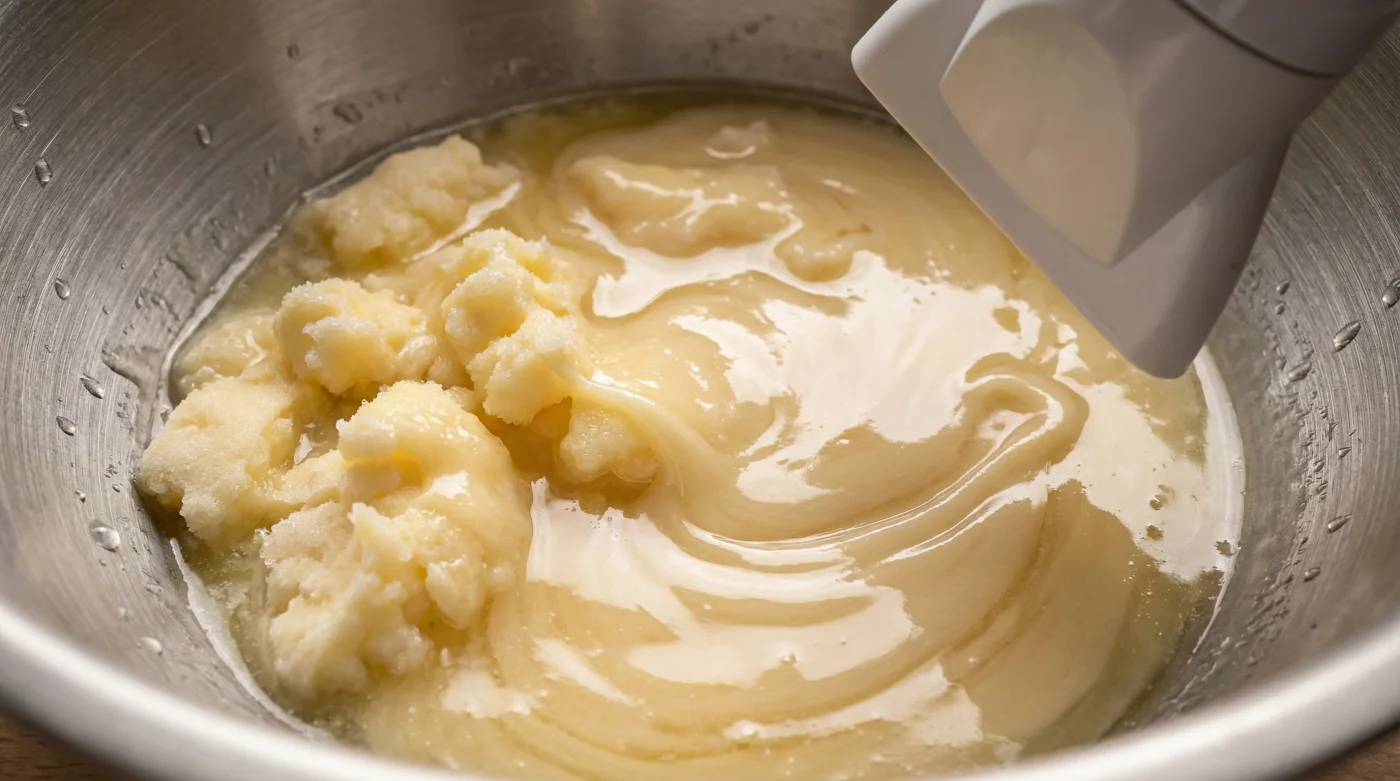
The mixer hums a steady, rhythmic mechanical song against the kitchen counter. You are anticipating a smooth, pillowy cloud of icing to crown your carefully baked Victoria sponge. The scent of vanilla bean paste lingers in the air, promising a perfect, comforting afternoon reward.
Then, you peer into the stainless steel bowl and your heart sinks. Instead of silken perfection, the mixture has curdled violently. It resembles scrambled eggs weeping thin liquid, a distressing sight that triggers an immediate, sinking sense of culinary panic.
The immediate reflex is often destructive. You consider scraping the entire ruinous mess straight into the food caddy, mourning the loss of a pound of good British butter and half a bag of icing sugar. Alternatively, you might be tempted to furiously pour more dry ingredients into the bowl, hoping to soak up the wayward moisture.
Both instincts are entirely wrong. What you are witnessing is not a ruined bake, but a temporary temper tantrum of physics. You merely need a gentle shift in temperature to coax the unruly ingredients back together.
The Perspective Shift: Mending the Broken Truce
Think of buttercream not as a simple mixture, but as a fragile truce between fat and liquid. Butter is largely fat with a little water; your milk, cream, or egg whites bring more water to the party. When the environment drops too cold, the butter fats tense up, solidifying and entirely refusing to embrace the liquid.
This creates the dreaded split. Throwing more icing sugar at the problem is like throwing sand at a brick wall. It only creates a gritty, overly sweet paste that entirely ruins the delicate mouthfeel you originally set out to achieve.
The solution contradicts everything you might assume about following recipes rigidly. You do not need a different ratio of ingredients; you need to understand the physical state of the emulsion. By applying highly targeted, gentle external warmth, you relax the fat molecules just enough for them to swallow the errant liquid once more.
Enter Eleanor, a forty-two-year-old pastry chef who runs a bespoke cake business from a perpetually drafty converted barn in the Cotswolds. During the freezing winter months, her elaborate batches of Swiss meringue buttercream would routinely curdle as the cold air struck the metal mixing bowls. Rather than binning twenty quid worth of premium organic butter, she keeps a battered travel hairdryer permanently plugged in by the ovens. It is never completely lost, she reassures her panicked apprentices, aiming the warm air at the spinning bowl, it just needs a gentle, coaxing mechanical nudge to remember how to behave.
Her wisdom changes the entire landscape of home baking. You stop seeing a curdled bowl as a personal failure and start treating it as a system that simply requires a little mechanical adjustment.
Adjustment Layers: Reading Your Specific Bowl
Not all frosting responds at the exact same speed. You must observe the unique temperaments of the ingredients you have chosen to whip together. The baseline rule of applying warmth remains constant, but the timing shifts entirely based on your chosen fatty base block.
For the traditional purist creating standard American buttercream, combining softened butter and icing sugar usually splits because a splash of milk came directly from the fridge. The correction here is incredibly swift, often taking mere seconds of heat to right itself.
For the meringue master creating Swiss or Italian variations, the process is notoriously dramatic. When the cold butter hits the whipped egg whites, the temperature plummets, causing a terrifying, lumpy soup. Do not lose your nerve; keep the mixer running and let the hairdryer work its slow, invisible restorative magic over a minute or two.
For the plant-based baker, vegan butter blocks possess a drastically narrower melting window than dairy. You must watch the bowl incredibly closely, as vegan fats will rapidly transition from solid to a greasy puddle if exposed to heat for too long.
Mindful Application: The Resuscitation Technique
The process of fixing your frosting should be a mindful, deliberate act. Do not blast the bowl on the highest heat setting in a rush. You want to create a diffuse, gentle warmth, as if the metal is resting in afternoon sunlight.
Approach the stand mixer calmly. The goal is to soften the bowl’s edges, melting just enough butterfat to act as a bridge for the rest of the colder mixture to cross.
- Turn your hairdryer to a medium heat and a low or medium fan speed.
- Direct the nozzle at the bottom third of the metal or glass bowl while the paddle attachment continues to beat.
- Keep the appliance moving slowly back and forth to prevent a concentrated hot spot from entirely liquifying one side.
- The moment the edges of the mixture begin to glisten and pull away cleanly, switch off the heat and let the friction of the mixer finish the job.
Your tactical toolkit for this technique is remarkably minimal. The ideal butter temperature for a perfect emulsion sits right around nineteen degrees Celsius. Hold the hairdryer roughly six inches away from the surface of the bowl. Trust your eyes over the clock; the glossy transformation happens rather suddenly.
Finding Peace in the Pantry
Baking has a reputation for demanding rigorous perfection, but true culinary confidence comes from knowing how to recover. When you stop fearing a split emulsion, the kitchen shifts from a place of stress to a safe space for creation.
Understanding the science behind the ingredients grants you a deep, satisfying control over the process. You are no longer blindly following words on a page; you are reacting intuitively to the physical reality in front of you. It is a quiet revelation to watch a lumpy, weeping mess transform back into perfectly smooth, whipped silk.
You save your money, you save your ingredients, but most importantly, you protect your peace of mind and your afternoon tea. You walk away with a richer understanding of the craft, ready to tackle the next culinary hurdle with absolute, quiet assurance.
Baking is mostly physics wrapped in sugar; warm the fat, and the magic returns.
| Method | The Science | Added Value for the Reader |
|---|---|---|
| Throwing it away | Absolute loss of emulsion | None. Causes frustration and wastes expensive British butter. |
| Adding more icing sugar | Attempts to manually soak up excess water | Results in a gritty, overly sweet mess that ruins the texture. |
| Gentle Hairdryer Heat | Melts butterfat just enough to re-emulsify | Restores perfect silkiness in under a minute, saving the bake. |
Frequently Asked Questions
Why does buttercream curdle in the first place? It happens when the fat is too cold to absorb the liquid, causing the fragile emulsion to break under pressure.
Is it safe to use a hairdryer near food? Yes, provided you use a clean nozzle and keep it at least six inches away from the outside of the bowl.
Can I use a microwave instead? You can microwave a tiny portion of the frosting and whip it back in, but the hairdryer method offers far greater, gradual control without dirtying another dish.
Will this work on vegan butter? Yes, but vegan fats melt much faster. You must apply heat very sparingly to avoid turning the block into oil.
What if I over-melt the mixture? If it turns to soup, simply place the bowl in the fridge for fifteen minutes to chill the fats, then whip it again.