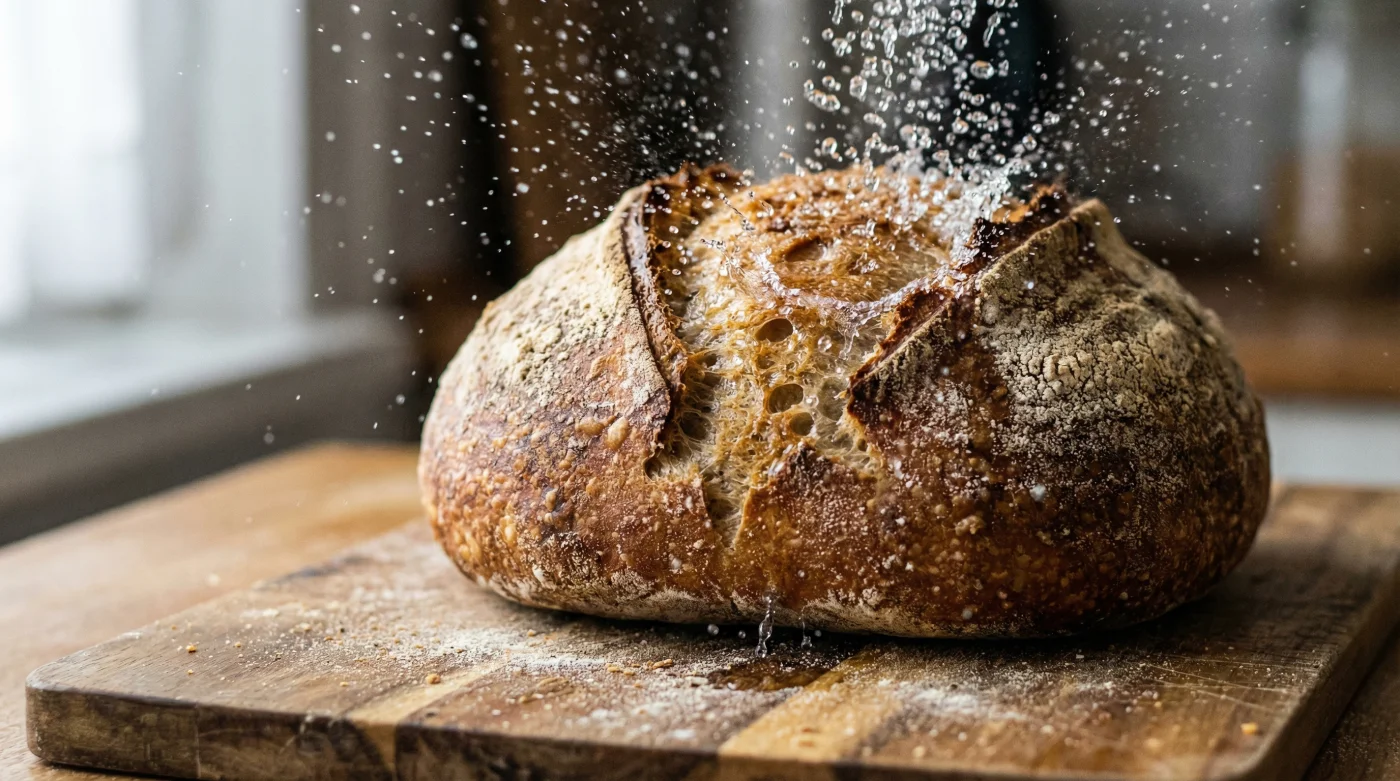
The morning light hits the kitchen worktop, illuminating a five-pound artisan sourdough sitting stubbornly on the wooden chopping board. Bought three days ago, it was a fragrant masterpiece of blistered crust and yielding, open crumb. Now, it resembles a geological artifact, resting heavy and cold, resisting the serrated blade with utter hostility.
The instinct, conditioned by years of dealing with supermarket sliced loaves, is to quietly slide the whole thing into the food waste bin. It feels like a small tragedy, discarding naturally fermented flour and water that took a baker seventy-two hours to coax into life. Guilt accompanies the thud as it hits the bottom of the compost caddy.
But that rock-like exterior is lying to you. The starchy matrix inside hasn’t vanished or spoiled; it has merely crystallised, locking up the remaining moisture in a microscopic fortress. By introducing a deliberate splash of cold tap water and a sudden burst of high heat, you can force the bread to breathe again.
You are about to execute a surprisingly brutal kitchen fix, turning external moisture into crust-reviving steam, and reversing the ageing process of your loaf in under ten minutes.
The Architecture of Stale Crumb
To rescue your sourdough, you must first stop treating it like a perishable vegetable and start treating it like a sleeping sponge. The stiffening of bread, a process bakers call retrogradation, is not the loss of moisture, but the relocation of it. The starches that gave your fresh slice that beautiful, bouncy texture have simply reorganised themselves, braiding their arms together against the cold air of your kitchen.
What looks like a fatal flaw—the impenetrable crust and the dense, unyielding interior—is actually a remarkably stable holding pattern. The structure is fully intact, merely waiting for the right environmental triggers to loosen its grip.
Water acts as a plasticiser. When you run a stale crust directly under a tap, the moisture sits on the surface. As it enters a hot oven, that surface water instantly flashes into steam. The steam penetrates the porous crust, heating the interior rapidly while rehydrating the starches, causing them to melt back into a gel. The bread practically resuscitates itself.
The Cornish Baker’s Morning Ritual
Thomas Aris, a forty-one-year-old baker who runs a wood-fired micro-bakery on the rugged coast near Newquay, views stale bread not as waste, but as an occupational reality waiting for a solution. Arriving at the bakery at three in the morning, he often finds the display loaves from the previous day sitting stiffly on the cooling racks. Instead of tossing them to the local gulls, Thomas takes a hardened boule, holds it directly under the cold running tap in the sink until it is dripping wet, and throws it straight into the residual heat of his brick oven. “Bread remembers how to be fresh,” he notes, pulling out a steaming, crackling loaf five minutes later. The crust is thin and shattering once more; the crumb is warm and trembling, indistinguishable from the day it was baked.
This technique is the quiet backbone of professional kitchens across the country, saving thousands of pounds in waste while guaranteeing a perfect table service. Moisture and heat command memory, forcing the baked dough back to its peak state.
Tailoring the Resuscitation
Not all stale bread suffers equally, and your intervention must match the state of the loaf. Treating an uncut boule the same way you treat a single, hardened slice will end in either a sodden mess or a charred puck.
For the untouched, rock-hard boule, you require total immersion. Fearlessly drench the exterior, ensuring every square inch of the crust is weeping with tap water. Do not worry about ruining the bread; the tight crust acts as a temporary shield, preventing the interior crumb from turning to pudding.
For the half-eaten loaf, where the exposed crumb is facing the open air, a targeted approach is necessary. Cupping water in your hands and splashing it exclusively over the intact crust works best. Keep the open, sliced end as dry as possible, or it will steam into a sticky paste. If the exposed crumb is heavily dried out, lightly misting it from a distance is permissible, but moderation is key.
For individual slices that have turned to rusks overnight, skip the running tap. Wrap them in damp paper, pressing the wet towel gently against the stiff crumb, and rely on a gentler heat to coax them back to life without drying them out further.
The Five-Minute Revival Protocol
This is a tactical intervention. You do not need precise measurements, only a mindful approach to temperature and timing. The goal is rapid steam generation followed by a brief period of crust re-crisping.
- Preheat aggressively: Bring your oven to 200°C (180°C Fan / Gas Mark 6). Do not attempt this in a cold oven, or the bread will simply sit and soak.
- The Splash: Hold your loaf under the cold tap for three to four seconds. Shake off the excess water so it is gleaming but not dripping puddles.
- The Bake: Place the wet loaf directly onto the middle wire rack. No baking sheet is required; you want the hot air to circulate entirely around the crust.
- The Listen: Leave it for six to eight minutes. You will hear the bread hissing as the water vaporises. Once the crust feels firm and sounds hollow when tapped, pull it out.
- The Rest: Let it sit on the worktop for two minutes. The residual internal steam will finish softening the core.
This toolkit is your insurance policy against forgotten kitchen provisions. Mastering this simple protocol eliminates the morning panic of finding nothing but a brick of sourdough for breakfast.
The Quiet Rebellion of Repair
There is a profound, grounding satisfaction in taking something entirely unworkable and restoring it to its former glory. In a culture conditioned to replace rather than repair, forcing a lifeless loaf of artisan bread to breathe again feels like a minor domestic victory. You are not just salvaging a five-pound investment; you are honouring the agricultural labour, the fermentation time, and the craft that produced it.
When you slice into that revived sourdough, watching the wisp of steam rise from a crumb that only minutes ago felt like concrete, your relationship with your pantry shifts. Waste becomes a choice, rather than an inevitability. The kitchen becomes a place of renewal, where even the most stubborn, forgotten remnants can be granted a brilliant, delicious second act.
“A hardened loaf isn’t dead; it has simply locked its doors to the world. A splash of water and a blast of fire is how you politely knock and ask it to open back up.”
— Thomas Aris, Head Baker
| Key Point | Detail | Added Value for the Reader |
|---|---|---|
| The Water Splash | Running stale crust directly under a cold tap for 3-4 seconds. | Provides the exact external moisture needed to create crust-reviving steam in the oven. |
| High Heat Blast | Baking at 200°C (180°C Fan) directly on the wire rack. | Forces rapid water vaporisation, softening the crumb without turning the loaf soggy. |
| Targeted Hydration | Protecting exposed crumb on half-eaten loaves while wetting the crust. | Prevents gummy, ruined interiors when reviving partially consumed sourdough. |
Common Curiosities Addressed
Can I use this method on supermarket sandwich bread?
No. Mass-produced sandwich bread lacks the robust crust structure to survive a direct watering; it will dissolve into mush.Will the bread stay fresh for another day after reviving?
Unfortunately not. The resuscitation is a temporary intervention. You must consume the revived bread within a few hours before it retrogrades again, often faster than before.What if my sourdough is already pre-sliced?
Do not put it under the tap. Wrap the stiff slices in a damp paper towel and place them in the oven, or simply use a toaster on a lower heat setting.Is it safe to wet the bread if there is slight mould?
Absolutely not. Staleness is structural, but mould is biological. If you see any mould, bin the loaf entirely, as the roots penetrate deep into the crumb.Should I use cold or hot water for the splash?
Cold tap water is ideal. It sits on the surface of the crust perfectly until the high heat of the oven forces it to turn into steam.