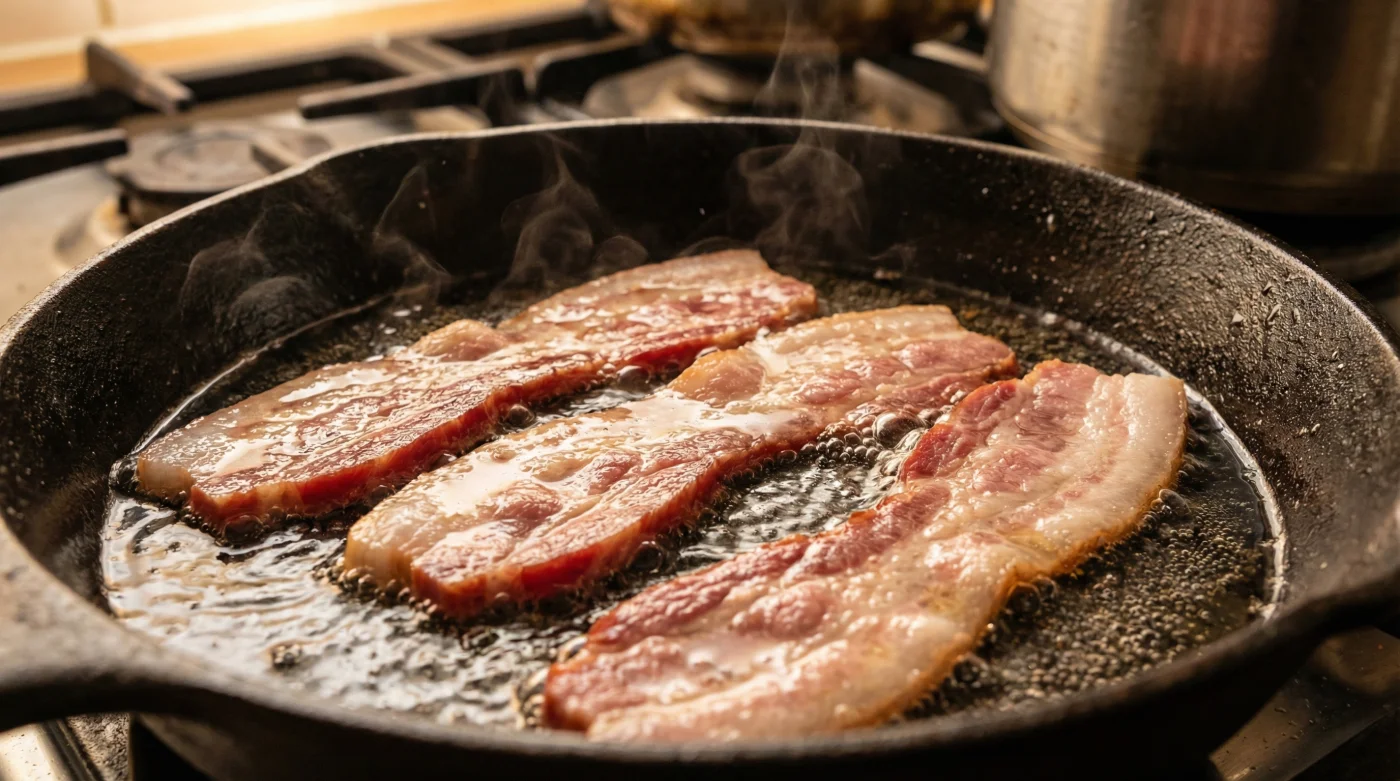
Morning light hits the kitchen counter. You peel apart the packaging of properly dry-cured pork, the faint scent of woodsmoke and salt lingering in the quiet air. You heat the heavy frying pan on the hob until it radiates a steady, expectant warmth, anticipating that familiar, comforting sizzle. You lay the meat down, expecting a flat, golden finish that mirrors the breakfasts served in grand hotels.
But almost immediately, the violent protest begins. The edges curl stubbornly, warping the meat into rigid, unmanageable waves. You press it down with the flat edge of a spatula, holding it against the hot iron, but the structural damage is already done. One side chars too quickly, while the thick fatty eye remains pale, flabby, and completely unrendered.
We accept this as the inevitable reality of cooking a fry-up at home. We assume the fault lies with the meat itself, perhaps containing too much water from the curing process, or we blame a lack of heavy cast-iron presses like those used in professional, high-volume diners. Yet, the finest breakfast chefs aren’t wrestling with their ingredients at six in the morning.
The professional pivot is shockingly simple and requires no extra equipment, completely rewriting the chemistry of your morning pan. A few tablespoons of tap water transforms the entire process. It sounds entirely counterintuitive to introduce liquid to a frying process, but a shallow puddle is the exact, mindful method needed for restaurant-quality consistency without the shrinking.
Coaxing the Fat Rather Than Shocking the Muscle
To understand why this technique is so effective, you have to look at the physical structure of what you are actually cooking. A rasher is essentially a laminated strip of tense lean muscle and dense fat. When exposed to immediate, aggressive heat from dry iron or hot oil, these two distinct textures react at entirely different, conflicting speeds.
Hot oil makes the meat curl instantly. The lean muscle fibres seize and shrink in a fraction of a second, snapping tight like a coiled spring. However, the fat needs significant time and gentle heat to break down and melt. This internal tug-of-war is what distorts the shape, pulling the ends violently up and away from the heat source.
Starting in cold water completely dismantles this biological conflict. The shallow pool acts as a thermal buffer, regulating the temperature climb of the metal. As the water slowly comes to a gentle simmer, it lightly steams the muscle tissue, keeping the protein structures relaxed and entirely pliable as they slowly warm through.
Meanwhile, the gentle, boiling heat perfectly targets the fat layers. By the time the water evaporates, the meat is peacefully sitting in its own pure, rendered liquid fat. The harsh shocking phase is skipped entirely. It fries evenly and smoothly across its entire surface, remaining completely flat without shrinking into a rigid, unappetising knot.
I first observed this watching Arthur Pendelton, a 62-year-old breakfast chef who runs a fiercely busy, unapologetically traditional cafe tucked away in a quiet corner of Manchester. While newer cooks were violently smashing their spatulas down on warped meat, Arthur calmly poured a small splash of water from a metal jug over his morning prep. He called the technique ‘breathing through a pillow’—softening the harsh shock of the raw heat so the pork could relax into the pan, yielding an impossibly flat, shatteringly crisp result every single time without losing an ounce of its intended size.
Tailoring the Technique to Your Chosen Cut
Naturally, not all pork is carved equal. The underlying technique remains identical, but the volume of your buffer needs to shift slightly depending on the specific profile of what sits on your chopping board.
Because streaky cuts carry a much higher ratio of dense fat to lean meat, they demand a more patient approach. For the Streaky Aficionado, you want the water to cover the base of the pan entirely, rising just to the top edge of the raw slices. This generous puddle gives that thick, rich marbling ample time to melt down into liquid gold before the harsh frying stage finally begins.
Then there is the traditional British favourite, the staple of the morning sandwich. Back bacon presents a slightly different challenge, as the large, prominent eye of lean loin can easily dry out and turn stringy if left to simmer for too long.
Precision is required to protect the loin. For the Back-Bacon Loyalist, you only need a faint shimmering layer of moisture—just enough to stop the initial curling upon contact with the pan. Keep the liquid incredibly minimal, allowing it to steam off within the first two minutes, protecting the lean meat while still rendering the narrow fat cap.
The Mindful Application Protocol
Transitioning to this method requires letting go of the urge to hear an immediate, aggressive sizzle. It is a quieter, far more observant way of cooking that relies on sensory cues rather than watching a clock.
You are listening closely for the transition point. The sound will distinctly shift from a rolling, bubbly simmer to a sharp, rhythmic crackle as the moisture disappears entirely and the frying phase automatically takes over.
Follow these precise, minimalist steps to establish your new morning routine:
- Place your cuts into a cold, dry frying pan, ensuring they sit flush against the metal without overlapping or crowding the edges.
- Pour in just enough cold tap water to coat the bottom of the pan—roughly two to three tablespoons for a standard batch of four.
- Set the hob to a medium heat and leave it alone; do not prod, press, or turn the meat while the water is visibly boiling.
- Once the liquid evaporates and the crackling sound begins, flip the meat once, cooking for a further minute until the fat turns a deep, translucent amber.
Your tactical toolkit for this method relies purely on restraint. Maintain a medium hob setting throughout the entire process; forcing a high heat will evaporate the buffer too quickly, defeating the purpose of the gentle render.
The Quiet Satisfaction of Getting It Right
Mastering this seemingly mundane kitchen detail shifts your entire relationship with morning preparation. It removes the quiet frustration of ruined, uneven breakfasts and replaces it with a deeply reliable, predictable sense of culinary success.
You no longer rely on brute force or heavy weights to force your food to behave. Understanding the underlying system—knowing exactly why the meat seizes and precisely how to disarm it—gives you total, effortless control over the final plate you serve to your family.
It turns a rushed, traditionally greasy chore into a deliberate, quiet act of care. You are no longer fighting the pan or accepting second-rate results. You are gently guiding the ingredients to their absolute best state, serving up plates that look intensely professional, born from nothing more than patience and a simple splash from the tap.
Patience and a thimble of cold tap water will do more for your morning cooking than the heaviest iron press in the world.
| Key Point | Detail | Added Value for the Reader |
|---|---|---|
| The Cold Start | Placing raw meat into a dry, cold pan before applying heat. | Prevents the immediate seizing of muscle fibres, preserving the original size of the cut. |
| The Water Buffer | Adding a shallow layer of tap water to regulate initial temperature. | Allows the dense fat to melt gently before the lean meat has a chance to burn or dry out. |
| The Auditory Cue | Listening for the simmer to shift into a sharp crackle. | Removes the guesswork from cooking times, telling you exactly when the frying phase has begun. |
Frequently Asked Questions
Will boiling the meat make it soggy or rubbery?
Not at all. The water evaporates entirely during the process, leaving behind only pure, hot rendered fat to fry the exterior to a perfect crisp.Does this method work for smoked and unsmoked varieties?
Yes, the structural science applies to both. However, smoked varieties will infuse the evaporating water with a wonderful, rich aroma as it cooks.Should I use a non-stick or cast iron pan?
Cast iron is vastly superior. It holds a steady, even temperature once the water evaporates, providing a much better crust than non-stick surfaces.How much water is too much?
If the meat is fully submerged and floating, you have added too much. You only want the liquid to touch the very bottom edges of the cuts.Can I keep the rendered fat afterwards?
Absolutely. Because the fat is rendered slowly without burning, the leftover drippings in the pan are pristine and perfect for roasting potatoes or frying bread.