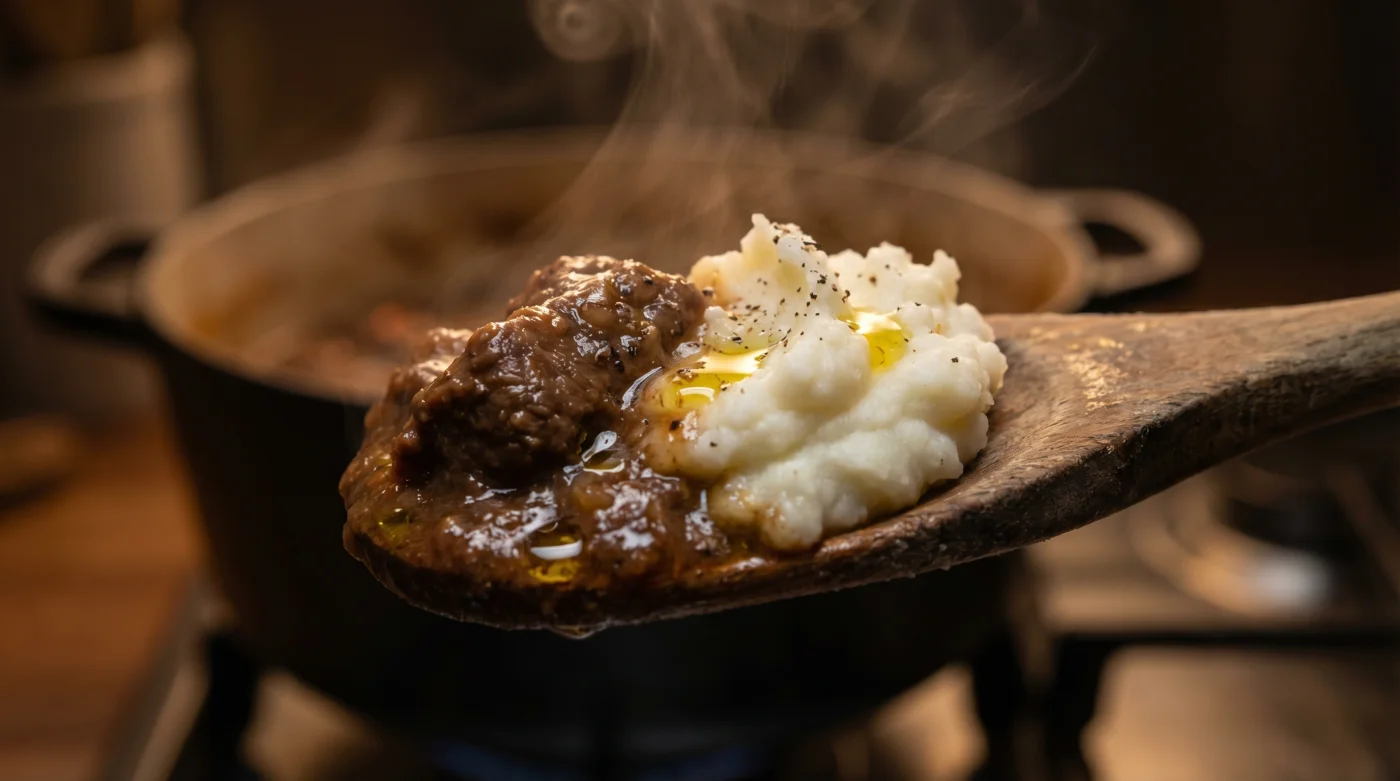
Rain lashing against the window pane, a heavy cast-iron pot simmering softly on the hob. The scent of roasted root veg and slow-braised shin of beef fills the kitchen. It is the sort of meal that promises a warm hug at the end of a long, damp Tuesday.
Yet, as you lift the wooden spoon to test the gravy, the liquid runs off the back like tap water. Instead of a rich, glossy coating, you face a thin broth that threatens to drown your careful prep and dilute the comfort of the evening.
The instinct is immediate. You reach into the dark recesses of the cupboard for the familiar yellow tin of cornflour, ready to mix a hasty slurry. But this chalky powder, whilst highly functional, inevitably dulls the deep, savoury notes you have spent hours building, leaving a faintly powdery ghost on the palate that lingers long after the meal is over.
There is a simpler, infinitely more sympathetic way to rescue the pot. The answer is likely sitting right next to your chopping board, waiting to bind the liquids seamlessly without a hint of artificial residue. A spoonful of leftover mashed potato is the kitchen fix you never knew you needed.
The Starch Symphony
Instead of viewing thickeners as a heavy blanket thrown over your cooking, think of them as an invisible scaffold. Processed cornflour acts like microscopic glass beads—it swells abruptly, creating a glossy but often gelatinous texture that mutes the vibrant acids of a good wine reduction or a splash of cider.
Mashed potato operates on a fundamentally different principle. The natural cellular structure of the tuber breaks down gently, releasing complex carbohydrates that behave like a melting sponge absorbing flavour. It does not mask the taste; it amplifies the inherent savoury character of the dish. This simple addition transforms a culinary disaster into a deliberate triumph, turning a watery mistake into a rustic, velvet-textured stew that feels intentionally slow-cooked.
Consider Arthur Pendelton, 62, who spent four decades working the stoves of busy gastropubs across the damp, wind-whipped Cotswolds. When a sudden rush of Sunday lunch orders left a massive batch of ale and mushroom pie filling dangerously thin, Arthur never reached for a tin of processed powder. He simply whisked a ladle of his buttery Maris Piper mash directly into the bubbling gravy. “Cornflour paints over the cracks,” he would say, wiping his hands on a flour-dusted apron, “but a good potato rebuilds the wall.” It was a trick born of sheer necessity, but it produced a sauce so remarkably silken that locals believed it was a highly guarded, multi-generational secret recipe.
Tailoring the Tuber
Not all stews require the exact same intervention. You can adapt this restorative technique depending on what sits in your larder and what simmers in your pot. Recognizing the variations ensures your gravy remains perfectly balanced.
For the Sunday Purist: If you are rescuing a classic beef and ale casserole, plain mashed potato is your strongest ally. Ensure it is entirely smooth before introducing it to the pan. A stray lump might look charmingly rustic, but a completely emulsified potato paste guarantees an invisible, luxurious thickening that rivals a professional restaurant jus.
For the Time-Starved Parent: When a midweek chicken and leek stew turns rebellious and watery, instant potato flakes are a surprisingly brilliant substitute for fresh mash. A solitary tablespoon scattered lightly over the surface and vigorously stirred will tighten the sauce in precisely sixty seconds. It is a pantry secret that bypasses the peeling, boiling, and mashing entirely, offering an immediate safety net when the children are demanding their tea.
For the Dairy-Free Cook: Should your leftover mash contain heavy cream or butter, be highly mindful of adding it to an intensely acidic tomato-based ragù, as the dairy might split under heat. In these delicate moments, simply crush a freshly boiled potato with a splash of the stew’s own cooking liquor before stirring it back into the fold, ensuring a clean, unbroken finish.
The Five-Minute Kitchen Fix
Executing this rescue mission requires a gentle touch rather than sheer force. The goal is to encourage the potato starches to swell and integrate without shocking the temperature of your dish or creating a gummy texture.
Rushing this process will only yield frustration. You must coax the starch into submission by deliberately matching its temperature to the bubbling liquid before fully combining the two elements.
- Extract a ladleful of the watery stew liquid into a separate, heat-proof bowl.
- Add two tablespoons of smooth, lump-free mashed potato to this reserved liquid.
- Whisk vigorously until the mixture resembles a thick, pouring cream, completely free of clumps.
- Slowly stream this tempered mixture back into the main pot, stirring constantly in a gentle figure-of-eight motion.
- Simmer gently for three further minutes to allow the starches to activate fully and banish any raw root vegetable notes.
Tactical Toolkit:
– Temperature: The stew must be at a rolling simmer (around 95°C) to activate the potato starch effectively.
– Tools: A small balloon whisk or a simple wooden fork for the tempering stage.
– Ratio: Start with 1 tablespoon of mash per 500ml of liquid; observe the consistency, then adjust as required.
A Quieter Confidence at the Stove
Cooking is rarely a straight line. Pots boil over, cuts of meat release unexpected amounts of water, and occasionally, the recipe in the book simply lies to you about reduction times. These minor crises are the reality of a working kitchen.
Leaning heavily on industrial, processed powders strips the intimacy from these moments. When you know how to heal a broken dish using only the natural ingredients already at your disposal, you stop reacting to the stove with panic and start responding with intuition.
Replacing cornflour with mashed potato is a quiet rebellion against the clinical precision of modern recipe culture. It is a reminder that the best solutions in the kitchen are usually rooted in thrift, patience, and a deep, practical understanding of natural chemistry. You are not just fixing a sauce; you are reclaiming control of your evening.
“A great sauce is an expression of its ingredients, not a hostage to artificial thickeners.”
| Key Point | Detail | Added Value for the Reader |
|---|---|---|
| Natural Emulsification | Potato starch bonds smoothly with cooking fats and water. | Prevents the gelatinous, ‘gloopy’ texture associated with over-thickened cornflour gravies. |
| Flavour Preservation | Acts like a sponge rather than a coating agent. | Maintains the sharp notes of wine and deep meaty flavours without a chalky residue. |
| Zero-Waste Strategy | Utilises leftover dinner components (mash) perfectly. | Saves money on processed thickeners whilst preventing food waste in the household. |
Kitchen Fix FAQ
Can I use cold, leftover mash straight from the fridge?
Yes, but always temper it first by mixing it with a ladle of hot stew liquid in a separate bowl. Adding fridge-cold mash directly to the pot will create stubborn lumps.Will this make my stew taste intensely of potato?
Not at all. The quantities used are small enough that the potato acts purely as a structural binder, absorbing the dominant flavours of the stew rather than imparting its own.What if my mash has a lot of milk and butter in it?
Dairy-rich mash adds a lovely silkiness to brown gravies, but avoid using it in highly acidic bases (like a heavy tomato sauce), as the dairy may curdle. Use plain crushed potato there instead.Can I freeze a stew thickened with mashed potato?
Absolutely. Unlike cornflour slurries, which can break and become watery upon thawing, natural potato starch holds its binding properties remarkably well in the freezer.Does this work for clear soups or just thick stews?
This method is best reserved for opaque, hearty stews and casseroles. If you want a perfectly clear broth or consommé, avoid potato, as it will naturally turn the liquid cloudy.