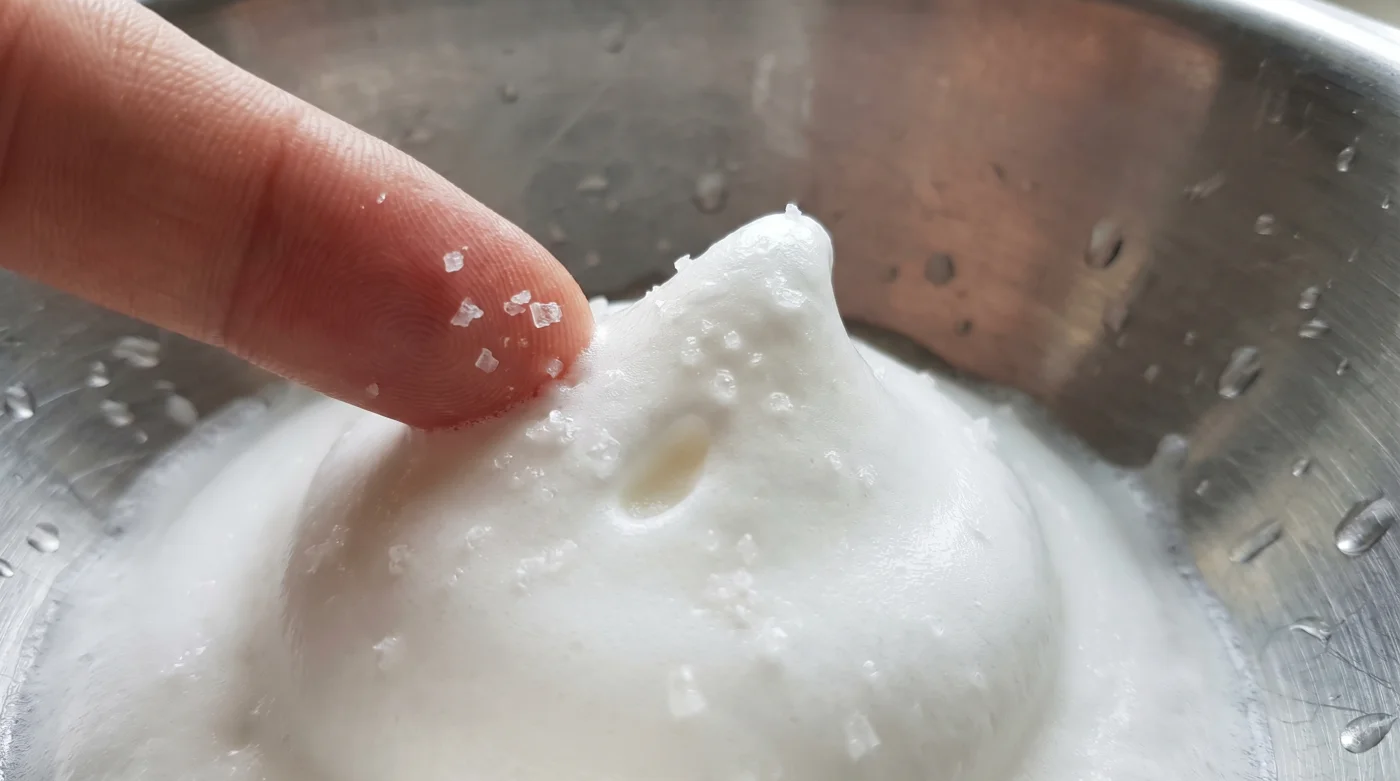
You stand at the worktop, the rhythmic metal-on-metal scrape of the whisk echoing through the quiet morning kitchen. Inside the stainless steel bowl, translucent liquid resists the motion, reluctantly giving way to a scattering of large, uneven bubbles. This is the nervous waiting game of the amateur baker, watching and hoping the fragile structure holds.
Generations of handwritten recipe cards dictate strict, uncompromising caution when dealing with this temperamental ingredient. You are told to wait for soft peaks, rain in the caster sugar with painstaking slowness, and never add salt until the very last second. Conventional wisdom insists that early sodium will draw out moisture and completely ruin the volume.
Yet, step into the prep area of a high-end patisserie before dawn, and you will witness a blatant disregard for this golden rule. The professionals are not nursing their ingredients with fear; they are commanding them with absolute scientific certainty. They understand that creating a towering, glossy meringue is an act of precise chemical manipulation.
Treating your delicate egg whites with excessive caution actually invites the collapse you fear. The key to a rigid, glossy foam that stands at attention does not lie in anxious waiting. It relies on a microscopic, deliberate disruption introduced before the whisk even begins to turn.
The Architecture of a Cloud
Imagine the proteins in your raw egg whites as tightly coiled balls of wool. In their natural state, they are curled up to protect their water-repelling centres from the surrounding moisture. To build a foam, you need these defensive coils to unwind, stretch out, and link arms to trap the air you are beating into the bowl.
This necessary unwinding process is called denaturation, and friction is a slow teacher. Relying purely on the mechanical force of a balloon whisk to bash those tight proteins into submission takes unnecessary time. The longer you beat the whites without structural support, the higher the risk of pushing them past their limit into a weeping, grainy mess.
When you drop a tiny pinch of fine sea salt into the bowl right at the start, you fundamentally change the microscopic environment. The sodium and chloride ions immediately interact with the tightly wound proteins, encouraging them to relax and unravel almost instantly without the need for aggressive force.
By boldly breaking the old rule, you accelerate the structural foundation of your bake. The salt acts as a microscopic wedge, easing the stubborn proteins apart so they can form a stronger, more resilient network around the air pockets, drastically reducing your total whisking time.
The Baker of Bodmin Moor
Elias Thorne, a fifty-eight-year-old pastry chef running a quietly acclaimed dessert bar on the edge of Bodmin Moor, watches his new apprentices make the same mistake every season. They treat the meringue base like fragile spun glass, holding their breath as they whisk. Elias, however, casually tosses a pinch of crushed sea salt into a massive bowl of raw whites, hits the power switch on the commercial stand mixer, and walks away to attend to his pastry cream.
He calls it waking the proteins up from their cold slumber. By introducing the salt immediately, Elias ensures the structural integrity of the foam is locked in before the first grain of sugar is even weighed. It completely removes the nervous prep tension from his morning routine, yielding flawless, glossy peaks that hold their shape for hours in a damp coastal kitchen.
Tailoring the Technique
For the Pavlova Purist
When building a crisp outer shell meant to hold heavily whipped double cream and sharp summer fruits, stability is your primary and most urgent concern. A proper pavlova must endure a massive sugar load without weeping a sticky puddle onto your baking parchment in the oven.
Adding your salt early gives the relaxing proteins the immediate strength to carry a heavy sugar load. The initial unwinding creates a tightly knit scaffolding, ensuring your caster sugar dissolves fully into the matrix rather than dragging the extracted moisture downwards into a sticky, dense puddle.
For the Savoury Soufflé Maker
Without the reinforcing presence of melted sugar, a savoury foam relies entirely on the raw strength of the egg whites to achieve that dramatic, fleeting height. You are asking the fragile proteins to do all the heavy lifting against the downward pull of gravity.
In this specific scenario, the early salt is a non-negotiable early structural requirement. It aligns the proteins so efficiently that the resulting foam possesses a rubber-like elasticity, expanding beautifully in the harsh oven heat without snapping under the folded weight of strong cheddar and thick béchamel.
Building the Unbreakable Foam
Implementing this technique requires a mindful shift in timing, rather than an investment in expensive equipment. You are simply rearranging the sequence of events to work in harmony with the chemistry of the bowl, rather than fighting blindly against it.
Begin with a meticulously clean, spacious mixing bowl. Any lingering trace of fat will coat the proteins and entirely prevent them from bonding with one another. Simply wipe the metal surfaces clean with a halved lemon to ensure absolute purity before you crack your first shell.
The physical execution of this method is minimalist and highly precise:
- Separate your eggs while fridge-cold, but let the whites sit covered on the worktop until they reach room temperature.
- Add a microscopic pinch of fine table salt directly to the resting liquid whites.
- Whisk on a low, steady speed until the entire surface is covered in tiny, uniform, opaque bubbles.
- Only once this stable base foam forms should you increase the whisking speed and begin slowly incorporating your sugar.
Your tactical toolkit relies entirely on temperature control and friction management. Working at twenty degrees Celsius ensures the raw proteins are relaxed enough to accept the salt’s immediate intervention, whilst a large balloon whisk provides the broad, sweeping motion necessary to aerate the freshly relaxed network.
Mastery Beyond the Recipe
Letting go of inherited kitchen myths transforms baking from an anxious chore into a quiet, mindful daily practice. When you truly understand why an ingredient behaves the way it does, you stop blindly following strict instructions and start cooking with deliberate intent.
That microscopic pinch of salt is a powerful daily reminder that control comes through deep understanding. You no longer need to hover nervously over the mixing bowl, second-guessing the visual texture or praying the fragile structure holds its shape. You have intentionally built a foundation that will simply not fail.
The peace of mind that follows this simple adjustment is surprisingly profound. Whether you are folding a delicate genoise sponge for a weekend gathering or simply preparing a quick Tuesday evening omelette, you carry the knowledge of a professional.
You can finally approach the kitchen without the burden of outdated culinary anxiety. Your tools and ingredients become willing partners in the process, leaving you with quiet confidence in the kitchen.
“Baking is just edible physics; once you understand the chemical rules of the bowl, the raw ingredients have no choice but to do exactly what you tell them.”
| Key Point | Detail | Added Value for the Reader |
|---|---|---|
| Timing the Salt | Adding salt to raw, liquid egg whites before whisking begins. | Saves minutes of whisking and guarantees a stable foam. |
| Protein Denaturation | Sodium ions force tightly coiled proteins to unravel early. | Prevents over-beating and stops meringues from weeping. |
| Temperature Control | Allowing separated whites to sit until they reach 20°C. | Maximises volume and elasticity for taller bakes. |
Common Curiosities
Will adding salt early make my meringue taste savoury?
Not at all. You are using a microscopic pinch—barely a few grains per egg. It is a structural intervention, not a seasoning.Does this rule apply to carton egg whites?
Yes. Pasteurised whites are notoriously stubborn to whip because the commercial heat treatment slightly alters the proteins. The early salt trick is crucial for coaxing them into a stable foam.Can I use flaky sea salt instead of fine salt?
Avoid large flakes. They take too long to dissolve in the limited moisture of the whites. Use a fine powder or finely crushed table salt for immediate chemical absorption.What if I accidentally add the sugar at the same time?
Sugar physically slows down protein coagulation. If added too early alongside the salt, it will heavily delay the foaming process, resulting in a dense, heavy syrup rather than a light cloud.Should I still add cream of tartar?
Cream of tartar is a powdered acid that lowers the pH, offering another distinct layer of stability. You can absolutely use both; they work beautifully in tandem to build an unbreakable structure.