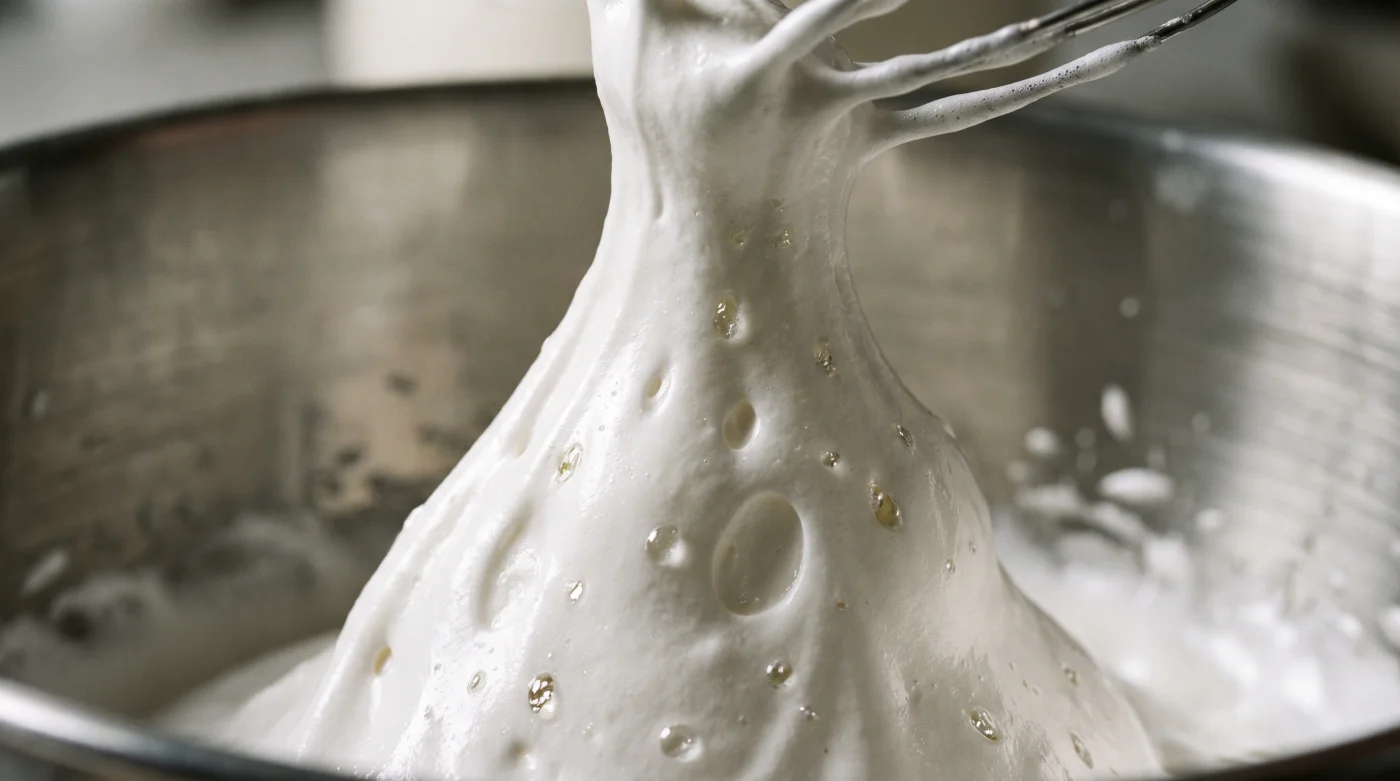
You stand over the mixing bowl, the metal cold against your hip, listening to the rhythmic metallic scrape of the whisk. The kitchen is quiet, save for the hum of the stand mixer. Inside the steel drum, the egg whites are transforming, shifting from a slippery translucent puddle to a bright, snowy mass. You watch the glossy trails left by the beaters, feeling a familiar mix of anticipation and creeping dread as the volume slowly climbs toward the rim.
Too often, this is where the heartbreak begins in home kitchens across the country. You push the mixer a fraction longer, chasing an illusion of stiffness, believing that sheer mechanical force will lock the airy structure in place. You pipe the perfect stars or smooth out a pristine pavlova disc, only to watch through the glass oven door later as that proud, towering shape slumps into a wept, syrupy puddle on the baking parchment.
The natural instinct is to blame yourself, or perhaps the dampness of a rainy British afternoon. We are taught that achieving a flawless, statuesque foam requires nothing but endless patience, furiously fast whisking, and crossed fingers. Yet, brute mechanical force is the exact opposite of what those delicate strands of egg protein actually need to survive the brutal, dehydrating heat of the oven.
There is a quieter, profoundly simpler method used on professional pastry benches. It is a subtle two-ingredient professional pivot that entirely contradicts the ‘beat it until it surrenders’ mentality. By introducing microscopic droplets of plain white vinegar, you completely rewrite the chemical environment of the bowl, allowing the mixture to stabilise itself from the inside out.
The Architecture of the Sugar Cloud
Think of a beaten egg white as a fragile scaffold built entirely of water and unfurled protein strands. As you whip air into the mixture, these microscopic strands link hands, creating a temporary net that catches bubbles and inflates. Without intervention, these natural bonds are incredibly precarious. They are prone to tightening too aggressively, squeezing the water out like a wrung flannel, which causes that dreaded weeping.
This is precisely why simply whisking longer almost always ends in failure. Overbeating forces the proteins to clench uncontrollably, shattering the delicate internal scaffold and causing the smooth mixture to turn grainy and separated. The acid found in white vinegar acts as a chemical mediator, gently coating those protein strands so they repel each other just enough to avoid a disastrous, tight collapse.
Elias Thorne, a 42-year-old head patissier running a busy coastal bakery in Cornwall, intimately understands this delicate chemical balancing act. Working in an environment where heavy sea mist and fluctuating humidity regularly invade the kitchen, Elias spent his early career watching towering lemon meringue pies slip and slide off their pastry bases. He realised that trying to beat the moisture out of the air was a fool’s errand. Instead, by simply swiping his copper mixing bowls with a cloth lightly dampened in white vinegar, and adding barely a quarter teaspoon of the acid to his whites, the proteins stabilised immediately. His peaks held razor-sharp edges, defying both the damp coastal air and the fierce, direct heat of the commercial deck ovens.
Tailoring the Acidic Bond
Not all sweet foams require identical treatment. Understanding how to adapt this specific acidic intervention allows you to tailor the final texture depending on exactly what you intend to bake, whether it is a delicate, hollow shell or a dessert with a dense, marshmallow-like core.
For the classic French meringue—the simplest method, often piped into fragile kisses or folded gently into almond sponges—the vinegar acts as an immediate insurance policy against deflation. You introduce the microscopic droplets right as the egg whites turn a cloudy, opaque white. It secures the air pockets early, ensuring the caster sugar dissolves smoothly without dragging the delicate volume down into a heavy paste.
When approaching a robust Swiss meringue, where the sugar and whites are heated together over a gently simmering bain-marie, the rules change entirely. Because the heat has already altered the protein structure, the acid is introduced right at the end of the whisking process. Here, the vinegar simply locks the glossy finish in place, ensuring the resulting buttercream or toasted topping will hold its piped ridges for days.
The Droplet Technique
Applying this professional pivot requires genuine restraint. It is absolutely not about indiscriminately pouring sharp liquid into your sweet mixture, but rather creating a highly specific micro-environment where the pH drops just enough to encourage flexibility.
Move slowly and deliberately as you set up your workspace. Gather your tools and ensure that absolutely every surface touching the raw whites is completely devoid of grease, as lingering fat from butter or egg yolks is the one thing an acidic environment cannot combat.
- Wipe the interior of your stainless steel or glass bowl with a piece of kitchen paper moistened with a single drop of white vinegar.
- Begin whisking your room-temperature egg whites on a medium-low speed until they resemble loose, foamy bath bubbles.
- Add precisely one-eighth of a teaspoon of white vinegar per two large egg whites, allowing the spinning whisk to distribute the droplets evenly.
- Gradually rain in your fine caster sugar, one tablespoon at a time, only increasing the speed to medium-high once the crystalline grit has completely dissolved between your fingertips.
Your tactical toolkit for this precise process is refreshingly minimalist. You do not need expensive stabilising powders or commercial additives. Rely instead on a scrupulously clean balloon whisk, a heavy-bottomed bowl that anchors securely to your worktop, and the patience to stop the mixer to physically feel the mixture.
A Quiet Confidence at the Oven Door
There is a profound shift in how you approach the craft of baking once you finally stop fighting your own ingredients. By relying on a microscopic droplet of common vinegar rather than the sheer, frantic velocity of a mechanical whisk, you are actively stepping away from the anxiety of a collapsing dessert.
You are no longer crossing your fingers and hoping for the best; you are engineering a reliable, scientific outcome. The once-temperamental meringue becomes a predictably sturdy medium, fully capable of holding intricate, sharp piped details or confidently supporting heavy layers of rich clotted cream and tart summer berries.
The oven door eventually transforms from a brightly lit window of dread into a deeply satisfying display case. Your carefully piped peaks hold their perfect shape, resolute and chemically secure, proving beautifully that the most powerful kitchen interventions are often the ones entirely invisible to the naked eye.
“A beautiful peak isn’t built by beating the life out of the egg; it’s coaxed into holding its breath by giving the proteins exactly what they need to relax.” – Elias Thorne, Head Patissier
| Key Action | Chemical Reality | Value for the Home Baker |
|---|---|---|
| Swiping the bowl with vinegar | Neutralises lingering fat molecules that disrupt protein bonding. | Guarantees the whites will whip up, ending the frustration of flat, useless eggs. |
| Adding acid at the foaming stage | Coats protein strands, preventing them from forming overly tight bonds. | Stops the mixture from turning grainy or separating into watery puddles. |
| Halting the whisk at glossy peaks | Preserves the maximum elasticity of the water-and-protein scaffold. | Ensures the baked shape remains towering and crisp, avoiding sudden oven collapses. |
Frequently Asked Questions
Will the vinegar make my dessert taste sour?
Not at all. The microscopic amount used—typically an eighth of a teaspoon per two eggs—is entirely masked by the caster sugar, leaving only a perfectly neutral, sweet profile.Can I use malt or cider vinegar instead?
It is highly recommended to stick to plain white vinegar. Coloured or flavoured vinegars contain impurities and strong tasting notes that can subtly taint the pristine white colour and delicate flavour of the foam.What if I have accidentally overbeaten the whites before adding the acid?
Once the proteins have clenched and the mixture looks like lumpy cotton wool, the structure is broken. It is best to start fresh, as even acid cannot repair a shattered protein bond.Does this technique work for vegan aquafaba meringues?
Yes, the principle remains exactly the same. A tiny droplet of acid helps stabilise the starches and proteins in chickpea water, giving you significantly firmer peaks that resist weeping in the oven.Do I still need to bake it at a very low temperature?
Absolutely. The acidic environment provides structural integrity, but high heat will still burn the sugar before the moisture evaporates. A low, slow bake remains vital for a crisp, mallow-centred finish.