You know that specific quiet that falls over a Sunday afternoon when the rain settles in against the windowpanes. It is the sort of weather that demands immediate action in the form of butter, flour, and the warming hum of the oven. You pull your mixing bowl onto the worktop, ready to assemble a dark, sticky batch of ginger biscuits.
But then you reach into the back of the pantry. Your fingers close around the packet of dark muscovado, and your heart sinks. Instead of the yielding, damp sand you require, you retrieve a heavy, unyielding brick. It feels more suited to building a garden wall than folding into a delicate pastry cream or sponge.
The standard response involves hacking at the solid mass with a sturdy dinner knife, sending amber shards flying across the kitchen tiles. Or perhaps you try warming it in the microwave, only to end up with a weeping, caramelised puddle at the edges and a rock-hard core in the centre that remains entirely unusable.
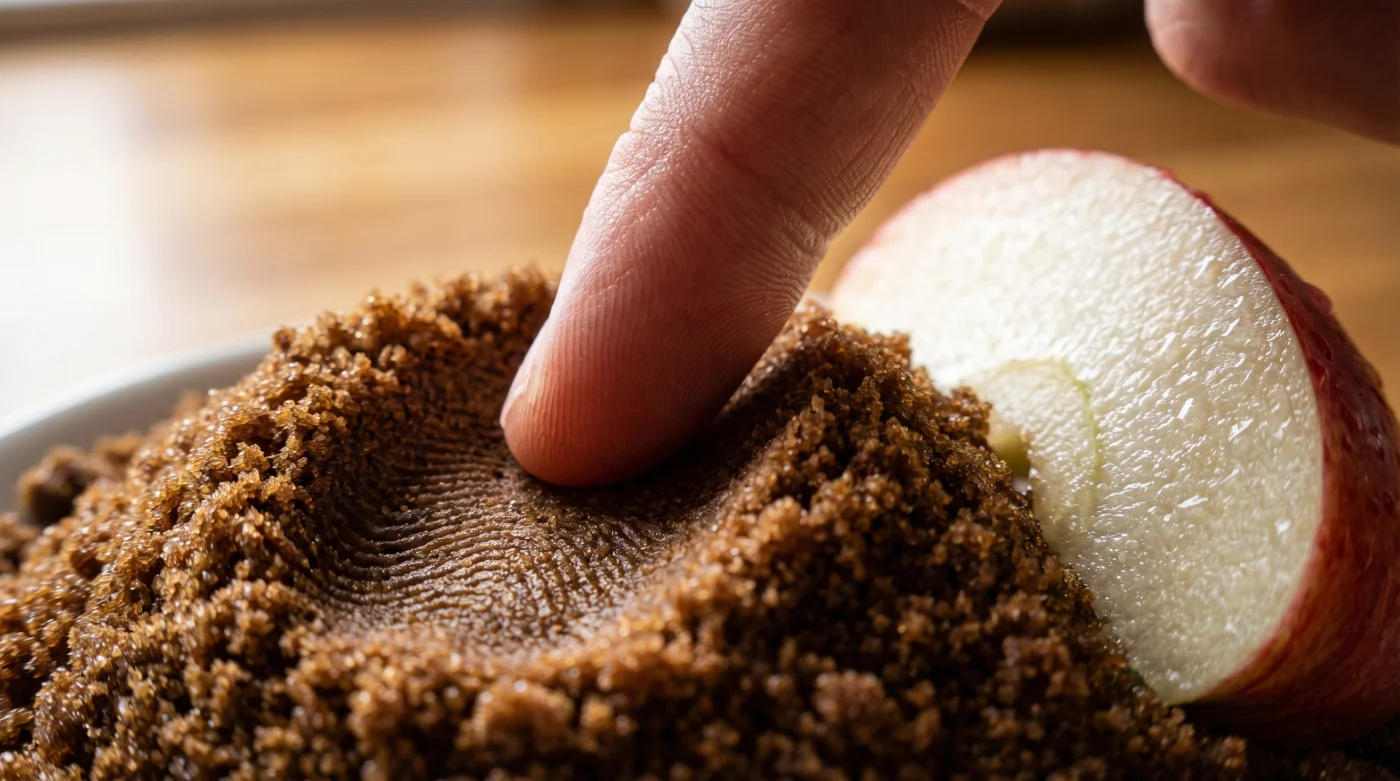
The truth is, the professional baker does not battle their ingredients. They understand that restoring this pantry staple requires a gentle, invisible touch rather than brute force. The secret lies in the fruit bowl, relying on the slow, steady exhalation of moisture from a single apple slice to fix hard sugar clumps fast.
The Moisture Economy
We tend to categorise our baking supplies as inert powders, completely detached from the organic world. But you need to look at brown sugar through a different lens. It is not entirely dry; it relies on a delicate, invisible film of molasses coating every individual crystal, acting like a protective, sticky barrier.
When that moisture evaporates into the dry air of your cupboards, the molasses crystallises, binding the granules together with surprising strength. This dehydration is not a failure of the product, nor does it mean your provisions have gone off. That very susceptibility to moisture loss is exactly what provides the chewy, dense crumb in your favourite cakes.
Instead of viewing the solid lump as a ruined ingredient, see it as a reservoir that simply needs refilling. You do not need expensive terracotta disks or chemical softeners. A humble wedge cut from a Bramley or a Cox apple acts as a slow-release humidifier, exhaling microscopic water vapour into the trapped air of your storage jar.
The molasses, thirsty for equilibrium, eagerly absorbs this ambient dampness. The sugar breathes in the moisture, slowly relaxing its grip, crystal by crystal, until it returns to its original, supple state without altering the flavour profile of your recipe.
Eleanor’s Apple Orchard Logic
Eleanor Davies, a 62-year-old pastry chef working out of a damp stone bakery in rural Somerset, has built a formidable reputation on her treacle tarts. She buys sugar in twenty-kilo sacks and refuses to waste a single gram to the dry winter air of her storeroom. She never chips away at hardened clumps. Instead, she treats her storage bins like a dormant garden waiting for morning dew. By placing the cores and thick peelings of her baking apples directly into the sealed containers, she creates a perfectly balanced microclimate. It is a quiet, zero-waste pantry hack that guarantees her ingredients remain flawless, entirely eliminating the panic of a seized batter.
Tailoring Your Apple Intervention
Not every baker operates on the same timeline. How you apply this fruit-based humidifier depends entirely on when you need to get your baking tin into the oven, and how much time you have to spare.
For the Desperate Baker: If you have precisely forty minutes before guests arrive and your ingredients are solid, you need to force the climate change. Place a fresh apple wedge into a microwave-safe bowl alongside the hardened sugar block. Cover it tightly with a microwave-safe plate and heat it on the lowest possible setting for ten seconds. The fruit rapidly releases steam, acting like a sauna to instantly relax the molasses bonds.
For the Weekend Meal Planner: If you prefer to front-load your domestic chores, the preventative approach is far superior. Transfer fresh supermarket bags immediately into an airtight Kilner jar alongside a thick slice of fruit. This guarantees that your provisions are always ready for deployment the moment inspiration strikes.
For the Frugal Pantry Master: You do not need to sacrifice a perfectly good piece of eating fruit for this trick. If you hate waste, use the skin you peeled away for your morning porridge. The discarded peel holds plenty of ambient water to do the job perfectly, turning compost scraps into a valuable kitchen utility.
Mindful Application: Reanimating The Crystals
Putting this system into practice requires only a moment of mindful preparation. It is less about following a recipe and more about setting up a self-sustaining environment where physics does the heavy lifting for you.
Gather your hardened sugar, a sharp knife, a crisp apple, and a small square of baking parchment. You are creating a closed loop, ensuring the moisture transfers purely through the trapped air rather than through direct contact.
- Select the fruit: Cut a quarter-inch slice from any apple variety; the specific type matters far less than the water content.
- Create a barrier: Place a small piece of baking parchment directly on top of the sugar block.
- Position the humidifier: Rest the apple slice on the paper to stop the fruit sugars from touching the crystals, preventing any risk of fermentation or mould.
- Seal the environment: Lock the lid of your storage container tightly so the humidity is forced to rise internally.
- Wait for the thaw: Leave the jar overnight on the worktop; by morning, the block will yield entirely to the gentle pressure of a wooden spoon.
Once the texture has been fully restored, simply remove the exhausted piece of fruit and toss it in the compost bin. The sugar will hold its ideal, damp consistency for weeks so long as the rubber seal on your jar remains firmly shut.
Reclaiming the Rhythm of the Kitchen
Fixing a mundane annoyance might seem like a trivial victory, but a smoothly functioning kitchen relies entirely on these small, reliable systems. When your ingredients are ready the moment you reach for them, cooking ceases to be an administrative chore and returns to being a joyful, creative outlet.
You are no longer wasting time fighting your provisions with heavy utensils or boiling kettles. You simply open the jar, scoop out the perfectly soft sand, and move gracefully onto the next step of your afternoon baking.
It is a quiet reminder that sometimes the best solutions in our homes do not require buying new gadgets or throwing things away. Sometimes, all it takes is a clever realignment of what we already have sitting in the fruit bowl, breathing life back into the things we thought were ruined.
A well-maintained pantry relies on working with nature rather than against it; controlling moisture is the quiet secret behind every successful bake.
| Key Point | Detail | Added Value for the Reader |
|---|---|---|
| The Barrier Method | Place baking parchment between the fruit and the sugar. | Prevents mould and fermentation while allowing moisture to transfer safely. |
| Zero-Waste Option | Use leftover apple peels instead of a fresh slice. | Saves money and reduces food waste while achieving identical softening results. |
| The Overnight Thaw | Leave the sealed container on the worktop for 12 hours. | Restores perfect texture without the risk of melting or scorching the molasses. |
FAQ
Will the sugar taste like apple afterwards? No, the transfer is entirely moisture-based. Unless the fruit directly touches the crystals for an extended period, the rich molasses flavour remains completely unchanged.
Can I use a different type of fruit? Yes, a slice of bread or a citrus peel works similarly, but apples provide the most consistent, clean moisture release without imparting strong residual odours.
How long does the sugar stay soft once fixed? Provided you keep the jar strictly airtight, the sugar will maintain its soft, damp texture for several weeks before needing another intervention.
Is it safe to leave fruit out at room temperature? Yes, within a sealed sugar jar for a short 12 to 24-hour period, it acts solely as a humidifier. Simply remove the apple slice once the sugar softens.
What if my sugar has turned completely white and hard? If the colour has faded significantly, the molasses may have degraded beyond simple dehydration. The apple trick works best on sugar that is simply hardened, not completely aged out.