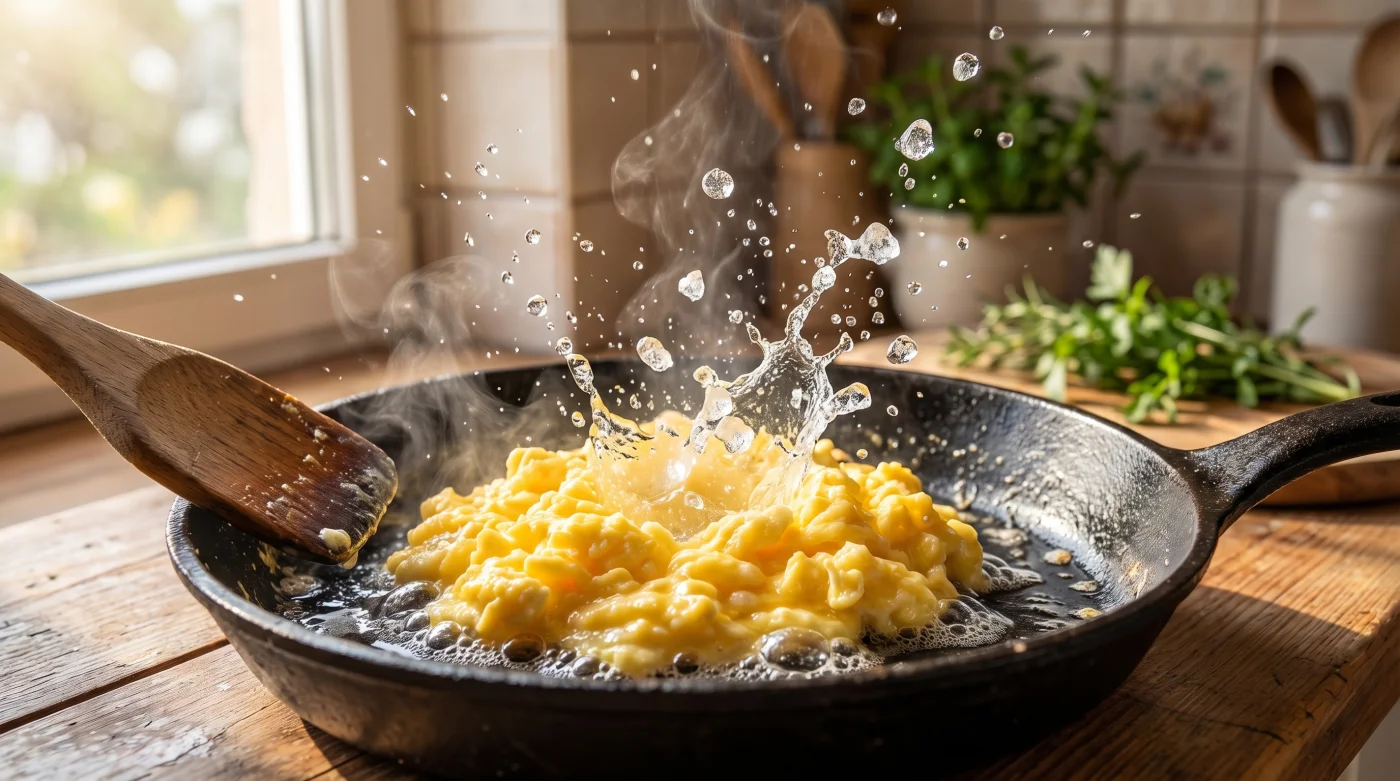
The early light filters through the kitchen window, catching the slow spiral of steam from a recently boiled kettle. It is that quiet, suspended moment of a Sunday morning, where the only pressing demand is breakfast. You stand by the hob, a bowl of fresh eggs resting on the worktop, a knob of butter waiting in the frying pan.
For years, convention has dictated your next move. You reach for the milk, perhaps even a splash of double cream, conditioned to believe that dairy fat is the only route to a luxurious, trembling curd. It is a domestic habit passed down through generations, a comforting rhythm that rarely produces a complaint, but often results in a slightly heavy, weeping plate of food.
Yet, watch closely in the kitchens of those who cook for a living, and you notice an entirely different motion. They bypass the fridge entirely. Instead, they pivot towards the tap, running it until the water is ice cold, before slipping a measured splash directly into the beaten yolks.
It feels entirely counterintuitive at first glance. Water feels like a dilution, a sure-fire way to create a soggy, tasteless mess on your toast. But this single, zero-waste addition is the invisible framework behind the lightest, most voluminous breakfast you will ever slip onto a plate.
The Alchemy of Steam
To understand why this works, we must briefly abandon the idea of cooking as a set of rigid instructions and look at the physical reaction happening in your pan. When you add milk or heavy cream to beaten eggs, the extra lipids and proteins bind tightly with the egg proteins as they hit the heat. This creates a dense, closely knit structure that easily tips into rubbery territory if you blink for a second too long.
Adding cold water fundamentally changes the environment inside the pan. Think of a balloon, suddenly catching a warm thermal updraft on a crisp morning. As the liquid egg mixture touches the gentle heat of the melted butter, the water droplets do not bind; they instantly evaporate. This rapid conversion from liquid to vapour creates thousands of microscopic steam pockets trapped inside the setting egg.
The result is a structure that is entirely self-supporting yet incredibly delicate on the palate. It is the culinary equivalent of breathing through a pillow rather than trying to inflate a solid brick. What you initially viewed as a boring, flavourless filler is actually an active mechanical ingredient, doing the heavy lifting to force the soft curds apart from the inside out.
A Lesson from the Cornish Coast
Arthur Pendelton, a 58-year-old former hotel chef who now runs a notoriously busy breakfast service in a small Cornish cafe, relies exclusively on this method. This is strategic provisioning, a brilliant way to sidestep the erratic shelf-life of fresh cream while guaranteeing an immaculate texture every single time. Arthur stands over his wide, battered aluminium pans each morning, effortlessly turning out hundreds of portions. “It is about trusting the raw ingredient,” he often mutters to new kitchen staff. “You don’t need to mask the natural flavour with dairy. The cold tap creates the lift, the butter provides the fat, and the heat does the rest.” His plates arrive at the table looking impossibly generous, the pale yellow folds trembling ever so slightly as the waiting staff place them down on the wooden tables.
Tailoring the Morning Ritual
Adapting this method at home allows you to bypass the sudden panic of an empty milk bottle, leaning fully into a pantry hack that requires zero packaging and costs absolutely nothing. However, the exact application of this technique depends entirely on who you are feeding and the pace of your morning.
For the Sunday Purist, the absolute focus is on maintaining the delicate integrity of the egg flavour. You want a slow, deliberate scramble over the lowest possible heat setting on your hob. The water here acts as a thermal buffer, giving you a wider margin of error before the proteins seize and toughen. You drag the spatula through the mixture, watching the pale ribbons form, knowing the internal steam is keeping them incredibly soft.
For the busy parent navigating a chaotic weekday morning, the priority shifts heavily towards volume and speed. Children are rarely patient when hungry, and stretching three eggs to look like four is a small, quiet victory that eases the morning rush. Vigorously whisking in the cold water aerates the mixture significantly before it even hits the hot metal of the pan.
The rapid expansion of steam forces the eggs to puff up almost instantly upon contact with the foaming butter. It takes a mere fraction of the time compared to a slow scramble, requires no frantic rummaging in the fridge for extra ingredients, and leaves the plates entirely clean in a matter of minutes.
The Cold Water Protocol
Bringing this technique into your daily routine requires a gentle shift toward mindful, minimalist action. We are actively removing the unpredictable variables of different dairy fats and relying purely on precision, temperature, and timing.
Keep the heat remarkably low, allowing the butter to melt slowly without foaming aggressively or turning brown. The goal is a gentle, continuous coaxing of the ingredients, not a violent, aggressive fry.
- The Golden Ratio: Use exactly one tablespoon of ice-cold tap water per large egg.
- The Pre-Whisk: Beat the eggs and water vigorously in a bowl until the mixture is uniform and a light foam settles on the surface.
- The Salting Window: Hold back the salt until the eggs are half-cooked in the pan; salting too early can draw out moisture and deflate your carefully built steam pockets.
- The Pan Pivot: Remove the frying pan from the hob when the eggs still look slightly too wet. The residual heat trapped in the heavy metal will finish the job by the time you carry it to the dining table.
Beyond the Frying Pan
Mastering this seemingly simple morning task offers a strange, quiet satisfaction that extends far beyond the confines of the kitchen. It is the sudden realisation that sometimes, the absolute best solution is not an expensive addition or a complex new product, but a subtle, intelligent readjustment of what you already have at your disposal.
Stop relying on masking agents, like heavy double creams and excessive amounts of cheese, and learn to manipulate the raw materials. It strips back the unnecessary noise of complicated, multi-step recipes, leaving you with a highly dependable, graceful routine that never fails.
Sitting down to a plate of perfectly textured eggs, knowing they were achieved with nothing more than a splash from the tap and a bit of focused attention, changes how you start the day. You are no longer just putting together a quick breakfast; you are practicing a quiet, daily sort of mastery.
The finest meals are rarely born from expensive additions, but from understanding exactly how a simple ingredient behaves under pressure.
| Key Point | Detail | Added Value for the Reader |
|---|---|---|
| The Catalyst | One tablespoon of ice-cold tap water per egg. | Removes the need to buy cream; saves money and eliminates food waste. |
| The Reaction | Water converts to steam upon hitting the hot pan. | Creates internal air pockets, preventing the proteins from becoming rubbery. |
| The Timing | Remove from the hob while still slightly wet. | Ensures the residual heat finishes the cooking perfectly on the plate. |
Frequently Asked Questions
Will adding water make my scrambled eggs taste bland? Not at all. Because water evaporates into steam, it leaves behind the pure, unmasked flavour of the egg and the butter, actually intensifying the taste rather than diluting it.
Can I use warm water straight from the tap? It is highly recommended to use ice-cold water. The stark temperature contrast between the cold liquid and the warm frying pan is what creates the rapid, lifting burst of steam.
Should I still use butter in the frying pan? Absolutely. The water provides the physical lift and texture, but a small knob of butter provides the essential fat that carries the flavour and prevents sticking.
Does this technique work for omelettes as well? Yes. A tiny splash of cold water in an omelette mixture will help it puff up beautifully in the pan, giving you a lighter fold when you bring the edges together.
When is the exact right moment to add the salt? Wait until the eggs have just begun to set in the pan. Salting the raw mixture in the bowl can break down the proteins too early, releasing moisture before the steam has a chance to form.