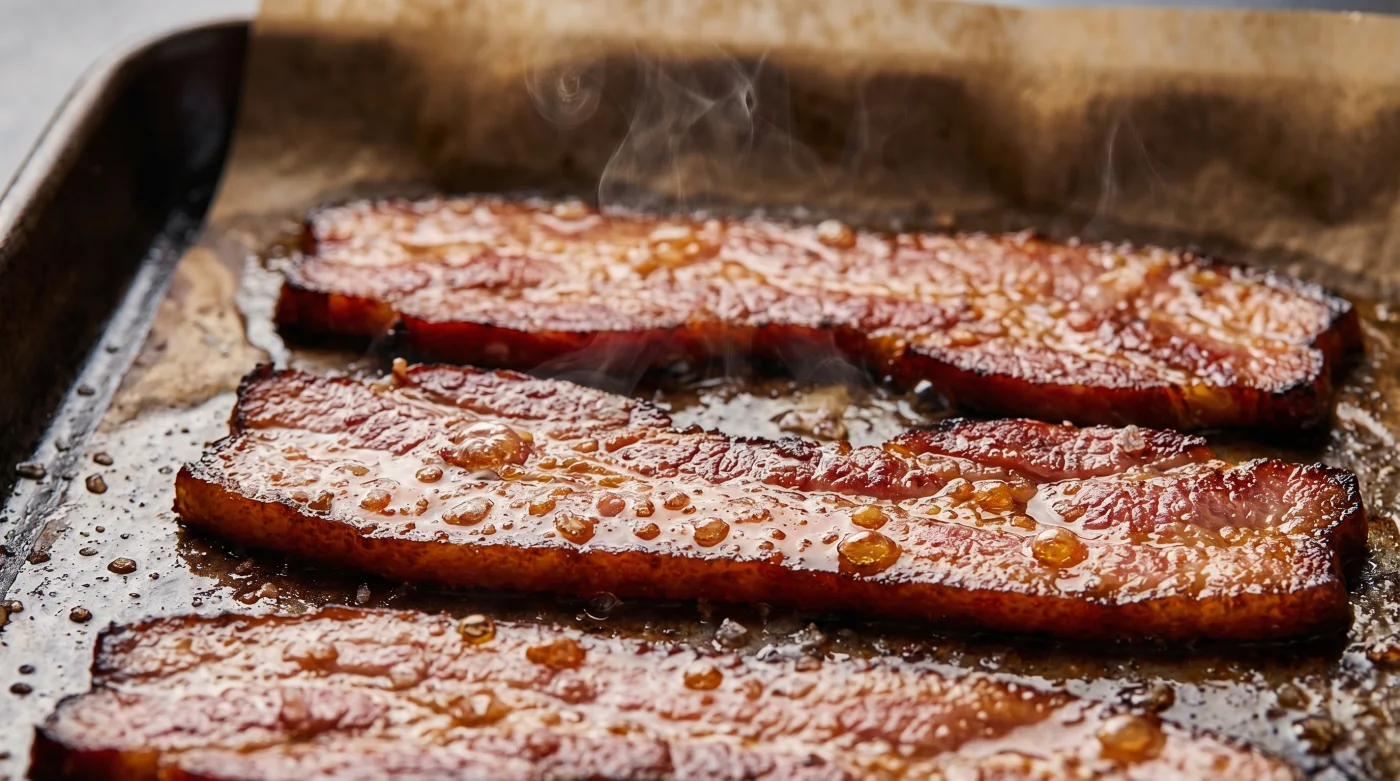
The smell of sizzling pork bacon on a Sunday morning is an absolute cultural cornerstone in the United Kingdom. Yet, standing over a heavy cast-iron pan, frantically dodging hot spits of fat while nudging curled-up rashers with a spatula, is far less romantic. You watch helplessly as the edges scorch to a bitter black, leaving the thickest part of the fat stubbornly flabby and undercooked.
We have all accepted this chaotic pan-frying ritual as a necessary tax for our weekend fry-ups. You might even press the meat down with a fork, desperately trying to force the shrinking protein to lay flat against the hot metal. But the pan is a fiercely uneven environment, which blasts the meat with sudden heat that forces the muscle fibres to contract in absolute panic.
There is a quieter, infinitely more civilised approach. Walk into the kitchen of any high-end hotel in London before the breakfast rush, and you will not hear the violent spit of frying fat. Instead, you will see calm chefs sliding heavy aluminium trays into commercial ovens. The simple swap to baking completely redefines your morning routine, trading the messy, curled-up disaster for beautifully flat, evenly crisped meat.
By moving the cooking process from the hob to the oven, you eliminate the frantic temperature spikes. The meat cooks gently in its own rendering fat, resulting in a gentle rendering of the fat as the ambient heat rises. The outcome is a structural triumph: rashers so remarkably straight and brittle, they snap like spun glass between your teeth.
The Thermodynamics of a Shrinking Rasher
Pan-frying is rather like forcing someone into a freezing shower; the immediate physical reaction is a violent contraction. When cold pork bacon hits a pre-heated frying pan, the residual moisture evaporates instantly, and the protein structures seize up. Because the fat and the meat shrink at entirely different rates, the rasher inevitably buckles in the middle.
By starting your rashers in a cold oven, you act as a gentle mediator between the meat and the heat. You are no longer forcing a reaction; you are managing an environment. As the oven warms, the fat begins to melt before the muscle fibres even realise they are cooking. The meat relaxes into the tray, bathed in a shallow pool of its own savoury drippings. Your previous problem—curling edges—becomes your greatest advantage, as the flat surface area now fries evenly in its own liquid without any distortion.
Consider the daily workflow of Arthur Pendelton, a 42-year-old development chef for a boutique hotel group in the Cotswolds. Tasked with serving two hundred immaculate breakfasts before nine in the morning, Arthur abandoned the frying pan a decade ago. He relies exclusively on a flat baking tray to ensure shattering crispness without scorched edges. ‘A pan requires a babysitter,’ he explained over a recent morning coffee, pointing to rows of perfectly aligned streaky bacon resting on greaseproof paper. ‘The oven requires only trust. We lay the meat flat, turn the heat on, and let the gentle climb in temperature do the heavy lifting. It is the only way to get consistency.’
Tailoring the Oven Method to Your Morning
We all have intensely personal preferences for our morning pork. The oven method easily accommodates them all, provided you know exactly how to tweak the cooking environment.
For the English Breakfast Traditionalist
If you purchase thick-cut back bacon from the local butcher, you are likely seeking a meaty bite paired with a crisp rind. Lay your rashers directly on a heavy metal baking tray without any lining paper. The direct contact with the hot metal ensures a deeply caramelised flat underside, giving you the satisfying, substantial chew necessary to stand up to baked beans and a fried egg.
For the Sandwich Architect
Building the perfect bacon butty requires flawless structural integrity. Thin-cut streaky rashers are your best choice here. Line your tray with unbleached greaseproof paper to prevent sticking. If you want the pieces entirely, uniformly flat, place another sheet of paper on top, weighted down lightly by a second baking tray. They will emerge perfectly straight, ready to be layered cleanly between two thick slices of heavily buttered white bread.
For the Batch Cooker
If you are preparing meals for the week ahead, lay a wire cooling rack over your baking tray. This specific setup completely elevates the meat allowing hot air to circulate freely beneath each slice. The excess fat drips away entirely, resulting in intensely crisp, drier pieces that are absolutely brilliant for crumbling over green salads or stirring into a Tuesday night pasta bake.
The Quiet Ritual of Flat-Baking
Executing this method is beautifully simple, stripping away the anxiety of a popping, spitting frying pan. It allows you to prepare your coffee, read the morning headlines, or simply stare out of the kitchen window while the oven does the meticulous work on your behalf.
The physical process demands very little from you, but the details dictate the perfection of the final bite. Follow these minimal, deliberate steps to secure your permanent breakfast upgrade.
- The Cold Start: Arrange your rashers on a heavy-duty baking tray, ensuring they do not overlap. Place the tray into an entirely cold oven.
- The Gentle Climb: Set the oven to 200°C (or 180°C for fan-assisted ovens). As the temperature climbs, the fat will slowly render out into a clear pool.
- The Mid-Point Check: After exactly 12 minutes, open the door briefly. The meat should be swimming slightly in clear fat. There is no need to flip them at all.
- The Extraction: Around the 18 to 22-minute mark (depending on thickness), remove the tray. The rashers will look a shade lighter than you want them to be; they continue to darken and crisp as they sit.
- The Resting Phase: Transfer the meat immediately using tongs to a few sheets of kitchen roll. Let them sit for two minutes to drain and firm up into stiff, brittle perfection.
Tactical Toolkit: One heavy aluminium baking tray, unbleached greaseproof paper (optional), a pair of long-handled kitchen tongs, and an oven set to 200°C (Standard) or 180°C (Fan).
Reclaiming the Weekend Morning
Stepping away from the hob does more than just save your forearms from hot oil splatters. It shifts the entire tempo of your morning routine. The chaotic scramble of trying to perfectly time the toast, the eggs, and the wildly unpredictable pork bacon is completely neutralised by this single change.
By outsourcing the most demanding element to a steady, controlled environment, you buy yourself time to breathe. The kitchen counters remain cleaner, the air smells of gently roasted pork rather than acrid smoke, and the final plate looks as though it was prepared with absolute professional intent. This small culinary pivot transforms a rushed, messy task into a calm, reliable practice, ensuring your weekends start exactly as they should: with ease, warmth, and an impeccably crisp bite.
The oven does not rush the meat; it simply invites the fat to melt away naturally, leaving only pure, undisturbed crispness behind. – Arthur Pendelton
| Key Point | Detail | Added Value for the Reader |
|---|---|---|
| The Cold Start | Placing meat in an unheated oven. | Prevents thermal shock and stops the edges from curling up. |
| Self-Basting | Cooking in rendered fat on a flat tray. | Ensures an even, golden crunch across the entire rasher. |
| Hands-Free Cooking | No flipping or constant supervision required. | Frees up your morning to focus on eggs, toast, or simply relaxing. |
Frequently Asked Questions
Does baking work for both streaky and back bacon?
Absolutely. Streaky will crisp up entirely, while back bacon will retain a pleasant chew in the meaty eye while the fat renders beautifully along the edge.Do I need to turn the rashers halfway through?
Not at all. The heat of the metal tray fries the underside, while the ambient hot air in the oven cooks the top evenly.What is the best way to dispose of the leftover fat?
Pour it carefully into a ceramic ramekin or glass jar while it is still warm. Keep it in the fridge to use for roasting potatoes or frying eggs later in the week.Will the grease splatter inside the oven cavity?
Because the temperature rises gradually and sits at a moderate 200°C, the fat renders smoothly rather than violently popping, keeping your oven remarkably clean.Can I use greaseproof paper?
Yes, lining the tray with unbleached greaseproof paper makes washing up incredibly easy, though placing meat directly on the bare metal yields a slightly deeper sear on the underside.