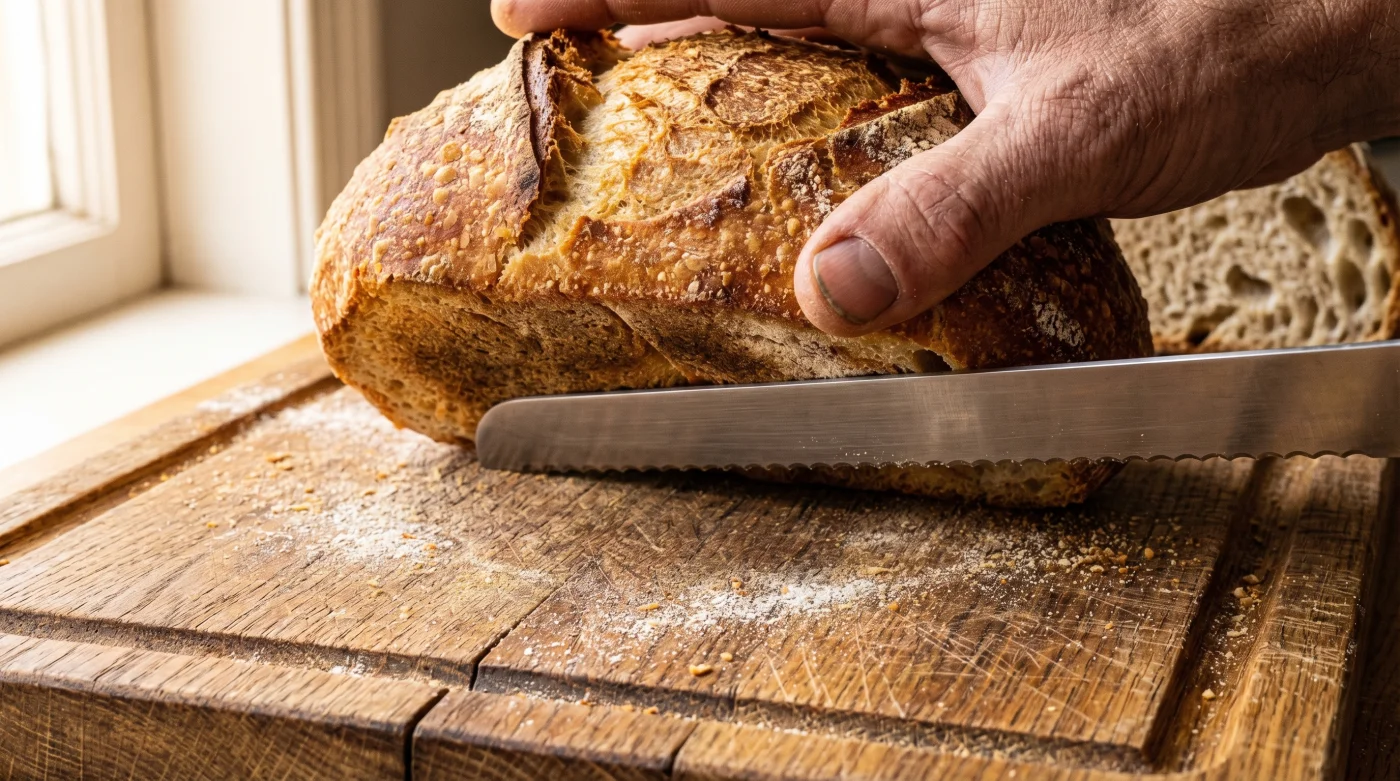
The kitchen is quiet, save for the faint, rhythmic crackle of a freshly baked loaf cooling on the wooden board. The air is thick with the comforting, yeasty perfume of caramelised flour and warm salt. You have waited patiently for this moment, perhaps picking up the artisanal sourdough from the corner bakery on your morning walk, or pulling your own proud creation from a hot cast-iron pot. The crust boasts a beautiful, blistered dome, promising a shattering crunch.
Yet, as you bring your knife down upon that beautiful crest, a quiet culinary tragedy unfolds. The blade catches on the tough upper crust, requiring a firm downward press. Before the teeth can saw through, the delicate, airy interior gives way. The pressure collapses the beautiful pockets of trapped steam, compressing the soft crumb into a dense, gummy paste. You are left with a misshapen, bruised wedge that barely resembles the majestic loaf you started with.
We have all accepted this as a minor domestic tax on eating fresh bread. We blame the knife, we blame our own impatience, or we attempt to hover the blade with surgical delicacy, hoping to saw without pressing. But the fault lies not in your tools or your technique, but in a simple misunderstanding of physics and structure. You are attacking the building from its most vulnerable point.
By executing one single, brutally simple inversion, you alter the entire physics of the cut. You flip the entire loaf upside down. The kitchen secret that turns ruined crumb into flawless, professional slices every single time requires no new equipment, no waiting, and no special skill. It merely requires you to look at your food from a different angle.
Reversing the Architectural Logic
To understand why slicing a loaf from the top down is a structural mistake, we must look at how bread behaves in the oven. The top crust expands and sets into a rigid, protective shell. It is the roof of the house. Beneath that roof lies the crumb, a delicate webbing of gluten strands and air pockets designed to be as light and yielding as a resting lung. When you press a knife into the roof, there is nothing underneath to support the weight of your hand. The air pockets simply buckle.
The base of the loaf, however, tells a completely different story. Having baked in direct contact with the hot stone or the base of the tin, the bottom crust is thick, flat, and dense. It is the concrete foundation of the structure. It has no give, no trapped air waiting to collapse. It is pure structural integrity.
When you turn the loaf upside down, you present this flat, dense foundation to the blade first. The knife has a stable, unmoving surface to bite into. As you apply the necessary downward pressure to breach the tough exterior, the energy pushes into the cutting board, rather than into the soft heart of the bread. By the time the blade reaches the delicate upper dome—now resting securely against the wood—the hard work is done. The crumb remains untouched, unsquashed, and structurally perfect.
What was once a frustrating mechanical flaw—the tough, impenetrable bottom crust—suddenly becomes your greatest mechanical advantage. It acts as a stabilising shield, absorbing the shock of the cut and protecting the fragile interior.
The Wisdom of the Early Shift
Elias Thorne, a sixty-two-year-old master baker working out of a small, flour-dusted unit in Somerset, has been turning his loaves upside down since he was an apprentice in the late nineteen-seventies. Watching him portion a massive, two-kilo miche for the morning rush is like watching a carpenter at work. He moves with a quiet, ruthless efficiency. He never squashes a single slice.
“People treat bread like it’s a delicate pastry that needs to be admired from the top down,” Elias explained one cold November morning, brushing excess flour from his apron. “But it’s a living structure. When you cut from the top, you’re stepping on a suspension bridge without the cables. Flip it over. Let the floor take the weight. The bread wants to be cut that way.” He demonstrated with a battered, wooden-handled serrated blade, slicing through the inverted crust with a rhythmic, sawing motion. The resulting slices fell away perfectly uniform, the crumb completely undisturbed, ready to soak up cold butter and local jam.
Tailoring the Inversion for Every Bake
While the fundamental rule of flipping the loaf applies universally, different types of bread require slight adjustments in your approach. Understanding these variations ensures you respect the specific character of what you are preparing.
For the Sourdough Purist
Artisan sourdoughs often feature an aggressively hard, blistered crust and a wildly open, airy crumb. These are the most susceptible to squashing, but also the most difficult to breach. When inverted, the flat base requires patience. Do not force the knife. Allow the serrations to do the work, dragging the blade back and forth across the flat bottom until it bites. Once through the foundation, let the weight of the knife carry it through the open crumb.
For the Supermarket Tin Loaf
Even pre-sliced bread avoids this issue entirely, but uncut bakery tin loaves—with their soft, floured tops and slightly firmer bases—benefit immensely from the flip. Because the overall structure is softer, the risk of tearing is high. Turn the tin loaf on its side or completely upside down. Use a very gentle, almost feathery sawing motion. The base will still offer more resistance than the crown, preventing the middle from compressing into doughy balls.
For the Enriched Brioche and Challah
Enriched doughs are heavily laden with butter and eggs, making them incredibly soft and prone to smushing, especially when fresh. They often lack a hard bottom crust, but the base is still flatter and marginally denser than the braided or domed top. A swift, confident sawing action is required here. Invert the brioche to give yourself a flat runway, and slice with a longer, faster stroke to prevent the sticky crumb from dragging against the steel.
Mindful Application: The Slicing Ritual
Mastering this simple fix is about slowing down and applying intention to a mundane task. It turns a rushed, frustrating morning chore into a moment of satisfying precision.
Follow these mindful steps to ensure flawless execution:
- Clear your board: Ensure your wooden cutting board is entirely flat and free of debris that might cause the inverted loaf to rock unsteadily.
- Assess the heat: Never cut a loaf straight from the oven. The starches need time to set. The crust should sing and pop, but the bread must be cool to the touch.
- The Confident Flip: Take the loaf in both hands and turn it over deliberately. Appreciate the solid, dense thud as the flat bottom meets the wood.
- The Sawing Stroke: Place your knife at the edge. Do not press down. Pull the knife towards you to initiate the cut, using the full length of the blade.
The Tactical Toolkit is equally important. A standard chef’s knife will simply crush the bread, regardless of orientation. You require a dedicated bread knife with wide, scalloped serrations. A ten-inch blade is the minimum requirement for a standard boule, providing enough length to saw without the tip exiting the bread and tearing the crust on the return stroke.
Beyond the Breadboard
It might seem trivial to dedicate such thought to the act of slicing bread. But our days are built upon these small, repetitive actions. When we rush through them, fighting against the natural properties of the materials we handle, we accumulate tiny frustrations. A ruined slice of beautiful bread is a minor annoyance, but it represents a disconnect between us and the food we consume.
When you take a moment to understand the structural reality of the loaf, and adapt your approach to suit it, you transform frustration into satisfaction. You preserve the integrity of the baker’s work, or your own hard-earned effort. The airy pockets remain open, ready to trap melting butter or hold the perfect smear of marmalade. You create order out of potential chaos, starting your morning with a quiet, personal victory that tastes entirely perfect.
“The mark of a true craftsman is not the complexity of their tools, but their willingness to turn a problem completely upside down until the solution reveals itself.”
| Key Point | Detail | Added Value for the Reader |
|---|---|---|
| Standard Slicing (Top-Down) | Blade presses against the domed roof, compressing the airy crumb beneath before piercing the crust. | Highlights the root cause of daily frustration, validating the reader’s past difficulties. |
| Inverted Slicing (Bottom-Up) | Blade cuts through the flat, dense foundation first, while the delicate top crust is supported by the board. | Provides a zero-cost, immediate mechanical fix that guarantees professional results. |
| Tool Calibration | Using a 10-inch widely scalloped serrated knife rather than a smooth blade or a short utility knife. | Ensures the reader understands that the correct tool amplifies the success of the new technique. |
FAQ: Navigating the Inverted Cut
Why does my bread still tear when cutting upside down?
You are likely pressing down rather than sawing. Let the serrations do the work by using long, horizontal strokes across the flat base. Your arm should move back and forth, not up and down.Can I do this while the bread is still warm?
It is strongly advised to wait. Warm bread has unset starches that act like glue. Even upside down, a hot loaf will drag and clump on the blade. Let it cool entirely for the perfect crumb.What if my loaf is perfectly round and rocks on the board?
If the top dome is so pronounced that it wobbles when inverted, simply slice the loaf in half straight down the middle first. Then, place the two cut halves flat-face down on the board and slice them into semi-circles.Does this work for gluten-free loaves?
Absolutely. Gluten-free bread often suffers from an even more fragile crumb structure and a tougher exterior crust. Flipping it provides crucial stability and prevents the slice from crumbling into dust.How do I store the loaf once I’ve cut it?
Keep the loaf cut-side down on the wooden board. The board protects the exposed crumb from the air, preventing it from drying out, while the thick crust protects the rest of the loaf.