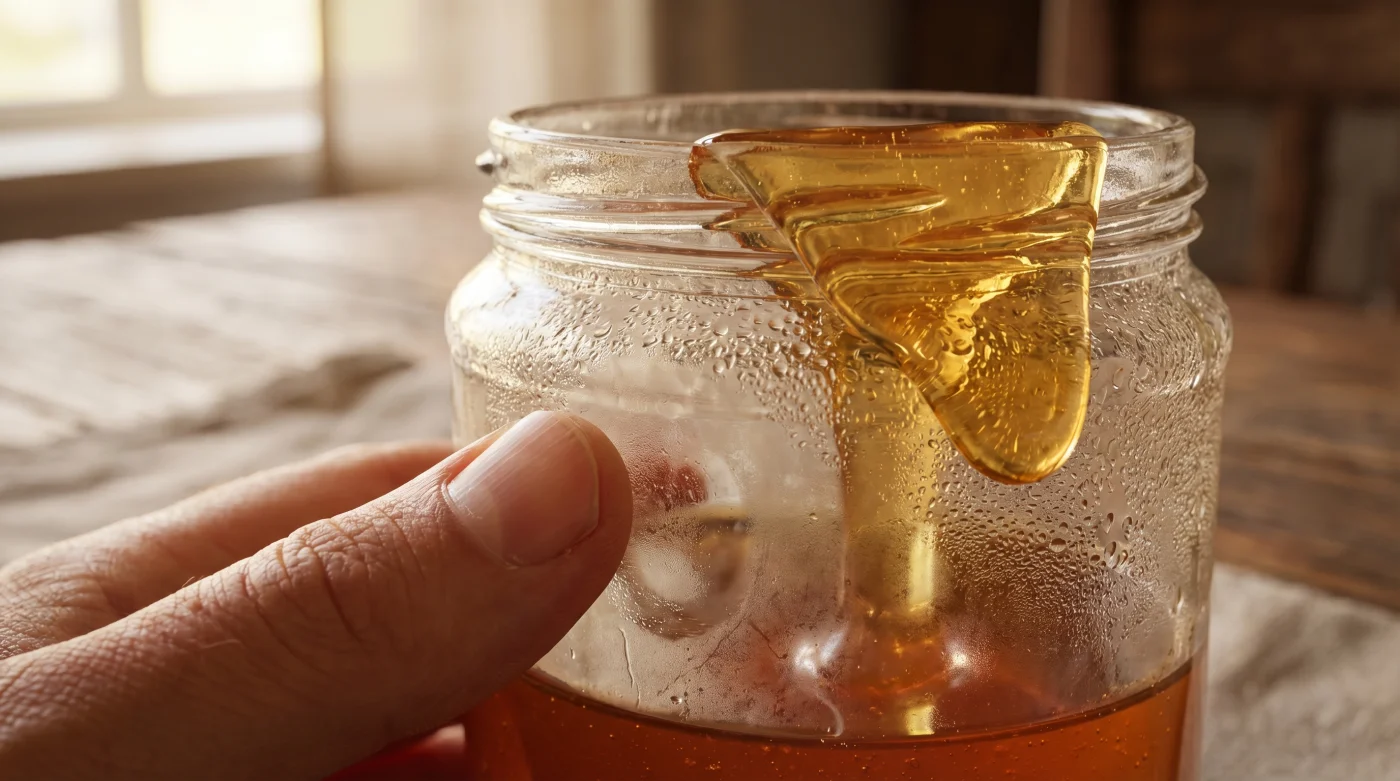
You are standing in the kitchen at a quarter to seven. The kettle has just clicked off, the room feels slightly damp from the early chill, and you reach into the cupboard for the honey. Instead of a thick, amber ribbon ready to fold over your porridge, your spoon hits a pale, immovable wall. The golden syrup you bought weeks ago has transformed into a stubborn, granular brick.
It is a uniquely frustrating moment that derails the quiet rhythm of the morning. You scrape desperately at the surface, managing only to extract chalky shards that refuse to melt properly into your tea. The temptation to impatiently microwave the plastic bottle or glass jar is almost overwhelming, promising a quick return to liquid form.
Yet, taking the quick, violent route destroys the very thing you bought. Blasting honey with harsh radiation boils the delicate sugars and obliterates the natural enzymes, leaving you with a scalding, flavourless syrup that will inevitably cool back into a strangely textured lump. You are essentially cooking away the medicinal qualities that made the honey worth buying.
The professional approach to decrystallising requires almost zero effort, demanding only a shift in your timing. By using a gentle soak in warm water, you can coax the honey back to its natural state without degrading its quality. It is the ultimate lazy fix, yielding a perfectly smooth pour every time.
The Architecture of Crystallisation
Before you fix the problem, you have to understand that this solid state is not a flaw; it is a sign of authenticity. Supermarket squeezy syrups stay permanently liquid because they are ultra-filtered and pasteurised at high heat, a process that strips out pollen and destroys the complex profile of the nectar. Real honey is alive, and when left in a cold British cupboard, it simply goes to sleep.
The hardness is merely the natural glucose separating from the water content, forming tiny crystals that bind together. The higher the glucose content—like in rapeseed or spring blossom honey—the faster it turns solid. You aren’t dealing with spoiled food; you are dealing with an ingredient that is temporarily highly organised.
Think of it less like melting plastic and more like relaxing a cramped muscle. You cannot beat a muscle into submission, nor can you boil it without causing damage. It requires a gentle, sustained warmth to loosen the bonds naturally, allowing the sugars to slowly release their grip on one another.
Approaching the jar with this mindset changes the task entirely. You stop fighting the ingredient and start working with its natural chemistry, resulting in a far superior flavour and texture.
Elias Thorne, 62, a second-generation apiarist from the Mendip Hills in Somerset, watches this battle happen every winter. ‘People bring jars back to my market stall, claiming the honey has gone off,’ Elias notes, tapping a rock-solid jar of his prized heather harvest. He explains that he spends months carefully extracting the honey cold to preserve the delicate enzymes, only to watch customers ruin it in thirty seconds in the microwave. His strictly enforced solution isn’t a complex piece of catering equipment; it is a simple bowl of warm tap water. ‘Just give it a bath,’ he tells them. ‘Let it sit. It’s the lazy fix, but it’s the only proper way.’
Adjustment Layers: Tailoring the Thaw
While the basic principle remains the same, the exact method you choose depends entirely on your daily routine and how much honey you need to rescue. Adapt the warming process to fit your specific constraints.
For the Morning Panicker
If you have just discovered the hard honey and your toast is already popping up, you need the tap-water method. Fill a heavy ceramic bowl with water straight from the hot tap—it should be warm enough to comfortably leave your hand in, roughly around 40 degrees Celsius. Submerge the jar up to its shoulders. It won’t melt the entire jar instantly, but within five minutes, the honey resting against the inner glass will soften enough to yield a generous, liquid spoonful for your breakfast.
For the Weekend Restorer
If you have a bit of foresight and an entirely solid jar, rely on the traditional airing cupboard trick. Wrapping the glass jar in a thin tea towel and leaving it beside your hot water cylinder overnight provides the perfect, low-grade ambient heat. By the time you wake up, the entire mass will have gently relaxed into a thick, pourable consistency without you having to boil a single kettle, saving entirely the raw properties of the nectar.
For the Bulk Purist
Those buying raw honey in larger catering buckets need a slightly more sustained approach. A slow cooker filled with a water bath can work, provided it is strictly monitored. Set it to the ‘keep warm’ function, never ‘high’, and leave the lid off. The goal is to create a microclimate of gentle warmth, checking the water periodically to ensure it never exceeds the temperature of a hot summer afternoon.
The Mindful Protocol
Executing the lazy fix requires stepping back and letting thermodynamics do the heavy lifting. The steps are beautifully minimal, focusing on patience over sheer brute force.
Your Tactical Toolkit consists of a heavy-bottomed bowl, a damp cloth, and water no hotter than 40 degrees Celsius. Keep these principles in mind:
- Ensure the lid of the honey jar is tightly sealed to prevent any water seeping into the syrup, which can cause fermentation.
- Place the glass jar into the bowl first, then pour the warm tap water around it, stopping about two centimetres below the lid.
- Leave the jar entirely undisturbed for twenty minutes; do not attempt to shake or violently stir it while it is only half-melted.
- If the water goes cold before the honey is fully liquid, empty the bowl and refresh it with a new batch of warm tap water.
- Once fully liquid, dry the outside of the jar thoroughly before returning it to the cupboard to prevent mould growth on the glass.
By treating the process as a passive background task, you remove the stress from the situation. You simply set the conditions and let the gentle heat work while you get on with brewing the tea or reading the paper.
Beyond the Pour
Mastering this simple technique offers a subtle but profound shift in your kitchen habits. It moves you away from the frantic, modern urge to force ingredients to bend to your immediate will. When you stop microwaving your honey and start bathing it, you are actively choosing quality over speed.
This small act of provisioning sets a calmer tone for the day. You are no longer fighting with your pantry staples; you are managing them with quiet competence. The reward is a jar of honey that retains all its floral notes, its complex sweetness, and its soothing texture, pouring effortlessly exactly when you need it.
The truest sign of a capable cook is not the speed at which they force an ingredient to submit, but the patience they show in allowing it to express its best qualities.
| The Method | The Detail | The Value to You |
|---|---|---|
| The Microwave | High-frequency radiation, rapid boiling. | Destroys enzymes, ruins flavour, crystallises worse later. |
| The Boiling Pan | Submerging jar in 100°C water on the stove. | Risk of shattering glass, melts plastic, cooks the honey. |
| The Lazy Bath | Submerging jar in 40°C warm tap water. | Preserves all raw benefits, creates a perfectly smooth pour. |
Frequently Asked Questions
Why does honey go hard in the first place?
Honey is a super-saturated solution of natural sugars. Over time, especially in cooler UK kitchens, the glucose separates from the water and forms crystals. It is a natural mark of high-quality, unpasteurised honey.
Can I just put a plastic squeezy bottle in boiling water?
Absolutely not. Boiling water will warp and melt the thin plastic, potentially leaching chemicals into your honey. Always use warm tap water, which is safe for both the honey and the packaging.
How long does the lazy fix actually take?
To get enough for a piece of toast, it takes about five minutes. To completely liquefy a fully solid 454g jar, it may take two to three changes of warm water over the course of an hour.
Will the honey just go hard again tomorrow?
It will eventually crystallise again, but not immediately. By melting it gently and completely, it should remain liquid for several weeks before the crystals begin to form again.
Is it safe to eat hard honey without melting it?
Yes, completely safe. Many people prefer the crunchy texture spread on hot toast, as the heat of the bread melts it instantly. The warm water bath is purely for when you need it to pour easily.