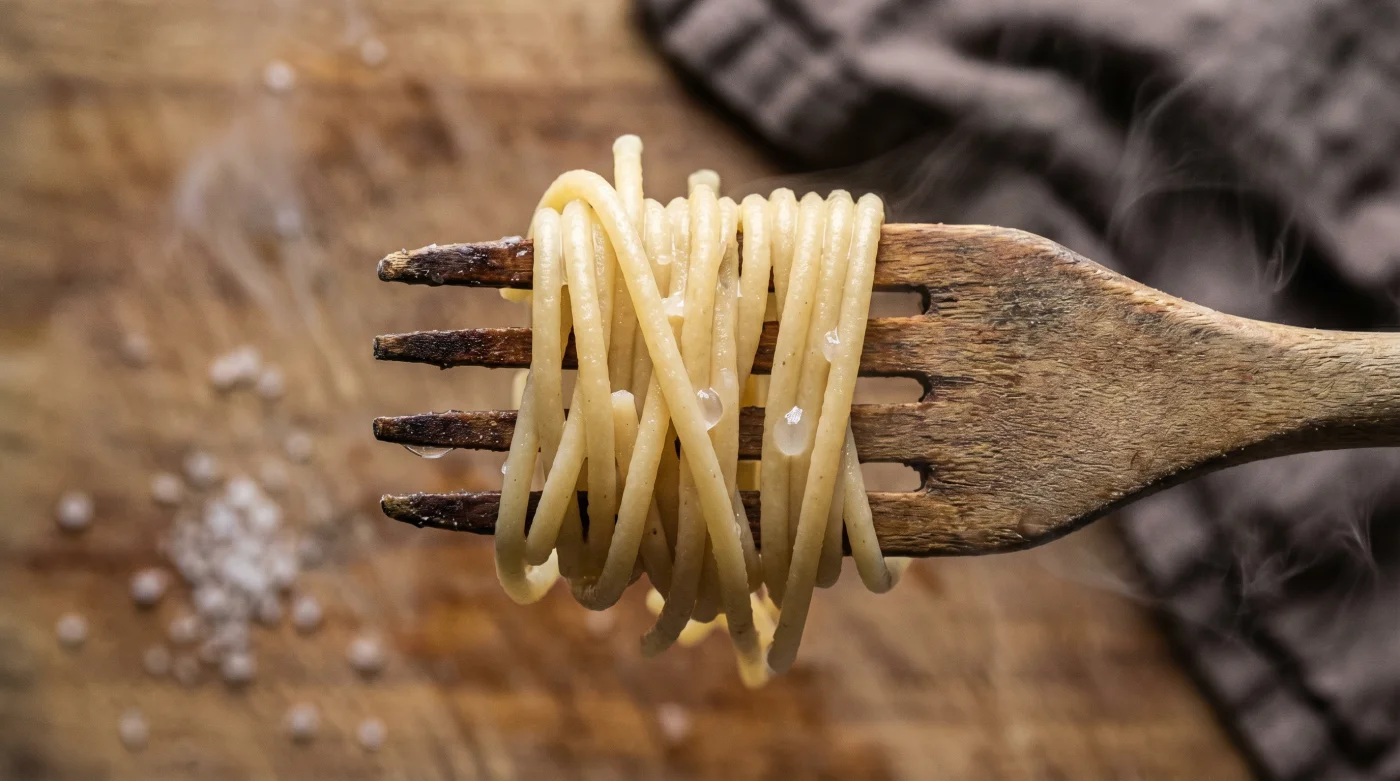
The sounds and smells of an evening kitchen settle around you. A heavy steel pot of water rumbles on the stove, the steam catching the fading afternoon light. You reach for the olive oil bottle, a comforting motion ingrained over decades of home cooking.
You tip the bottle, pouring a slick of golden fat over the violently bubbling surface, watching it pool into little iridescent coins. It is what your mother did, and her mother before her, a generational ritual designed to stop the strands clinging together.
Yet, in the steamy, clattering kitchens of Soho trattorias, that bottle of extra virgin stays firmly on the pass. To a professional chef, that well-intentioned drizzle is actively ruining your evening meal before the tomatoes have even hit the pan.
The secret to flawless, slippery ribbons of linguine or perfectly distinct tubes of rigatoni is not found in a bottle. It is found in understanding how durum wheat behaves when it hits violently hot water, stripping away the noise to reveal pure technique over habit.
The Illusion of the Golden Slick
Think of boiling pasta not as a passive cooking method, but as managing a microscopic traffic jam. When dry durum wheat hits the water, the outer layer instantly gelatinises, turning as sticky as a damp envelope waiting to be sealed.
Your human instinct is to lubricate the problem. But oil and water, as any school child knows, vehemently despise one another. That expensive glug of olive oil merely floats on the surface, doing absolutely nothing to the starch warfare happening in the depths below.
The true tragedy occurs the moment you tip the pot into the colander. As the water falls away down the sink, that oil slick drops rapidly downwards, coating your beautiful, porous pasta in a waterproof jacket. Your rich ragù or delicate carbonara will simply slide off, leaving a sad puddle of lonely sauce at the bottom of the bowl.
Marco Rossi, a 42-year-old pasta chef running a tiny, flour-dusted prep kitchen in Marylebone, watches home cooks make this mistake with quiet despair. He violently shakes a steel colander, sending clouds of steam into the extractor. “Pasta wants to be married to the sauce,” he explains. “When you oil the water, you are putting a raincoat on the bride. Give the pasta space to move, give it heat, and throw the oil away.”
Tailoring the Technique to the Shape
Not all dried pasta behaves identically in the pot. You must adapt your approach depending on the architecture of the carbohydrate you are working with, respecting its physical form.
For the long strands, like spaghetti, linguine, and bucatini, you face the greatest risk of clumping. They require an immediate, vigorous swirl with tongs the second they submerge. They bend, they tangle, and they require a watchful eye for the first ninety seconds to prevent them weaving into an impenetrable nest.
The hollow tubes, such as penne, rigatoni, and macaroni, act differently. They trap air and water within their cavities, making them less prone to nesting but giving them a stubborn habit of sitting heavily at the base of the pan. A wooden spoon, scraped firmly across the bottom, ensures they do not weld themselves to the metal.
Delicate shapes like farfalle and fusilli present another challenge entirely. Their creases and folds are beautifully designed to catch tiny morsels of meat and cheese, but they also trap dense pockets of starch. They require a generous sea of water, allowing the sticky residue to dilute heavily rather than concentrating in the tight grooves.
The Uncluttered Pot
The true professional solution to sticking requires absolutely no extra ingredients. It simply demands a shift in your physical attention at the stove. You are trading a useless addition for mindful mechanics.
First, you must give the starch somewhere to go. Cramming half a kilo of spaghetti into a tiny saucepan is a recipe for gluey disaster. Fill your largest, widest stockpot with plenty of cold water, leaving enough room for a furious boil to develop without spilling over.
Salt the water until it tastes sharply of the sea, but hold your nerve until it is rolling aggressively before adding the pasta. This is where your intervention matters most.
As the dry pieces hit the roiling water, pick up your utensil. Do not walk away to chop garlic, check your phone, or pour a glass of wine. The crucial window of starch release happens immediately.
- Wait for a true, aggressive rolling boil before the pasta goes in—the physical agitation of the bubbles separates the pieces for you.
- Stir continuously for the first two minutes. This is the precise moment when the surface starch is at its stickiest.
- Ensure you use roughly one litre of water for every 100 grams of dried pasta.
- Never rinse the pasta after draining; you desperately want that residual, microscopic starch layer to bind your sauce.
The Tactical Toolkit:
- Water Ratio: 1 Litre per 100 grams.
- Salt: 10 grams (roughly a dessert spoon) per litre.
- Crucial Window: The first 120 seconds of submersion.
- Weapon of Choice: Long metal tongs or a sturdy, flat-edged wooden spoon.
A Quieter Approach to the Stove
Stripping away the unnecessary oil is about more than just ensuring better sauce adhesion. It is a subtle exercise in trusting the physical process over the noise of inherited habits.
We so often add things to our cooking out of pure anxiety. We fear the sticking, the burning, the inevitable failure, so we throw another ingredient at the problem in a panic. Letting go of the oil is a small, quiet act of culinary confidence.
You slowly learn to rely on your own hands, your timing, and the physical properties of the food itself. A pot of aggressively boiling, generously salted water is entirely capable of looking after itself, provided you guide it safely through those first few chaotic moments.
When you eventually sit down to a bowl of perfectly dressed ribbons, the glossy sauce clinging fiercely to every single strand, you understand the quiet power of doing less. It is the purest, most honest form of home cooking.
“A flawless plate of pasta is defined not by what you hastily add to the boiling water, but by the strict discipline of what you deliberately withhold.”
| Key Point | Detail | Added Value for the Reader |
|---|---|---|
| The Oil Myth | Oil floats on the water’s surface and rapidly coats drained pasta. | Ensures your expensive, slowly simmered sauces actually stick to the food. |
| The Water Volume | 1 Litre of cold water per 100 grams of dried pasta. | Heavily dilutes the surface starch so it cannot act like a wet glue. |
| The Two-Minute Stir | Agitating the pasta immediately upon submersion in the pot. | Physically breaks the bonds of gelatinised starch before they have a chance to set. |
Common Frustrations Addressed
Should I ever add oil to cooked pasta?
Only if you are serving it stone cold in a summer salad later. If it is meeting a hot sauce in the pan, leave it entirely bare.Why is my pasta still sticking even with enough water?
Your heat is far too low. You need a violent, rolling boil to keep the individual pieces moving independently.Does the type of pan actually matter?
Yes. A wide, tall stockpot is vastly superior to a standard saucepan, as it allows the rapid bubbles to disperse the starch efficiently.Is the salt strictly there for flavour?
Primarily, yes, but it also slightly increases the boiling point of the water and microscopically roughens the surface of the pasta.What if I am cooking gluten-free pasta?
The mechanical rules are identical, but require even more vigilance in the first two minutes, as alternative starches can turn to mush rapidly.