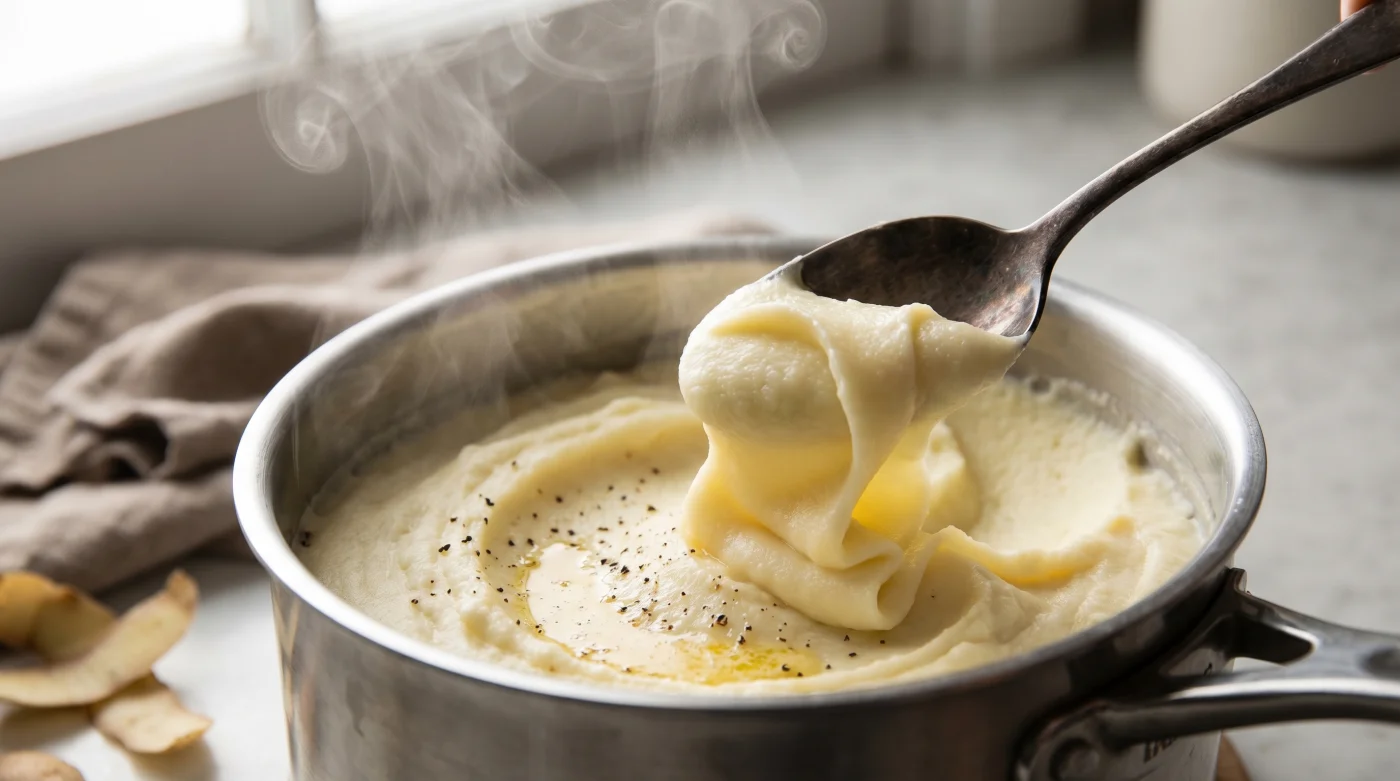
The Sunday afternoon light fades into a familiar grey dusk, casting long shadows across your kitchen worktop. Rain gently taps against the glass, while a colander sits in the sink, billowing an earthy, starchy steam that fogs the lower windowpanes. You pick up your trusty masher, anticipating the comfort of a perfect side dish, ready to turn those pale chunks into a buttery cloud.
Yet, as you carelessly pour a splash of milk straight from the cold fridge door, the mixture seizes. The potatoes tighten instantly. What was meant to be light and aerated suddenly feels heavy, dragging against the wooden spoon like wet cement.
This is the quiet frustration of the traditional British roast dinner. We spend hours tending to a joint of beef or meticulously timing Yorkshire puddings, only to falter at the final hurdle. We pour a frigid liquid directly into steaming hot starch, hoping sheer elbow grease will save the day.
To understand why this fails, you have to think of the potato not as a solid root, but as a fragile network of swollen starch cells. When hit with freezing temperatures, those cells rupture and release sticky amylose, shocking the cellular structure and forcing you to over-mix in a desperate panic. This is precisely how you create gluey dinner potato lumps.
The Thermal Shock Syndrome
When potatoes boil, their starch granules absorb water and swell. If you handle them gently, they remain intact, offering a fluffy, light texture. But the moment you introduce a severe drop in temperature, those swollen granules contract violently. The amylose within them turns rigid. This forces you to push harder with the masher, physically crushing the cells until they bleed their sticky contents into the pan.
You are no longer cooking a delicate vegetable purée; you are accidentally creating wallpaper paste. Imagine stepping out of a steaming hot bath and immediately walking into the snow. Your muscles would instantly tense, lock up, and refuse to cooperate. Your potatoes react to the temperature of your fridge with the exact same hostility.
The professional pivot here is staggeringly simple, requiring no new equipment and barely a minute of extra effort. The simple swap of heating your milk first changes the entire physics of the dish. You are no longer forcing cold fat into hot starch; you are coaxing them together.
By ensuring the dairy is warm, you allow the ingredients to merge, steeping in gentle heat until they become seamless. Think of how you dissolve sugar in a cup of tea. In hot water, the crystals vanish effortlessly, blending into the liquid. In iced water, they sink to the bottom, stubborn and gritty. The fats and sugars in your milk need that same thermal encouragement to bond with the starches in the potato.
When the dairy is already warm, the starch cells relax and open up, willingly absorbing the liquid like a dry sponge dropped into a warm puddle. The potatoes swell rather than shatter. You bypass the aggressive beating that causes glueiness, replacing it with a gentle folding motion that preserves the air you have just mashed into the pot.
The Pub Chef’s Secret
A previously mundane detail—the temperature of a few splashes of milk—becomes your greatest culinary advantage, guaranteeing restaurant-level silkiness every single time. Elias Thorne, a 62-year-old former pub chef from North Yorkshire, spent thirty years turning out hundreds of portions of mash a week for eager Sunday diners. His secret was not a complicated mechanical ricer, nor was it obscene, artery-clogging ratios of butter to potato.
Behind his chaotic line, he always kept a tiny, battered copper saucepan simmering quietly on the back burner, filled with whole milk, crushed peppercorns, and a bay leaf. He understood that treating the ingredients with thermal respect was the only way to achieve consistent, velvet perfection.
You would not dare pour freezing gravy on hot meat, he would say, wiping his hands on an apron dusted with flour, so why insult a steaming potato? His wisdom remains entirely applicable to your home kitchen.
Adapting to Your Potato Profile
Not all mashes are created equal, and knowing how to apply this warm-liquid principle to your specific household routine is what separates a chaotic kitchen from a calm one.
For the Sunday Traditionalist: If you are using whole milk and double cream, heat them together in a small pan until you see tiny bubbles forming at the edges. Do not let it boil over. The fats in the cream will melt entirely, coating the starch cells evenly for an intensely rich finish.
For the Midweek Parent: When time is running away from you and the children are hungry, the microwave is your ally. Pour your semi-skimmed milk into a heatproof jug and warm it for forty seconds. It is a tiny, practically invisible step that saves you five minutes of aggressive, frustrating mashing later.
For the Dairy-Free Pioneer: Plant-based milks, particularly oat milk, behave beautifully when warmed, but they lack the heavy fats of dairy. Add a generous spoonful of olive oil or a plant-based butter alternative to the oat milk while warming. Watch the temperature carefully; boiling plant milks can split, so remove them from the heat the moment steam begins to rise.
For those adding roasted garlic, mustard, or fresh herbs to their mash, the warm milk method offers a secondary, hidden benefit. If you add these aromatics to the milk while it heats, you create an infusion. The warmth extracts the volatile oils from the herbs, distributing flavour beautifully throughout the entire bowl, rather than leaving aggressive pockets of raw garlic.
The Five-Minute Smoothing Protocol
Moving from theory to practice requires only a slight adjustment to your timing. Implement this mindful sequence the next time you boil a pan of spuds. Gather your tools before you drain the water. You will need a colander, your masher, a wooden spoon, and a small heatproof jug or saucepan for your dairy.
Basic kitchen organisation brings instant calm to the final, frantic minutes before serving.
- Dry the spuds: After draining, return the potatoes to the hot, empty pan for sixty seconds over a low heat. Let the excess surface moisture steam away.
- Prepare the warmth: Heat your milk and butter until steam rises gently from the surface. Target roughly 60 to 70 degrees Celsius.
- Season the milk: Dissolve your sea salt and white pepper directly into the warm milk. This guarantees the seasoning permeates every single spoonful.
- Mash dry first: Break down the potatoes thoroughly before adding any liquid. This ensures you are not chasing lumps around in a milky puddle.
- Fold, do not whip: Pour the warm milk in gradually. Use a wooden spoon to fold the liquid into the mash, as if you were handling a delicate sponge cake batter. Stop the moment it comes together.
- The Rest Period: Once folded together, place a clean tea towel over the saucepan and let it sit off the heat for two minutes. This allows the starches to relax fully before serving.
Reclaiming the Sunday Table
Mastering this tiny thermal detail does much more than just improve a side dish. It removes the friction from the end of your cooking process, replacing a moment of frantic physical exertion with a quiet, satisfying stir. You pour hours of care into roasting meats, simmering gravies, and preparing vegetables.
Letting a cold splash of milk ruin the texture of your potatoes is a disservice to your own hard work. By treating the humble potato with a little basic scientific respect, you restore balance to the entire meal.
It is about finding peace of mind at the stove. Knowing exactly how ingredients interact gives you the confidence to cook instinctively, breathing through a pillow of soft starch rather than fighting against it. When you bring that steaming, perfectly smooth bowl to the table, you are not just serving dinner; you are sharing a small, quiet triumph.
The secret to beautiful food is never force; coax your ingredients into agreement, and they will reward you with perfect texture.
| Key Point | Detail | Added Value for the Reader |
|---|---|---|
| Temperature Matching | Heating milk to roughly 60-70C before adding to hot potatoes. | Prevents starch cells from seizing, guaranteeing a lump-free texture. |
| Dry Mashing First | Crushing the boiled potatoes completely before introducing liquids. | Stops lumps from floating in liquid, reducing the need to over-mix. |
| Gentle Folding | Using a wooden spoon to stir warm milk into the dry mash. | Preserves the aerated structure, ensuring the mash stays cloud-like. |
Frequently Asked Questions
Can I use a microwave to heat the milk?
Yes, a heatproof jug in the microwave for roughly forty seconds is a perfectly acceptable, time-saving method for warming your dairy.Does this trick work for sweet potatoes?
Absolutely. Sweet potatoes have a different starch structure, but they still benefit immensely from temperature-matched liquids to maintain a smooth consistency.What if I accidentally boil the milk?
Allow it to cool slightly before adding it to the pan. Boiling milk can sometimes separate, especially if using a plant-based alternative, so gentle steam is your target.Should I melt the butter into the milk?
Melting your butter directly into the warming milk is highly recommended. It creates a unified emulsion that coats the potatoes flawlessly.How do I fix mash that is already gluey?
Once the starch has turned to glue, it is difficult to reverse. However, spreading it in an oven dish, topping it with cheese, and baking it can transform a disaster into a comforting gratin.