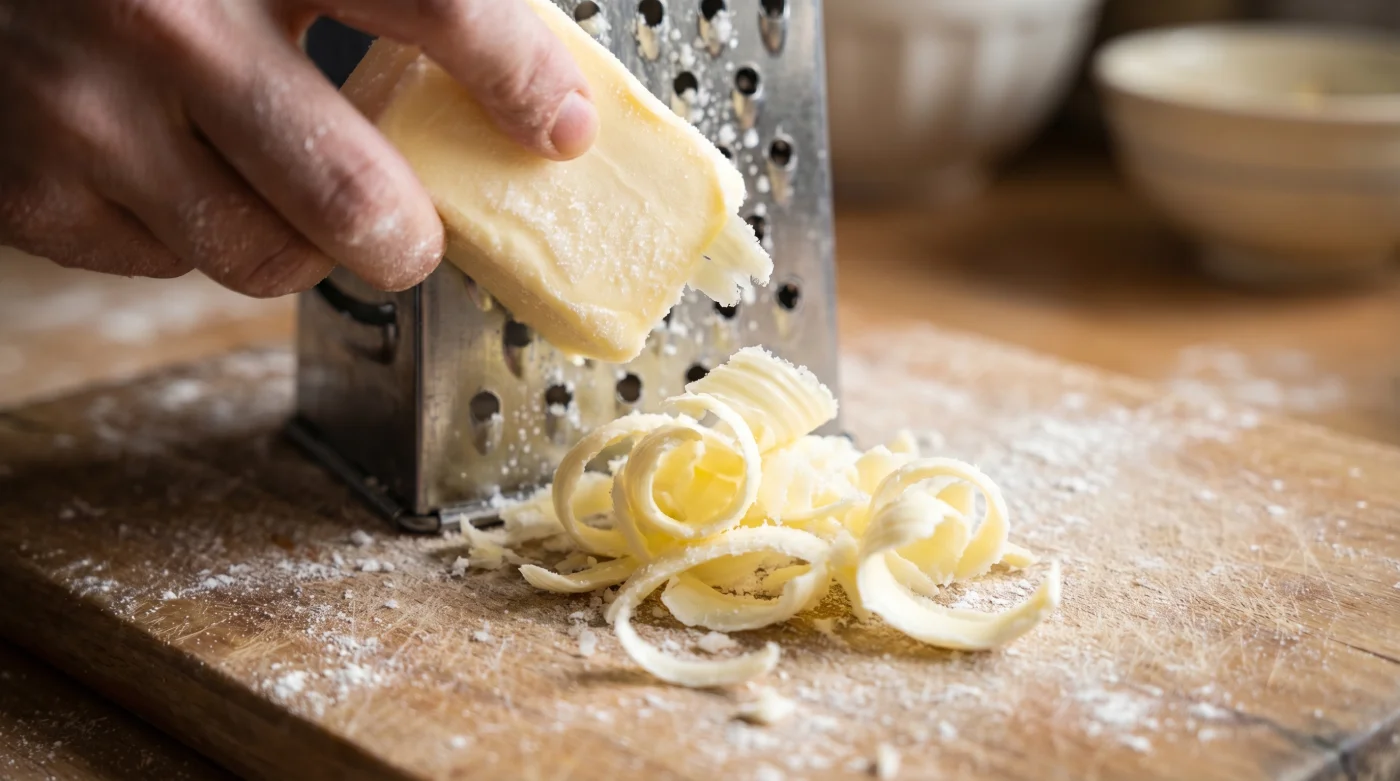
There is a specific, quiet tension that settles over a kitchen when you decide to make pastry from scratch. You weigh out the flour, you cube the chilled fat, and you begin the delicate, ancient ritual of rubbing the two together. You are told to use only your fingertips, lifting the mixture high to aerate it, praying for that elusive texture of coarse breadcrumbs.
Yet, as the minutes tick by, the ambient heat of the room and the warmth of your own hands conspire against you. The cubes begin to soften. The flour clumps. What should feel like dry, cold sand suddenly resembles a greasy, heavy paste, and you know, with a sinking heart, that your pie crust is going to bake into a dense, leaden shell.
Now, step into the prep area of a high-volume artisan bakery before the sun comes up. You will not find anyone delicately coaxing cubes of fat into flour with their fingertips. Instead, you will hear the rhythmic, metallic rasp of a heavy-duty box grater meeting a solid block of butter, fetched straight from the depths of a chest freezer.
It sounds almost violently crude, dragging frozen dairy across steel blades, yet this single pivot changes everything. Those coarse, icy ribbons of fat fall directly into the flour, perfectly sized and immaculately cold. This is not a shortcut or a desperate kitchen cheat; it is a calculated modification that guarantees the kind of aggressive, shatteringly crisp flakiness you normally pay £5 a slice for.
The Thermodynamics of a Perfect Flake
To grasp why this works, you have to stop looking at recipes as mere instructions and start seeing the architecture of your food. Think of the fat in your dough as thousands of tiny, dormant steam engines trapped in a net of gluten. When a pie goes into a hot oven, the moisture inside those isolated pockets of butter boils rapidly.
That sudden evaporation pushes the layers of flour apart, creating a structure that is lighter than autumn leaves. However, if the butter melts before it reaches the oven—if you overwork it on the kitchen worktop—those engines flood the engine room. You lose the distinct pockets, and the dough swallows the fat entirely, leaving you with a biscuity disappointment.
This is why the frozen grating method is so ruthlessly effective. By drastically dropping the temperature of the butter to sub-zero, you buy yourself precious time. The fat refuses to yield to the friction of the bowl or the ambient warmth of a standard British kitchen in mid-July.
Consider the daily reality of Eleanor Vance, a retired caterer who spent three decades turning out hundreds of Cornish pasties a week from a cramped, sweltering kitchen in St Ives. She never possessed the luxury of a marble slab or an air-conditioned larder. Her saviour was a battered aluminium box grater and a steady supply of frozen block butter. ‘Pastry smells fear, but it respects the frost,’ she would tell her apprentices. While competitors fretted over sticky dough and weeping crusts, Eleanor simply shredded her frozen butter, tossed it with a cold fork, and maintained a flawless, golden finish that kept her bakery queue stretching round the cobbled corner.
Adapting to Your Kitchen Rhythm
Not every bake demands the exact same approach, but this method flexes beautifully to fit the specific constraints of your day. Whether you are aiming for complex aesthetics or just trying to get a family dinner on the table, the frozen block provides a foundation of absolute reliability.
For the Sunday Purist, you want the romantic ritual of baking without the sheer unpredictability of traditional lamination methods. Perhaps you are attempting a delicate rough puff for a centrepiece beef Wellington. Grating the frozen block gives you those exact, uniform shards required for high-stakes folding, bypassing the arduous chilling periods between every single roll of the rolling pin.
For the Midweek Pragmatist, you are staring down a dreary Wednesday evening and a chicken pie that needs to be assembled right now. You simply do not have the hours to rest dough in the fridge twice before you can even think about turning the oven on.
Because the shredded fat is aggressively chilled from the frost, you can bring the dough together, roll it out, and drape it over your pie dish immediately. The structural integrity is already locked into the mixture, allowing you to bypass the preliminary resting phase entirely.
The Cold Mechanics of Grating
Executing this technique requires very little physical effort, but it demands absolute mindfulness. You are working with temperature just as much as you are working with ingredients. Move with purpose, keeping your bare skin away from the mixture whenever humanly possible.
Your tactical toolkit should remain incredibly minimal. Gather a 250g block of standard unsalted butter, frozen solid for at least four hours. You will also need a chilled stainless steel mixing bowl, a heavy-duty box grater, a blunt dinner knife, and a glass of water filled with actual ice cubes. This precise, unhurried, and mindful preparation is half the battle won.
Follow this specific protocol to construct your dough:
- Weigh your dry ingredients into the chilled bowl and place the grater directly inside the flour.
- Peel back just enough wrapper to expose the end of the frozen butter, holding the wrapped end to insulate the block from the palm of your hand.
- Grate the butter using the coarsest teardrop holes, stopping halfway to toss the frosty ribbons through the flour with your blunt knife.
- Once fully grated, drizzle your ice water in a tablespoon at a time, using a cutting motion with the knife until the shaggy mess just barely holds together when pinched.
Beyond the Bake
When you adopt this practice, you are doing more than just saving ten minutes of messy prep work. You are fundamentally shifting your relationship with the act of baking. Pastry has long held a reputation as a temperamental beast, a discipline supposedly reserved for those with inherently cold hands and infinite patience.
But by introducing a frozen block and a steel blade, you strip away the anxiety entirely. You stop hoping for a good outcome and start engineering one. The kitchen transforms from a space of quiet stress into a workshop of quiet competence, where the pastry shatters rather than crumbles, holding its structure as though suspended in glass.
Ultimately, cooking should feel like breathing through a pillow—soft, deep, and completely natural, not strained or forced. When you sit down at the table and cut into a pie crust that falls apart into a thousand delicate, golden flakes, you will realise that true kitchen authority does not come from working harder. It comes from understanding the physical nature of your materials, and letting the frost do the heavy lifting for you.
‘A baker who controls their temperature controls their destiny; the freezer is just as vital an instrument as the oven.’ — Eleanor Vance, Master Baker
The Frozen Butter Matrix
| Key Point | Detail | Added Value for the Reader |
|---|---|---|
| Friction Defence | Grating drastically limits contact with warm skin. | Eliminates the risk of a dense, heavy crust caused by melted butter. |
| Structural Evenness | The teardrop blades create uniform fat distribution. | Ensures every single bite has identical flakiness and lift. |
| Time Economy | Skips the initial double-chill required by rubbing in. | Takes a pie from raw ingredients to the oven in absolute record time. |
Frequently Asked Questions
Can I use margarine or baking spread instead of block butter?
No. Spreads contain too much water and too little fat. They will not freeze to the required solid state, resulting in a soggy, compromised dough.Do I need to freeze the flour as well?
It is not strictly necessary, but keeping your flour in the fridge or freezer for thirty minutes beforehand offers an excellent extra layer of thermal protection on a hot day.How long does the block butter take to freeze solid?
Aim for at least four hours, though leaving a spare block in the freezer permanently means you are always ready to bake on a whim.Will a cheap grater work, or do I need a specific brand?
Any standard box grater works perfectly, provided you use the large teardrop holes. Avoid microplanes, which will turn the butter into an unusable snow.Can I grate the butter into a food processor?
You can, but it defeats the purpose. The friction of the spinning metal blades will generate heat and undo the hard work the freezer just did.