You pull the baking tray from the oven, anticipating a golden, towering crown of crisp layers. Instead, the edges have collapsed inwards, pulling away from the ceramic rim of your pie dish. It is a familiar, quiet frustration, watching a beautiful supper lose its architectural grace in the final moments of cooking.
The butter has melted before the flour could set. The pastry slumps like tired shoulders, leaving exposed filling bubbling over the sides and a dense, chewy crust where you wanted shatteringly crisp flakes. It feels as though the dough has simply given up, retreating from the heat rather than rising to meet it.
Most packet instructions insist on a slow thaw. We are taught to leave it on the counter, watching it turn from a stiff board into a pliable, slightly clammy sheet. Yet, this well-meaning habit of bringing the dough to room temperature is exactly what sabotages the final lift, making the butter too soft to perform its essential duty.
The true professional approach is an exercise in impatience. Choosing to be stubborn and baking directly from frozen bypasses the danger zone entirely, forcing the butter to create steam instantly rather than bleeding slowly into the flour.
The Architecture of Cold Butter
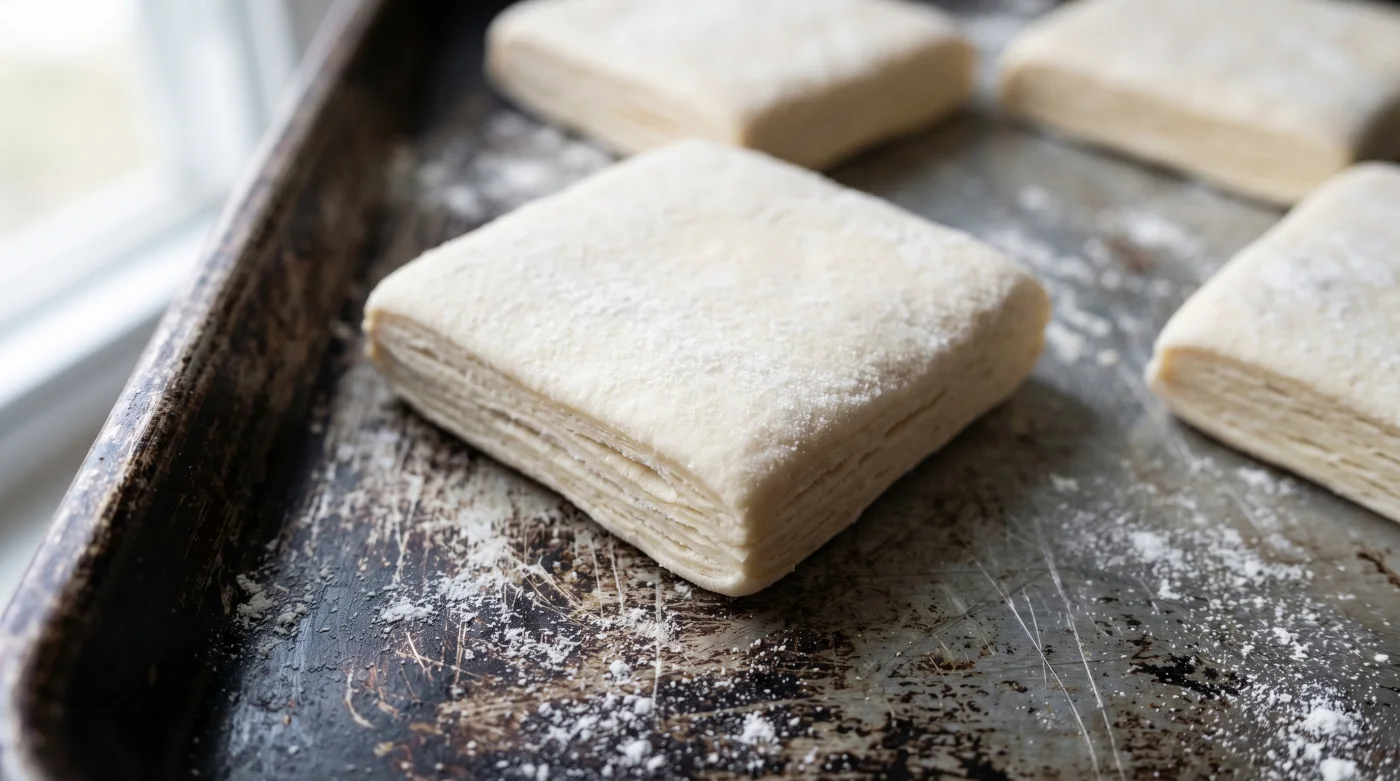
Think of puff pastry not as a solid piece of dough, but as a fragile suspension bridge. It relies on hundreds of microscopic layers of solid fat trapped between sheer sheets of wheat protein. It is a structure entirely dependent on the contrast between extreme cold and sudden, intense heat.
When you allow those fat layers to warm up on a kitchen counter, the structural integrity collapses. The butter softens, the layers fuse, and the dough shrinks, sighing heavily into a puddle like breathing through a pillow. The distinct boundaries that create flakiness are lost before the baking tray even touches the oven rack.
By introducing a frozen block to an intensely hot environment, you shock the system in the best possible way. The water inside the icy butter turns to steam so violently that it pushes the flour upwards, setting the protein before it has any chance to retreat or shrink back into itself.
Meet Eleanor, 42, a senior pastry chef working the early shift in a high-volume Bath brasserie. For years, she watched junior cooks carefully defrost sheets of puff pastry for the lunchtime chicken and leek pies, only to spend their afternoons trying to disguise the shrunken lids. One morning, running two hours behind schedule, she slammed frozen, pre-cut discs straight onto the hot pie fillings and shoved them into a 220°C oven. The resulting pastry was a perfectly pristine, towering lid that remained exactly where she had placed it. This lazy fix immediately became her kitchen’s standard operating procedure.
The Five-Minute Preparation Strategy
Adapting this viral prep method to your own kitchen requires a slight shift in how you organise your ingredients. It is about working with deliberate speed rather than lingering over delicate folds.
You are no longer waiting for dough to become workable. You are acting decisively, treating it like glass rather than a lump of malleable clay. Handling it this way prevents the warmth of your fingertips from compromising the butter.
Here is your tactical toolkit for mastering the frozen bake without a moment of hesitation:
- Keep it flat: Store your pastry boxes flat in the freezer so the sheets remain perfectly level and ready to use immediately.
- The hot knife: Run your kitchen knife under boiling water, dry it quickly, and slice the frozen pastry with firm, downward pressure to prevent sealing the fragile edges.
- High heat: Ensure your oven is fully preheated to 200°C (Fan 180°C) before the pastry even leaves the freezer drawer.
- Instant egg wash: Apply a thin layer of beaten egg over the frozen surface just seconds before baking, avoiding the cut edges so the layers can rise freely.
Adapting the Freeze for Different Bakes
Not all puff pastry creations are built the same, and your approach to the frozen method should flex depending on what you are pulling together for supper. The technique adjusts beautifully to various culinary demands.
For the quick savoury tart, simply score the frozen borders with a sharp paring knife, then spread your mustard and layer your thinly sliced tomatoes directly onto the icy centre before roasting.
If you are constructing a pot pie, the residual heat of your hot stew filling will begin to gently soften the underside of the frozen pastry lid. This creates a natural seal against the pie dish rim while the top remains bitterly cold and ready to puff dramatically.
When making sweet mille-feuille layers, you want intense crispness without the height. Simply weigh the frozen sheet down with a second baking tray and a sheet of greaseproof paper to enforce a dense, caramelised finish that snaps perfectly under a fork.
A Quieter Kitchen Routine
Mastering this specific detail does more than just rescue the appearance of your Sunday dinner. It fundamentally changes the rhythm of your cooking, removing a tedious, time-sensitive step from your mental checklist.
Letting go of the thawing process buys you precious time, turning an anxious waiting game into a five-minute assembly job. It is a rare instance where taking the genuinely easier route yields a technically superior, visually stunning result.
You are no longer fighting the ingredients or worrying about sticky dough clinging to the work surface. By keeping the pastry aggressively cold, you are respecting its true nature, allowing the oven to do the heavy lifting while you pour yourself a drink and watch the transformation happen through the glass.
The secret to shatteringly crisp layers isn’t finesse, it’s temperature shock; let the oven do the work while the butter is still asleep.
| Key Point | Detail | Added Value for the Reader |
|---|---|---|
| Skip the Thaw | Move pastry directly from freezer to hot oven. | Saves 40 minutes of prep time and prevents sticky, frustrating handling. |
| Hot Knife Slicing | Cut frozen sheets with a warmed, dry blade. | Maintains clean, uncompressed edges for maximum vertical lift. |
| Instant Egg Wash | Glaze the frozen surface just before baking. | Ensures an even, deep golden finish without dragging the dough. |
Essential Pastry Troubleshooting
Can I shape frozen puff pastry?
No, this method works for flat applications like pie lids, tart bases, and flat squares. If you need to twist, fold, or braid the dough, a brief partial thaw is necessary.
Will the middle bake through properly?
Yes, the intense heat penetrates the thin layers rapidly. Just ensure your oven is fully up to temperature before the pastry goes in.
What if I buy it in a solid block rather than pre-rolled sheets?
You will need to thaw the block enough to roll it out with a pin, but you should immediately freeze the rolled sheet flat for twenty minutes before baking to lock the structure again.
Does the pie filling need to be cold or hot?
For pot pies, a piping hot filling works brilliantly under a frozen lid. For open tarts, use room temperature ingredients to avoid dropping the surface temperature.
How long does the frozen bake take compared to thawed?
It typically adds merely two to three minutes onto your standard baking time, making it an incredibly efficient swap for your weekly cooking routine.