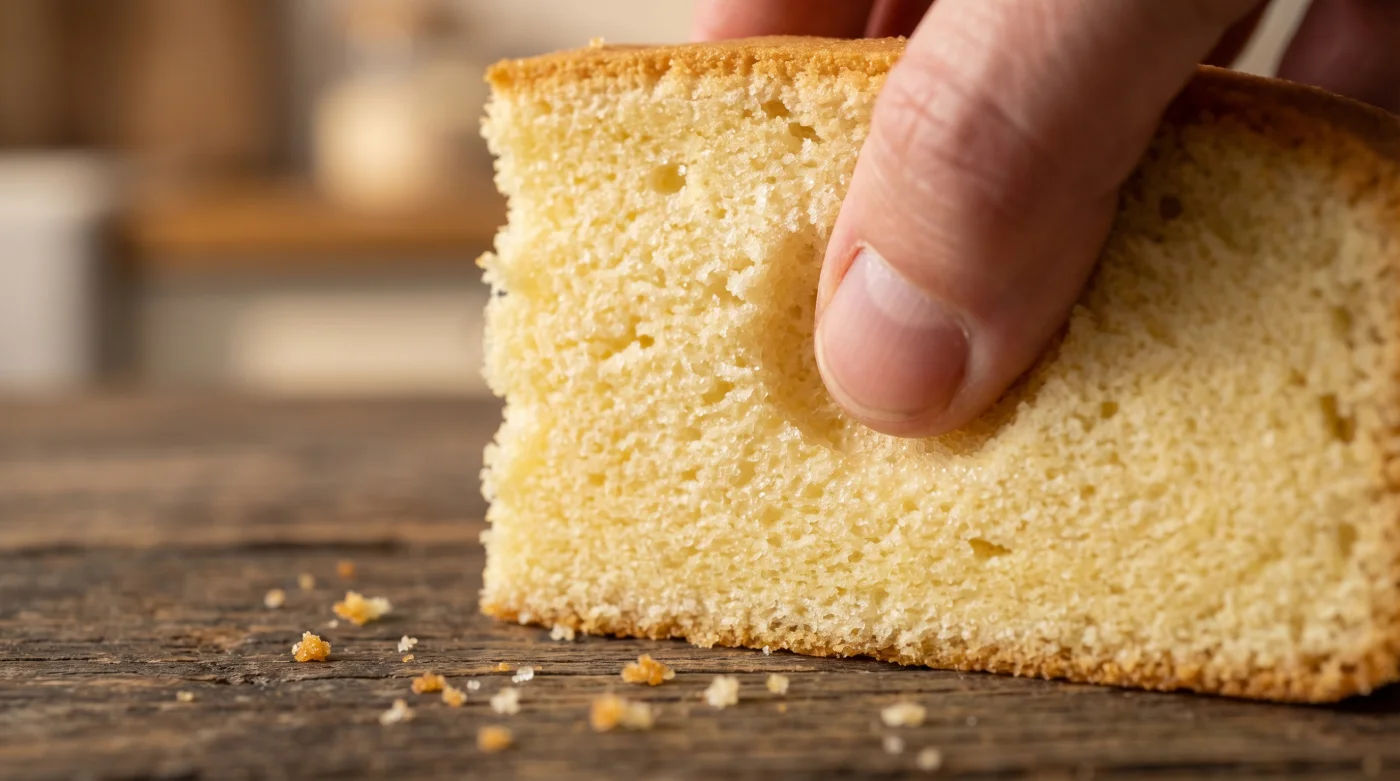
The scent of roasting sugar and butter fills the kitchen, a promise of comfort on a grey afternoon. You pull the tin from the oven, turn out the golden disc onto a wire rack, and wait. But when the bread knife finally glides through, the reality is stark. The crumb falls away into dry, dusty fragments on the plate, leaving you with a bake that feels more like an endurance test than a treat.
It is a quiet frustration known to anyone who regularly fires up their oven for a weekend bake. You followed the measurements to the gram, yet the resulting cake feels heavy, demanding a strong cup of tea just to swallow comfortably. This rigid home-baking trap relies entirely on traditional fat-to-flour ratios, leaving remarkably little room for the environmental variables that plague domestic kitchens.
Meanwhile, the thick slices sitting in the glass cloche of your favourite local bakery seem to defy physics. They stand tall and proud, yet yield to a pastry fork with a gentle, damp sigh. They possess a tender structure that outright refuses to dry out, even on their third consecutive day on display upon the worktop.
The secret behind that cafe-style resilience is not a complex industrial additive or a temperamental whisking technique. It is a remarkably simple professional pivot—a subtle modification that fundamentally alters how gluten and moisture behave in the fierce heat of your oven. You only need to open the fridge door and reach for a common morning staple.
The Perspective Shift: Rethinking Hydration
When we construct a cake batter, we are essentially building a temporary house out of flour proteins. Most standard recipes ask you to hydrate those proteins with milk and tenderise them with butter. But milk is thin, and butter, despite its incredibly rich flavour, solidifies once the cake cools down to room temperature, inevitably firming up the crumb.
This is where we must drastically change our approach. Think of your batter less as a rigid chemical formula and more as a living, breathing system. When you add Greek yogurt to cake batter for soft sponges, you are not just adding wetness; you are fundamentally changing the internal architecture. The lactic acid present in the thick yoghurt acts like a pair of microscopic scissors, gently snipping the long, tough gluten strands before they have a chance to tighten into rubbery bands.
We often view acidity in baking strictly as a tool for flavour, a sharp note deployed merely to balance the cloying sugar. But in this context, the slight tang is a purely secondary benefit. The true advantage of that thick, cultured dairy is how it forces the crumb to remain suspended in a permanent state of soft hydration, turning a mundane dairy product into your greatest structural ally.
Consider the daily reality of Martin Hughes, a 42-year-old pastry chef who runs a high-volume independent bakery in the damp, cobbled lanes of Edinburgh. Martin produces hundreds of loaf cakes a week, and he abandoned standard milk entirely five years ago. “People mistakenly think a moist cake is about melting in more butter,” he notes, scraping down the sides of a massive aluminium mixing bowl. “But excess butter just makes the sponge greasy. Full-fat Greek yoghurt gives the batter a plushness. It makes the cream tremble.” For Martin, swapping out standard liquid was the vital, structural professional pivot that allowed his delicate bakes to maintain their bakery-fresh texture long after they had travelled home in a cardboard box.
Adapting the Swap for Every Tin
Not all sponges demand the exact same treatment. The beauty of this thick dairy addition lies in its inherent versatility, adapting seamlessly to the specific demands of whatever you happen to be mixing on the worktop.
For the Citrus Purist
When working with lemon, orange, or grapefruit, the natural tang of the yoghurt works in perfect tandem with the zest. It amplifies the bright fruit notes without requiring extra juice, which often waters down the batter and leads to a dense, claggy base at the bottom of the tin.
For the Chocolate Devotee
Cocoa powder is notoriously thirsty. It absorbs moisture rapidly, which is why so many home-baked chocolate cakes lean towards the dry, powdery side. Folding in a generous spoonful of Greek yoghurt coats the cocoa particles in a protective layer of fat and acid, ensuring the final slice feels dense, fudgy, and intensely rich.
For the Victoria Sponge Traditionalist
If you are chasing an incredibly airy, cloud-like sponge, you might worry the sheer weight of the thick dairy will drag the rise down. The trick here is partial substitution. Replacing just a quarter of the butter with yoghurt maintains the vital structural lift while introducing that elusive, lingering softness to the crumb.
The Mechanics of the Perfect Fold
Executing this swap requires a remarkably gentle hand rather than aggressive, frantic whisking. To achieve the perfect moist crumb texture, you must respect the temperatures of your raw ingredients before they ever meet in the bowl.
Cold dairy will aggressively shock a warm, creamed butter mixture, causing the fragile batter to curdle and split into an unappealing, grainy mess. You must always allow the deep chill to drop from your ingredients. Let them sit on the worktop until they feel completely neutral to the touch.
When the time comes to combine, follow these mindful steps to ensure a flawless integration that protects your sponge:
- The Temperature Base: Ensure your Greek yoghurt has sat out of the fridge for at least forty minutes.
- The Wet Integration: Gently whisk the yoghurt into your beaten eggs and vanilla extract before introducing them to the creamed butter and sugar.
- The Gentle Fold: Once the sifted flour is added, switch immediately to a flexible silicone spatula. Fold the mixture by slicing down the middle and pulling up the sides, stopping the very second the last streak of white flour disappears.
- The Heat Adjustment: Because yoghurt-enriched batters are noticeably denser, drop your oven temperature by 10 degrees Celsius (or half a gas mark) and extend the baking time by five to eight minutes to prevent the outer edges from catching before the centre sets.
Beyond the Baking Tin
Mastering this subtle shift in your baking routine does far more than simply yield a better dessert for the weekend. It fundamentally removes the underlying, quiet anxiety of baking for a crowd of expectant friends or family.
There is a specific, sinking dread associated with slicing into a cake for guests, quietly praying the interior isn’t desert-dry. By leaning on the structural insurance of cultured dairy, you reclaim your kitchen peace of mind. You no longer have to frantically time your baking to the exact minute your guests arrive at the door, safe in the knowledge the sponge will be just as soft on a Tuesday morning as it was when it left the oven on Sunday afternoon.
It transforms the act of baking from a high-wire act of precise timing into a relaxed, forgiving practice. You are left with a quiet confidence, knowing that whatever tin you pull from the heat, the result will be a cake that practically melts on the tongue, offering pure, unadulterated comfort with every single forkful.
“A truly great sponge doesn’t just taste sweet; it holds onto its moisture like a tightly kept secret, refusing to let go long after the oven is turned off.”
| Key Point | Detail | Added Value for the Reader |
|---|---|---|
| Acidic Tenderisation | Lactic acid actively shortens tough gluten strands during mixing. | Prevents dense, chewy textures, ensuring a delicate bite. |
| Fat Suspension | Yoghurt retains fat at room temperature better than melted butter. | Keeps the cake tasting freshly baked for up to four days. |
| Thermal Protection | The thicker batter insulates the crumb from harsh oven heat. | Reduces the risk of dry, burnt edges on your sponge. |
Frequently Asked Questions
Can I use low-fat or fat-free yoghurt instead?
It is highly recommended to stick to full-fat versions. Low-fat options contain higher water content and stabilisers, which can make the sponge rubbery rather than soft.Does the cake taste sour after baking?
Not at all. The heat neutralises the sharp acidity, leaving behind a rich, rounded depth of flavour without any overt sourness.How much yoghurt should I substitute for milk?
If a recipe calls for milk, swap it out exactly gram for gram with Greek yoghurt, but thin the yoghurt with a tiny splash of water if the batter feels too stiff to drop from a spoon.Will this affect my baking powder or soda?
Yes, the acidity will react strongly with bicarbonate of soda, giving your cake an extra lift. If your recipe only uses baking powder, the yoghurt will still work perfectly for texture.How should I store a yoghurt-based sponge?
Keep it in an airtight container at room temperature. Putting it in the fridge will cause the starches to crystallise and dry out the crumb prematurely.