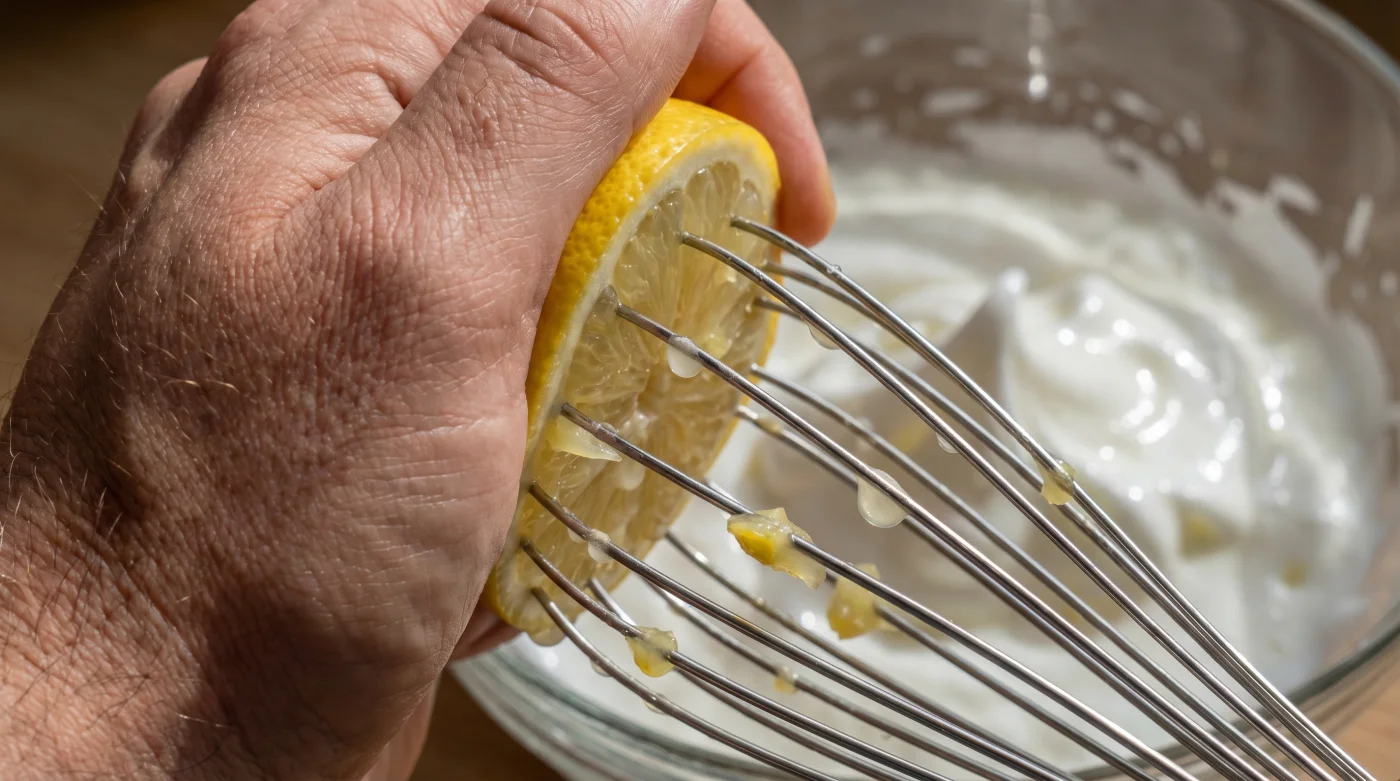
Picture a late Sunday afternoon in your kitchen. You are standing over a stainless steel bowl, your forearm aching, listening to the hollow, rhythmic clatter of wire against metal. You have been whisking for what feels like an eternity, yet the translucent, yellowish sludge at the bottom refuses to budge. The air in the room is warm, and your patience is wearing frighteningly thin.
The familiar dread settles as you watch those stubborn bubbles collapse back into liquid. We have all been taught that achieving a glossy, voluminous cloud of meringue requires exceptional stamina and perhaps a bit of luck. You might blame the eggs, the temperature of the room, or your own technique. But the truth often lies hidden in an invisible film clinging to your supposedly immaculate mixing bowl.
There is a lazy fix hiding right now in your fruit bowl. It is a deceptively simple trick that transforms a frustrating ten-minute forearm workout into a near-instant victory. Forget the dusty packets of cream of tartar languishing at the back of the cupboard; the sharp, clean mist of a freshly cut lemon is the only intervention you actually need.
The Architecture of a Cloud
Stacking slippery wet balloons in a windstorm is the closest approximation to whipping egg whites. When you drag a whisk through the liquid, you are untangling tightly coiled proteins and forcing air between them. Those proteins naturally want to snap back into their comfortable, curled-up shapes, which is why the foam so often collapses before you can add your sugar.
A single microscopic droplet of grease acts like a pin popping those balloons. Even if your bowl has just come out of the dishwasher, invisible oil residues from last week’s buttercream linger on the surface, entirely sabotaging your efforts. This is where the mundane half-lemon, usually relegated to a garnish, steps in as an invisible structural scaffolding.
Obliterating the invisible sabotage, the natural acidity slices straight through those lingering fat molecules. Simultaneously, it leaves behind a sheer layer of citric acid that gently relaxes the egg proteins, allowing them to bond securely and form firm, trembling peaks in a fraction of the time.
The Pastry Chef’s Secret
Eleanor, a 42-year-old independent baker running a cramped but beloved patisserie in the damp heart of Bath, relies entirely on this method. Working in a basement kitchen where the morning humidity often feels like breathing through a warm flannel, she simply cannot afford to let her macarons fail. ‘People think you need an expensive vintage copper bowl to get that perfect stiffness,’ she notes, wiping her hands on an apron heavily dusted with icing sugar. ‘But a brisk wipe with yesterday’s leftover lemon wedge cuts my whipping time in half. It acts like an anchor. It is the cheapest, most reliable insurance policy in my kitchen.’
Tailoring the Technique to Your Kitchen
The mechanical advantage fails if the chemistry is wrong, which is why this method adapts beautifully whether you are using traditional hand tools or a modern appliance. For the hand-whisk martyr, relying entirely on elbow grease, this acidic layer means you are no longer fighting the bowl. You are simply folding air into a highly receptive liquid, reducing the physical strain on your wrists dramatically.
For the stand mixer devotee, you likely trust the machine to do the heavy lifting. Yet, even powerful motors struggle against invisible fats. A quick swipe of citrus ensures the whisk attachment actually catches the proteins instead of just pushing them uselessly around the perimeter. It prevents over-beating, saving you from the grainy, separated mess that ruins a good pavlova.
Moisture weighs down structure, making this particularly vital if you are baking in a humid environment. If you live in an old, damp British cottage or are baking on a rainy Tuesday, moisture in the air will naturally weigh down your foam. The lemon juice acts as a chemical barrier, keeping the structural integrity sound even when the environment is working against you.
Executing the Lazy Fix
Putting this into practice requires almost zero extra effort. You simply need to adjust your preparation routine by about ten seconds. Treat the cold metal surface of your bowl as a blank canvas waiting to be properly primed for the task ahead.
Approach the bowl mindfully, laying out your tools before you crack a single shell. Here is the exact process to guarantee stiff peaks instantly, without the usual mess or anxiety.
- Slice a fresh lemon in half (even a slightly tired one from the fridge drawer will do perfectly well).
- Rub the exposed flesh firmly against the entire inner bowl, ensuring you reach the bottom curve.
- Wipe the wires of your whisk with the same lemon half.
- Wipe away any visible puddles of juice or stray pips with a clean paper towel, but do not rinse with water.
- Add your perfectly separated egg whites and begin whisking immediately.
Tactical Toolkit: Always opt for a stainless steel or glass bowl, as plastic absorbs grease permanently. Ensure your egg whites are sitting at exactly room temperature (roughly 21 degrees Celsius) before you start. Begin whisking at a slow pace for the first minute to establish a foamy base, then increase to medium-high. You can expect stiff, glossy peaks in under three minutes.
The Quiet Confidence of Control
Shifting from anxious chore to a fluid, calming meditation, baking changes when you stop fighting the ingredients and start manipulating the physical environment they exist in. The quiet dread of weeping meringues and flat sponges simply dissipates, replaced by the rhythmic, satisfying sound of a job well done.
Reclaiming your kitchen authority means trusting these quiet, chemical processes. You are no longer crossing your fingers and hoping the weather is right; you are laying down a guaranteed foundation. It proves that the most powerful culinary solutions are rarely found in expensive electronic gadgets, but in understanding how the humble, everyday elements sitting on your chopping board can be made to work tirelessly for you.
‘Acid is the invisible architect of the pastry kitchen; it builds walls out of water and protein before you even turn on the oven.’
| Key Point | Detail | Added Value for the Reader |
|---|---|---|
| The Acid Barrier | Citric acid breaks down invisible grease and relaxes coiled proteins. | Saves you from throwing out ruined batches and wasting expensive eggs. |
| Equipment Protection | Works on glass and stainless steel tools. | Prevents the need to purchase bulky, expensive copper mixing bowls. |
| Time Efficiency | Reduces physical whisking time by up to fifty percent. | Saves your arm strength and gets the dessert in the oven faster. |
Frequently Asked Questions
Can I use bottled lemon juice instead of a fresh lemon? Fresh is best because the physical rubbing action helps dislodge grease, but wiping a paper towel dampened with a few drops of bottled juice works in an absolute pinch.
Will my meringue taste like lemon? Not at all. The microscopic amount of juice left behind is entirely overpowered by the sugar and natural flavour of the eggs.
Does this work for whipping double cream? No, this is specifically for egg whites. Adding acid to double cream will cause it to curdle and separate instantly.
What if a drop of egg yolk gets in the bowl? Yolk contains fat. If a speck gets in, try to fish it out with a piece of the eggshell. If it has mixed in entirely, the lemon rub might not be enough to save it, and you may need to start fresh.
Can I use a lime or an orange? A lime has similar acidity and works well, but an orange is far too sweet and lacks the necessary acidic punch to stabilise the proteins effectively.