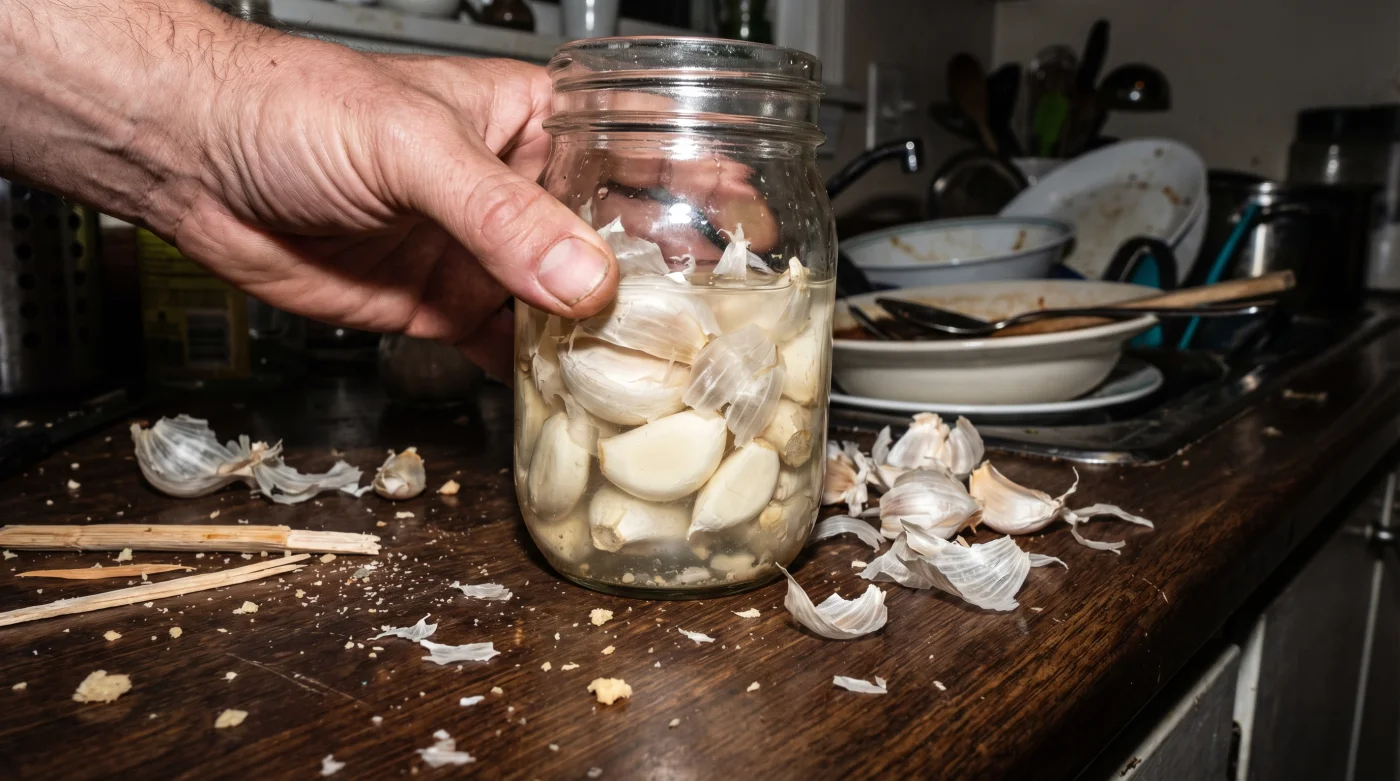
You know the exact feeling. You are standing at the kitchen counter, the rain drumming softly against the windowpane, staring down at a bulb of garlic. The recipe demands four minced cloves, but your hands are already faintly damp from rinsing vegetables. As you pry a single segment loose, the papery skin clings to your thumb like static. You pick, you scrape with your fingernails, and the thin membrane shatters into maddening, sticky confetti that refuses to let go. The scent binds to your skin, lingering for days despite vigorous scrubbing with lemon and stainless steel.
This tedious culinary friction is the quiet tax we pay for robust, warming flavours. Most of us accept the sticky fingers, the fragmented papery mess on the chopping board, and the scent trapped beneath our nails as an unavoidable penalty of cooking from scratch. We smash the clove with the flat of a heavy kitchen knife, hoping the skin splits cleanly, only to find the bruised, weeping flesh stubbornly fused to its wrapper, demanding even more delicate, frustrating picking.
But there is a radically different approach waiting in your cupboards, one currently surging across professional prep stations and viral cooking feeds alike. It requires no specialised silicone tubes, no expensive gadgets, and no delicate knife work whatsoever. Instead, it asks you to treat your daily prep work less like cautious surgery and more like aggressive, rhythmic percussion, altering your entire relationship with this foundational ingredient.
The Kinetic Shift in Prep
We are taught to treat garlic gently until the exact moment it meets the blade. You might carefully peel back the outer layers as if unboxing a fragile, ancient artefact, terrified of damaging the flesh within. Yet, the biological anatomy of an allium is entirely unsuited to this delicate unpicking. The skin is inherently brittle, dry, and fibrous, while the clove itself is firm, dense, and highly resilient to blunt impact.
To conquer the bulb, you must apply blunt force. Think of the papery wrapper not as a soft skin to be peeled away, but as a rigid shell to be shattered. By trapping the cloves inside a hard-sided vessel and introducing violent kinetic energy, you force the garlic to do the actual labour for you. The cloves batter against each other and the unyielding walls of the jar, creating thousands of microscopic fractures in the dry skin until it simply surrenders and falls away.
It is a loud, unapologetically aggressive, and deeply satisfying subversion of traditional, quiet kitchen etiquette. The acoustic feedback itself becomes a tool. You will hear the initial dull, muffled thuds of skin-covered cloves gradually shift into the sharp, bright rattle of naked garlic striking glass, signalling that the job is complete without you ever needing to look inside.
Consider Arthur Pendelton, a 58-year-old prep chef working in the subterranean kitchen of a frantic Soho brasserie. Every morning, before the delivery lorries have even finished reversing down the narrow, rain-slicked streets of London, Arthur is tasked with processing three kilogrammes of fresh garlic for the daily service. The air is thick with the smell of roasting bones and bleaching fluid. Speed is his only currency. He does not sit hunched over a cutting board with a paring knife, meticulously undressing each individual clove.
Instead, he works with the rhythm of a bartender. He drops handfuls of separated segments between two large aluminium mixing bowls, clamps them shut rim-to-rim, and shakes them with sudden, violent intensity. Within twenty seconds, he opens the bowls to reveal a mountain of perfectly stripped, pristine garlic, entirely untouched by human hands. The domestic equivalent of Arthur’s brass-tacks, high-volume efficiency is sitting right there in your recycling bin: a simple, empty jam jar.
Tailoring the Technique to Your Kitchen
Not every meal requires a mountainous volume of aromatics. How you apply this concussive, viral method depends entirely on the specific rhythm of your cooking and the scale of the feast you are preparing. The beauty of the jar method lies in its endless adaptability to your immediate environment.
For the Sunday batch cooker, preparing a massive base for a rich, slow-cooked ragù or freezing portions of an aromatic curry paste, you need to upgrade your vessel. A large Kilner jar or two identical ceramic bowls held tightly together will easily accommodate an entire shattered bulb at once. The sheer mass of the cloves colliding accelerates the friction, stripping twenty segments in the exact time it takes the kettle to boil for your morning tea.
Conversely, the midweek soloist faces a different scenario. When a quick, fiery stir-fry calls for just two modest cloves, deploying a massive storage jar is simply overkill. Keep a washed-out mustard or caper jar permanently stationed by the stove. It provides the perfect, confined architectural space to violently rattle a small pair of cloves, preventing them from simply bouncing gently and uselessly off the distant glass walls.
For the zero-waste pragmatist, this violent shaking yields an unexpected secondary benefit: a distinct, clean separation of naked cloves and papery husks. Do not impulsively sweep those dry skins into the food waste bin. They are packed with residual, earthy flavour. Scoop the discarded husks into a freezer bag; they act as a brilliant, rustic addition when simmering your next batch of homemade chicken or vegetable stock, straining out later to leave a deep, roasted undertone.
The Tactical Toolkit: Mindful Application
Executing this rapid prep trick requires a specific, intentional choreography. It is not merely about rattling glass aimlessly; it is about engineering the exact right environment for maximum friction. Gather your tools and prepare your workspace.
Approach the kitchen counter with deliberate, minimalist intent. You will need a sturdy glass jar with a tight-fitting metal lid, a firm surface to press the bulb against, and a willingness to generate a brief burst of loud noise.
- Place the entire, intact garlic bulb on your heaviest chopping board and press down firmly with the heel of your hand to shatter the dried root base, easily separating the individual cloves.
- Drop the required number of unpeeled cloves into your completely dry, empty jar. Ensure the jar is no more than thirty percent full; the garlic desperately needs empty airspace to gain momentum and crash.
- Screw the lid on as tightly as possible. Grip the jar firmly with both hands, adopting a slightly wide, grounded stance for physical balance.
- Shake the jar violently up and down for exactly fifteen seconds. You want to hear the heavy, percussive thud of the cloves hitting the metal lid and the thick glass base with genuine force.
- Empty the chaotic contents onto your board. The papery skins will gently drift away, leaving behind bare, smooth garlic ready to be crushed, sliced, or minced.
Reclaiming the Rhythm of Cooking
There is something profoundly grounding about mastering these small, fiercely practical physical efficiencies. Cooking at home often feels like a relentless race against the clock, a frantic, breathless juggle of simmering pans, ticking oven timers, and mounting piles of washing up. When you successfully eliminate the frustrating, microscopic tasks that stall your momentum, you buy back precious moments of mental clarity.
By replacing tedious picking with fifteen seconds of percussion, you radically transform an irritating daily chore into a brief, exhilarating burst of active energy. You step away from the sink with clean, scent-free hands, holding perfectly prepped ingredients that are immediately ready for the pan. It reminds us beautifully that the kitchen does not always demand delicate, quiet patience; sometimes, a bit of noisy, applied physics is exactly what a dark Tuesday evening dinner truly requires to get moving.
“Treat prep work not as a hurdle, but as a percussion instrument; sometimes the most aggressive methods yield the most pristine results.” — Arthur Pendelton
| Key Point | Detail | Added Value for the Reader |
|---|---|---|
| Jar Selection | Use thick glass with a metal lid (e.g., jam jars). | Prevents breakage and creates optimal kinetic friction. |
| Air Space | Fill the vessel to a maximum of thirty percent capacity. | Ensures cloves have sufficient room to accelerate and collide. |
| Skin Retention | Freeze discarded husks in an airtight bag. | Creates a zero-cost flavour base for homemade broths. |
Frequent Kitchen Queries
- Can I use a plastic container instead of a glass jar? Plastic absorbs the impact, dampening the sharp kinetic friction required to shatter the skins. Glass or aluminium is highly recommended.
- Does this bruise the garlic and alter the flavour? The impact is entirely superficial. Unless you are storing the peeled cloves for several days before cooking, it will not negatively impact your dish.
- What if the skins are unusually stubborn and slightly damp? Very fresh, newly harvested garlic might resist the shake. Give the cloves a firm roll on the counter before placing them in the jar.
- Do I need to trim the root ends first? No, the violent shaking is usually sufficient to detach the skin from the dry basal plate without requiring any preliminary knife work.
- How long should the peeled cloves be kept in the fridge? Naked cloves lose their natural protective barrier rapidly. Use them immediately, or submerge them in olive oil and consume within two days.