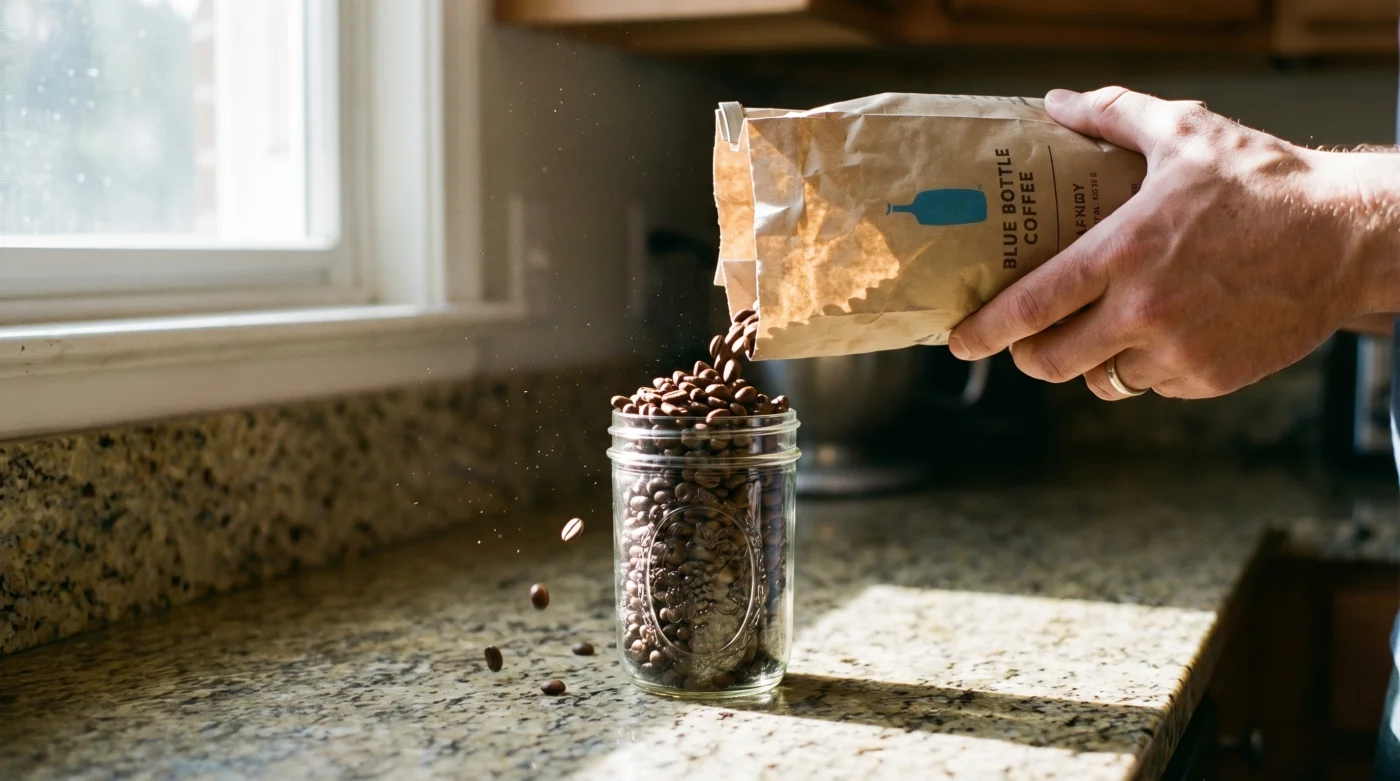
You drag yourself into the kitchen before the sun has even considered rising, navigating the cold floorboards in half-sleep. The kettle boils with a familiar, comforting hiss, and you reach for that crinkled paper bag of coffee beans, tightly rolled and secured with a flimsy tin tie. You grind the beans, expecting that heady, dark-chocolate aroma to aggressively fill the room. Instead, you get a faint whisper of roasted dust, a muted ghost of what you bought just a week ago.
The resulting brew sits in your favourite mug, looking the part with a thin, unconvincing crema, but tasting entirely flat and hollow. It is a daily disappointment that pushes you towards expensive café runs by mid-morning. We naturally assume the beans were a bad batch, or that our brewing method lacks the precision of a trained barista with commercial machinery. But the fault rarely lies in the water temperature, the pressure of your espresso machine, or your lack of formal training.
The reality is much simpler, and far less expensive to remedy. That supposedly airtight bag from the local roaster or supermarket is silently suffocating your morning ritual. Professional baristas know that the environment surrounding a bean dictates its lifespan, yet we routinely abandon our week’s supply in the very packaging designed merely for temporary transport, not for long-term survival in a fluctuating domestic kitchen environment.
Fortunately, the remedy requires practically zero effort or financial investment. It is the ultimate lazy kitchen fix: moving your freshly bought beans immediately into a heavy glass jar. This single, highly mundane swap creates an immediate, impenetrable barrier against the elements, ensuring that tomorrow’s morning coffee tastes much stronger, richer, and remarkably closer to the roaster’s original, intended profile.
The Lung Capacity of a Coffee Bean
Most of us view roasted coffee as a static, finished product, much like dried pasta or a bag of flour. In truth, a freshly roasted coffee bean is remarkably active and highly volatile. It is constantly exhaling carbon dioxide while simultaneously attempting to absorb moisture, ambient odours, and oxygen from its immediate surroundings.
Leaving these delicate beans in their original, increasingly crumpled retail bag is akin to asking them to hold their breath in darkness. Every time you unroll the top of the packet, you force a fresh wave of oxygen into the bottom of the bag, which immediately begins attacking the fragile lipids and oils coating the exterior of the roast. This oxidation is precisely what turns a vibrant, fruity espresso into a cup of bitter, wooden-tasting water.
The perspective shift happens when you stop treating coffee like a non-perishable pantry staple and start treating it like a loaf of freshly baked bread. A paper or thin foil bag fitted with a plastic one-way valve is brilliantly engineered for the first few days after roasting. It allows excess carbon dioxide to escape safely without the packet bursting open in the back of a delivery van on the motorway. But the moment you tear the seal open in your kitchen, that highly controlled protective environment is completely shattered.
By simply tipping those beans into a sturdy glass jar equipped with a heavy rubber seal, you instantly arrest this rapid chemical decline. The thick glass offers absolute chemical inertia. It does not impart plastic flavours, it heavily blocks ambient kitchen humidity caused by boiling pans, and it significantly slows the damaging oxidation process by strictly limiting the volume of air trapped inside. The mundane act of filling a jar transforms a vulnerable ingredient into a fiercely protected daily luxury.
Elias Thorne, a 42-year-old independent coffee roaster operating out of a heavily insulated, draughty shed in Cornwall, spends his working days obsessing over the precise second a bean reaches its peak development. He monitors the Maillard reaction with intense scrutiny, dropping the beans into the cooling tray exactly when the sugars caramelise. Yet, he once watched in total dismay as a regular customer complained about a ‘lifeless’ batch of his highly prized, meticulously sourced Colombian roast.
When Elias visited the customer’s flat to investigate the supposed roasting error, he found the open bag of beans sitting directly above the kettle, absorbing daily blasts of steam. “You wouldn’t store a dry sponge next to a running shower, would you?” Elias pointed out, promptly pouring the remaining beans into a heavy, repurposed Kilner jar from the cupboard. Three days later, the customer rang back to apologise profusely; the coffee had regained its vibrant, heavy-bodied punch simply by escaping the damp air.
Tailoring the Glass Protocol
Not all coffee consumption happens at the exact same pace, and your domestic habits should dictate your storage strategy. Your approach to this straightforward glass-jar method needs to reflect how quickly you empty your supply, ensuring the fragile beans remain perfectly pristine right down to the final grind of the week.
For the Busy Parent: If you are churning through a standard 250g bag every four or five days simply to survive the school run, a single, medium-sized glass jar sitting on the worktop is perfectly adequate. Your primary enemy here is the daily exposure to fresh air every time you eagerly flip the lid open. Keep the jar tucked securely into a shaded, cool corner next to the grinder, away from the glare of the kitchen window, and the lazy fix will work flawlessly.
For the Weekend Brewer: When a larger bag needs to comfortably last three weeks or more, opening the same large vessel over and over again will slowly but surely degrade the quality. The ambient air rushes in to replace the beans you just took out. The smart solution here is to decant your fresh purchase into three or four much smaller glass jars, keeping the bulk of your supply sealed until absolutely necessary.
For the Occasional Decaf Drinker: Decaffeinated beans are notoriously prone to staling faster than their caffeinated counterparts due to the structural damage caused during the decaffeination process. Keeping them tightly sealed in a small jar, buried at the back of a dark cupboard, will strictly limit their vulnerability to oxidation, ensuring that late-night cup remains a comfort rather than a chore.
Executing the Lazy Fix
Implementing this beneficial change to your morning routine requires absolutely no special skills, expensive subscription services, or complex technical knowledge. It is merely a minor, mindful shift in your post-shopping unpacking routine. Taking sixty seconds to establish a proper environment pays massive dividends in flavour.
When you bring a fresh bag home from the shops, strongly resist the overwhelming urge to simply dump it in the cupboard next to the tinned tomatoes. Your morning coffee tastes dramatically stronger and richer when it hasn’t spent the night fighting off the humid air generated by your dishwasher running its evening cycle just a few feet away.
Follow this straightforward, incredibly low-effort physical ritual to secure your weekly caffeine supply:
- Thoroughly wash and completely dry your chosen glass jar; even a faint trace of residual moisture inside will instantly sour the beans.
- Carefully inspect the rubber seal or the foam lid lining for tiny cracks, ensuring a proper, airtight vacuum can form when closed.
- Pour the roasted beans gently down the side of the glass to avoid chipping or breaking them, leaving as little empty air space at the top as physically possible.
- Store the newly filled jar in a consistently cool, pitch-dark cupboard, ensuring it is positioned far away from the radiant heat of the oven or the steam of the kettle.
Having the exact right equipment to hand makes this effortless transition a completely foolproof everyday morning routine.
- The Ideal Jar: Heavy, thick-walled glass with a sturdy rubber gasket and a secure metal clasp (such as a traditional Kilner or a Mason jar).
- The Ideal Temperature: Ambient room temperature, consistently hovering roughly between 18°C and 20°C throughout the day.
- The Flavour Lifespan: Expect two to three weeks of optimal, punchy aromatics once the beans are safely decanted from their retail packaging.
A Quieter Morning Ritual
It is exceptionally easy to overlook the small, seemingly insignificant details in our chaotic daily routines. We so often chase complex, expensive solutions—fiddling endlessly with microscopic grind sizes, buying overpriced filtered mineral water, or upgrading our espresso machines—when the very foundation of the brew is quietly deteriorating in a rolled-up paper sack.
Tending to your coffee beans with this laughably simple glass jar method does substantially more than just protect their delicate flavour profile. It actively brings a moment of deliberate, satisfying calm to your early morning kitchen management. You are no longer scrambling with frustrating torn packaging, unravelling sticky tape, or chasing runaway beans across the worktop before your eyes are even properly open.
Instead, your early morning begins with the satisfying, heavy, mechanical clunk of a glass lid lifting. The dense, chocolatey aroma that instantly greets you is completely intact, highly potent, and deeply true to its agricultural origins. You are experiencing the coffee exactly as the roaster intended.
By simply giving your coffee the basic respect of a proper, airtight vessel, you firmly guarantee that the very first sip of the day actually delivers the deep comfort it promised. It is a minor, highly achievable domestic victory, proving time and again that sometimes the absolute laziest fixes yield the most profound daily results.
“Treat your freshly roasted coffee beans exactly like cut flowers; they desperately need the correct environment to keep their fading vibrancy alive.”
| Key Point | Detail | Added Value for the Reader |
|---|---|---|
| Storage Material | Thin retail bag vs. Heavy glass jar | Prevents stale flavours and aggressively blocks kitchen moisture. |
| Air Exposure | Constantly opening a large bag vs. decanting into a jar | Keeps your morning coffee tasting consistently strong all week. |
| Location | Sitting on the bright worktop vs. hiding in a dark cupboard | Protects delicate coffee oils from degrading rapidly in sunlight. |
Frequently Asked Questions
Can I use clear glass if I leave it on the kitchen side?
Only if that specific spot receives absolutely zero direct sunlight; otherwise, ultraviolet light will quickly degrade the delicate coffee oils.Does an empty jam jar work as well as a clasp jar?
Provided the metal lid is scrubbed completely free of lingering odours and seals tightly, a heavy upcycled jam jar is a brilliant, zero-cost option.Should I ever store my glass jar of beans in the fridge?
Never. The constantly fluctuating temperatures inside a fridge cause rapid internal condensation, which will violently ruin the beans overnight.How often do I actually need to wash the coffee jar?
Give it a thorough wash with warm, soapy water every single time you switch to a new bag to prevent old, rancid oils tainting the fresh batch.Will this glass trick work for pre-ground coffee too?
Yes, moving ground coffee to an airtight glass jar will stall the staling process, though whole beans will naturally retain their flavour much longer.