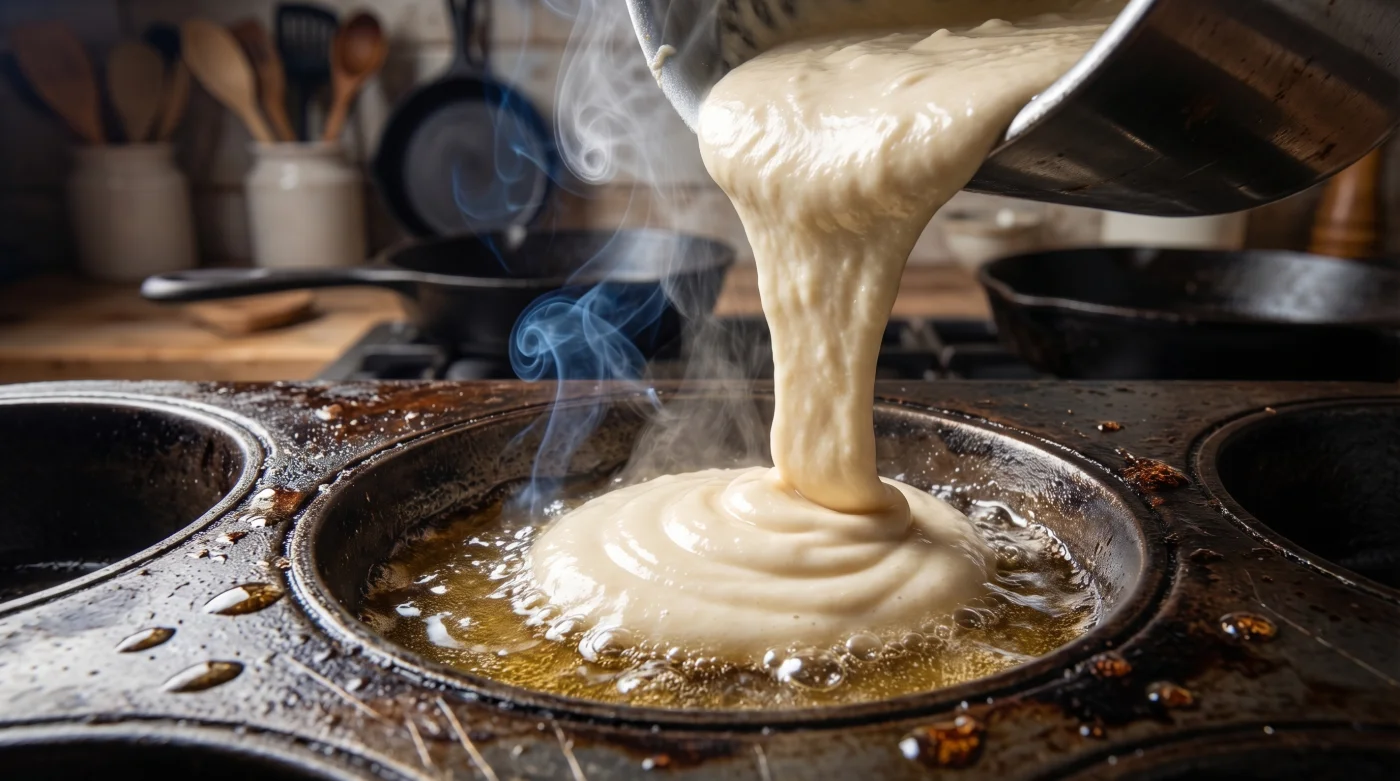
Picture a Sunday afternoon in late November. The kitchen windows run with condensation, the scent of roasting beef hangs heavy in the air, and you are staring nervously at a battered metal tin.
For years, this exact moment has brought a familiar knot to your stomach. You pour the pale, whisked batter into a lukewarm tray, slide it into the oven, and wait for a miracle that never comes. The resulting sunken disks feel like a quiet failure against the triumph of the carved roast.
But watch a seasoned pub cook at work. They do not tiptoe around the oven or treat the batter with undue delicacy. They pull out a tin of fat so hot it practically hums with stored energy.
When the cold batter hits that blistering oil, it does not pool; it immediately sears and climbs. You are about to stop hoping for luck and start commanding a spectacular rise.
The Thermal Shockwave
Most recipes treat baking as a gentle process of building structure over time. This is your first mistake when it comes to the traditional Sunday side dish. A true Yorkshire pudding does not rise through gentle coaxing; it erupts.
Think of the resting liquid as water hitting a scorching iron. If the iron is merely warm, the water sits there, lifeless. If it is blistering, the water turns violently to steam. The flour and egg structure stretches instantly to trap that rapid steam, forcing the edges up the sides of the tin before they have a chance to set solid.
Your kitchen secret is not a magical ratio of plain flour to milk. It is the raw, aggressive application of heat. Heating the pan fat first until it smokes is the only way to generate that upward shockwave.
It transforms a notoriously difficult bake into a piece of reliable weekend physics.
Consider Arthur Pendelton, a 68-year-old retired carver who spent four decades working the Sunday shifts in a busy North Yorkshire pub. Arthur used to tell his young apprentices to close their eyes when pouring the batter. “You shouldn’t need to look,” he would say, wiping flour from his heavy apron. “When that liquid hits the fat, it should crackle like tearing thick paper. If it hisses softly, shut the oven door and wait another five minutes.” Arthur knew that the smoking oil was not just a preliminary step; it was the entire foundation of a towering crust.
Adapting to Your Sunday Rhythm
Not every kitchen operates at the same pace, and not every roast dinner is planned days in advance. You can adjust the technique to suit your provisions.
For the Traditionalist: You are using beef dripping. It possesses a magnificent high smoke point and carries the savoury ghost of the main joint. Place a pea-sized lump in each hole of your heavy metal tin. Wait for a blue haze before pouring.
For the Busy Parent: Time is slipping away, the gravy needs stirring, and the children are hovering near the worktop. Use standard vegetable or sunflower oil. Never reach for extra virgin olive oil; its smoke point is too low and it will burn bitter long before it generates the necessary heat.
For the Restless Planner: Make your mix the night before. Letting it sit in the fridge hydrates the starch grains fully. Cold batter hitting smoking fat creates the most extreme temperature differential possible, guaranteeing a cavernous centre while leaving the base beautifully chewy.
Commanding the Rise
Execution requires nerve, not panic. You must move deliberately from the hob to the oven, keeping the heat trapped exactly where it belongs.
Follow these mindful, uncompromising steps:
- Preheat your oven to 220°C (Fan 200°C) or Gas Mark 7, placing your empty tin inside to absorb the ambient heat.
- Add your chosen fat to the hot tin, returning it to the oven for at least ten minutes until it shimmers fiercely.
- Bring the tin to the hob to pour. Do not rest it on a cold marble worktop, which will immediately drain the heat.
- Pour the resting batter firmly into the centre of each hole. Expect a sharp spit.
- Return the tin quickly to the upper middle shelf. Shut the door and do not open it for 25 minutes.
The Tactical Toolkit: Measure equal volumes of eggs, plain flour, and milk in a jug, not on scales. A heavy-gauge metal tin is entirely non-negotiable; modern silicone moulds will simply not retain the fierce heat required to push the batter upwards.
Beyond the Sunday Table
Mastering this simple thermal trick does more than fill a plate beside your roasted carrots and parsnips. It strips away the anxiety of a meal that is supposed to be grounded in comfort and gathering.
When you pull a tray of towering, golden structures from the fierce heat, you are participating in a very old, incredibly clever bit of everyday chemistry. The mundane detail of heating oil until it hurts the eyes becomes your greatest culinary advantage.
You are no longer leaving your Sunday lunch to the whims of chance. You are crafting a moment of absolute reliability in the middle of a noisy, chaotic week.
“The difference between a heavy pancake and a towering crown is ten degrees of heat in the tin.”
| Key Point | Detail | Added Value for the Reader |
|---|---|---|
| The Fat | Beef dripping or vegetable oil heated to smoking point. | Prevents sticking and initiates the rapid steam expansion needed for a tall rise. |
| The Temperature Shift | Cold, rested batter poured into 220°C hot oil. | Creates a thermal shockwave, guaranteeing crisp edges and a soft, chewy base. |
| The Hardware | Heavy-gauge metal muffin or pudding tin. | Retains the blistering heat outside the oven just long enough to pour the batter safely. |
Frequently Asked Questions
Why did my Yorkshire puddings rise and then collapse?
You likely opened the oven door too early. The structure relies on trapped steam, and a sudden rush of cool kitchen air will cause them to deflate before the flour walls have baked rigid.Can I use self-raising flour instead of plain?
Stick to plain flour. Self-raising flour creates a spongy, cake-like texture rather than the crisp, hollow shell you are trying to achieve with the smoking fat.Is it absolutely necessary to rest the batter?
While not strictly mandatory for a rise, resting the liquid for at least an hour allows the gluten to relax and the starch to absorb the milk, resulting in a significantly better chew and taller sides.How much fat should I put in each hole?
A layer of roughly three to four millimetres is sufficient. You want enough to coat the bottom entirely and create a shallow pool for the batter to fry in as it expands.Can I reheat them if I make them ahead of time?
Yes. Bake them fully, let them cool on a wire rack, and simply flash them in a hot oven for three to four minutes just before serving the gravy to revive their crispness.