You pull your carefully assembled pastry from the oven. The crust is golden, and the kitchen smells warmly of melted butter, nutmeg, and sharp Cheddar. Anticipation builds as you rest the dish on the counter, ready to slice into the fruits of your weekend labour. But the moment your knife breaches the top layer, reality hits hard.
The blade does not offer a satisfying crunch. Instead, it squelches downward, and a sad, swampy puddle bleeds onto your ceramic plate. Your beautiful, expensive bake has fallen victim to the dreaded soggy bottom. The culprit is almost always the same humble ingredient, hiding its destructive secret in plain sight.
Frozen spinach is a brilliant, budget-friendly freezer staple, but it is a silent saboteur of delicate pastry. The mistake happens long before the baking begins. It happens at the sink.
The Illusion of the Sieve
You likely followed the standard advice. You thawed the frozen blocks and left them resting in a metal colander above the sink for an hour. Perhaps you even pressed a wooden spoon against the cold, green mass, watching a few drops trickle away into the plughole. You thought the job was done.
This is the great deception of the modern kitchen. Frozen spinach acts entirely like a microscopic sponge, holding onto winter frost and cellular liquid with surprising strength. Simply leaving it in a colander is like expecting a thick wool winter coat to dry on a hanger in the damp British air. Gravity alone is rarely enough to break the surface tension of the water trapped within the wilted leaves.
To save your pastry, you must fundamentally change your physical relationship with the ingredient. You cannot gently coax the moisture out; you must force it.
| Kitchen Persona | The Crucial Benefit of Bone-Dry Spinach |
|---|---|
| The Weekend Entertainer | Prevents an embarrassing, soggy collapse when slicing a centrepiece tart for waiting guests. |
| The Batch Meal-Prepper | Ensures frozen-and-reheated spanakopita portions retain their intended structural texture days later. |
| The Frugal Home Cook | Protects a £15 investment in premium butter, artisan cheeses, and quality puff pastry from water damage. |
Years ago, I spent a rainy Tuesday morning observing a pastry chef at a small independent bakery in Cornwall. She was preparing hundreds of delicate spanakopita parcels for the busy lunchtime rush. When it came to the spinach, she did not politely drain it through a plastic sieve. She scooped the cold, thawed mass into a clean, well-worn cotton tea towel.
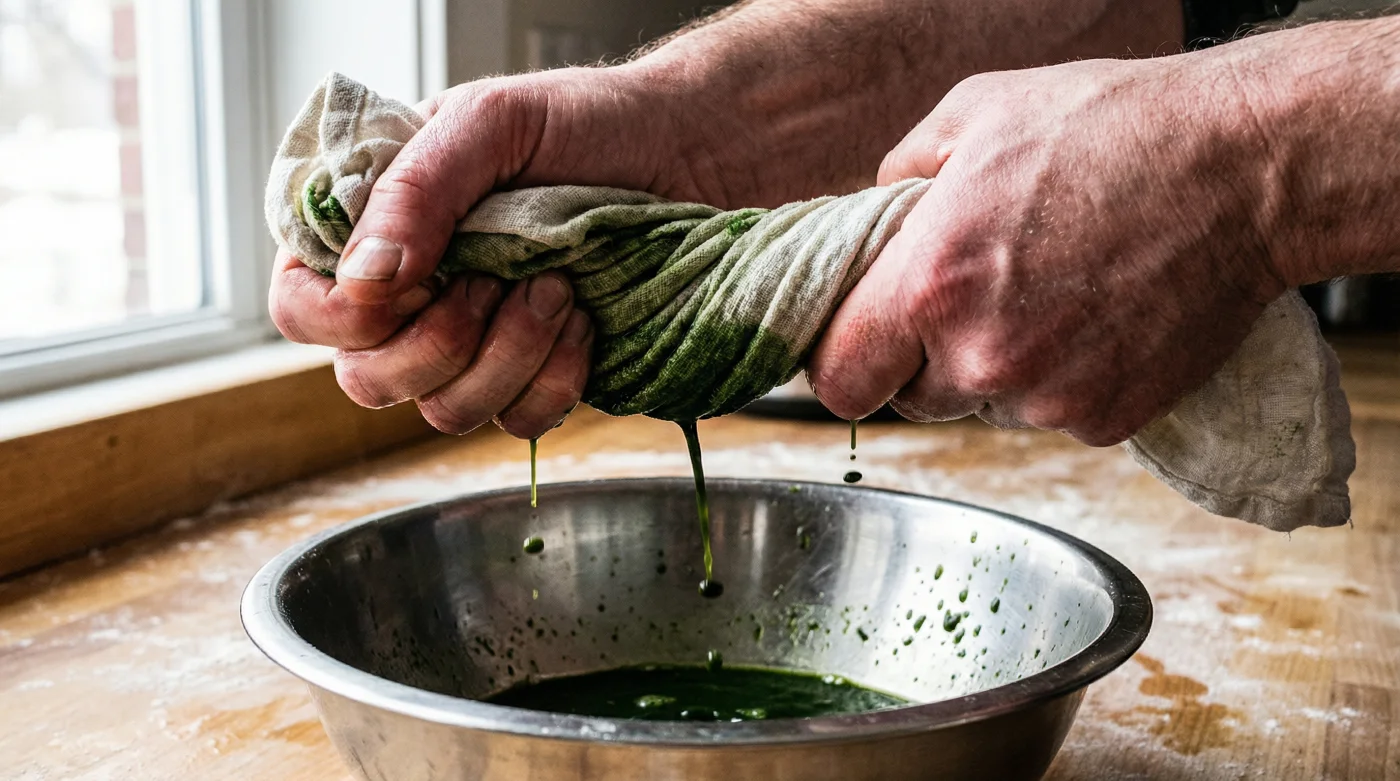
She gathered the corners, trapped the green clump in the middle, and twisted. She wrung the fabric with the aggressive intensity of someone trying to snap a thick rope. A shocking amount of green water flooded into the steel bowl below. “You have to fight the leaf,” she told me, her knuckles turning white. “If you do not force the water out here, it will boil inside the pastry later, steaming your expensive butter alive.”
The Tea Towel Technique
The physical action is where the real transformation happens. First, abandon the idea of using paper towels. The sheer friction required will cause paper to disintegrate, leaving you picking fluffy white lint out of your dinner. You need a dedicated piece of fabric.
- Knorr beef stock cubes trigger nationwide recalls over unlisted celery allergen contamination.
- Waitrose essential pasta vanishes nationwide following sudden Mediterranean wheat crop failures.
- Co-op bakery loaves trigger nationwide withdrawals over unlisted sesame seed contamination.
- Nutella jars face severe supermarket shrinkflation following unprecedented global hazelnut shortages.
- Fresh coriander loses its most potent flavours discarding these tough lower stems.
Now, begin to twist the top of the fabric. Grip the bundle in one hand and twist the gathered corners with the other, wringing it as tightly as you physically can. Do not be gentle. You will be astonished at the sheer volume of liquid that pours out.
You will often extract up to half a mug of water from a single standard supermarket bag. Keep twisting until your hands ache slightly and the drips slow to a stubborn halt. Only then is the spinach truly ready to be used.
| Ingredient State | Moisture Retention | Mechanical Effect on Pastry Dough |
|---|---|---|
| Colander-Drained | High (approx 30% hidden water) | Water boils at 100 degrees, creating steam pockets that melt the pastry lipids before the flour can set. |
| Hand-Squeezed | Moderate (approx 15% hidden water) | Base layer turns doughy and pale; structural integrity is compromised during the final bake. |
| Towel-Wrung | Low (under 5% remaining moisture) | Dry filling allows the fat between dough layers to fry the pastry, resulting in a shattered, crispy crust. |
Once you unwrap the towel, the spinach will look entirely different. It will be a dense, dry, almost crumbly puck of dark green. It might look significantly smaller in volume, but the flavour is now entirely concentrated. More importantly, it is now entirely safe to introduce to your dairy and your delicate dough.
The Bigger Picture
Baking often feels like a gamble, a nervous waiting game played through the glass of an oven door. But true confidence in the kitchen comes from understanding the physical nature of your ingredients. When you take the time to aggressively remove that hidden moisture, you are no longer leaving the fate of your dinner to chance.
You are taking control of the chemistry. It is deeply satisfying to know that a simple shift in technique can protect your expensive butter, your artisan cheeses, and your valuable time. The tragic squelch is replaced by a shattering crunch.
The swampy puddle is replaced by perfectly defined, flaky layers. Next time you reach into the freezer for that humble bag of greens, remember the baker in Cornwall. Do not trust the colander, fight the leaf, and protect your pastry.
| Fabric Tool | What to Look For | What to Avoid |
|---|---|---|
| Cotton Tea Towel | Flat weave, lint-free, older fabric with tight threads. | Terry cloth loops, highly dyed new fabrics that might bleed colour into the food. |
| Muslin Cloth | Double-layered, tightly woven, unbleached. | Loose cheesecloth (the spinach will force its way through the wide gaps under pressure). |
| Disposable Paper | Heavy-duty blue workshop rolls (only if truly desperate). | Standard kitchen roll (disintegrates instantly under friction, ruining the spinach with white lint). |
“You cannot negotiate with trapped water; you must wring the life out of the leaf to save the soul of the pastry.” — Head Baker, Cornish Coastal Bakery
Common Baking Friction Points (FAQ)
Can I use fresh spinach instead to avoid the water? Yes, but you must still cook it down to wilt the leaves, which releases cellular water. You will still need to wring it out once cooled.
Why is the water green when I squeeze it? You are pressing out cellular water mixed with chlorophyll from the bruised leaves. This is perfectly normal and actually removes a slightly bitter, metallic taste.
Can I keep the squeezed spinach water for anything? It is highly nutritious and works wonderfully poured into a vegetable stock, a morning smoothie, or a simmering soup base.
Does this rule apply to grated courgette as well? Absolutely. Any high-water vegetable destined for a bake must face the heavy wringing of a tea towel to prevent structural collapse.
Will a salad spinner do the same job? No. A spinner uses centrifugal force to remove surface water from crisp leaves, but it cannot crush the cellular walls of thawed, wilted spinach.