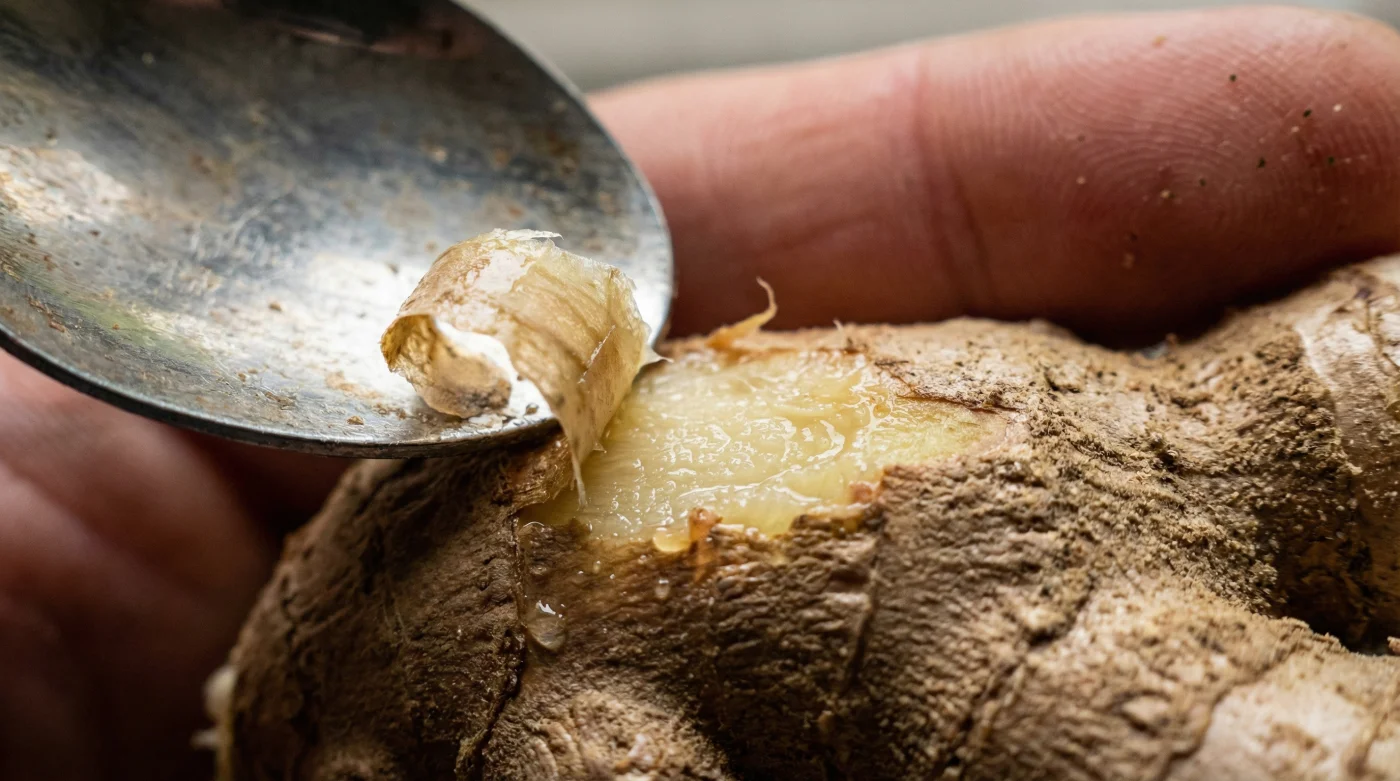
There is a specific, sharp fragrance that hits the air the moment a knife cuts into fresh ginger. It is bright, peppery, and promises warmth on a damp Tuesday evening. You stand at your kitchen counter, paring knife in hand, trying to navigate the knobbly, stubborn root. As you slice away the rough, beige exterior, you watch in dismay as thick chunks of the vibrant yellow flesh fall straight into the food waste bin. You are paying good money for this ingredient, yet half of it vanishes before it even reaches the pan. It feels inherently wrong, yet instinct tells you that a sharp blade is the only way to tackle a tough-looking root.
The Sledgehammer and the Sculpture
We treat fresh root aromatics as though they require brute force. Your instinct to reach for a sharp vegetable peeler or a paring knife comes from years of peeling potatoes and carrots. But treating ginger like a potato is akin to carving a delicate wooden sculpture with a sledgehammer. The skin of fresh ginger is not a thick bark; it is merely a paper-thin membrane protecting the moisture within. When you use a straight, rigid blade to navigate a highly irregular, curving surface, geometry works against you. The blade cannot bend, so it simply shears off everything in its path, taking the most flavourful, oil-rich flesh resting just beneath the surface along with it.
Years ago, standing near the pass of a relentlessly busy kitchen in Soho, I watched a junior prep cook painstakingly hacking away at a massive crate of ginger. The head chef walked over, quietly took the paring knife out of the young cook’s hand, and replaced it with a humble metal teaspoon. ‘Stop fighting the shape,’ he murmured, demonstrating how the blunt edge of the spoon effortlessly grazed the skin away without bruising the flesh. That single interaction changed how I viewed kitchen prep entirely. It was a lesson in yielding to the ingredient rather than forcing it to conform to the tool.
| Who Benefits Most | The Real-World Impact |
|---|---|
| The Thrifty Home Cook | Stops throwing away pennies with every meal; preserves the entire purchased weight. |
| The Weekend Batch Prepper | Navigates ginger joints rapidly without the risk of slicing a thumb on slippery wet flesh. |
| The Flavour Chaser | Retains the layer immediately under the skin, which houses the highest concentration of essential oils. |
Mastering the Teaspoon Technique
Switching your method requires almost no new equipment, just a shift in muscle memory. Take a standard stainless steel teaspoon from your cutlery drawer. You want one with a relatively thin edge, not a chunky, decorative piece. Hold the ginger root firmly in your non-dominant hand. Grasp the bowl of the spoon directly, placing your thumb inside the curve and your fingers supporting the back, rather than holding it by the long handle. This gives you absolute, grounded control over the metal.
Press the edge of the spoon against the ginger and scrape downwards. You will immediately notice how the skin simply pills and slips away, leaving a perfectly smooth, bright yellow surface behind. The friction is entirely focused on the microscopic outer layer. Because the spoon is curved, it naturally cups the rounded nodes and dips effortlessly into the tight crevices where branches meet. There is no snagging, no cutting, and absolutely no waste.
This technique removes the anxiety from prep work. A sharp blade on a wet, fibrous root is a recipe for a nasty slip. The spoon method is so incredibly safe that you can allow a child to help you prepare the base for your Friday night curry. You move faster, you keep your fingers intact, and your compost bin receives only the papery scrapings rather than half your grocery shop.
| Preparation Tool | Mechanical Action | Estimated Flesh Loss |
|---|---|---|
| Standard Paring Knife | Rigid shearing through fibrous curves | 20% to 30% |
| Y-Shaped Vegetable Peeler | Flat dragging that snags on nodes | 15% to 20% |
| Metal Teaspoon | Surface scraping adapted to organic shapes | Less than 2% |
Choosing the Right Root
- Knorr beef stock cubes trigger nationwide recalls over unlisted celery allergen contamination.
- Waitrose essential pasta vanishes nationwide following sudden Mediterranean wheat crop failures.
- Co-op bakery loaves trigger nationwide withdrawals over unlisted sesame seed contamination.
- Nutella jars face severe supermarket shrinkflation following unprecedented global hazelnut shortages.
- Fresh coriander loses its most potent flavours discarding these tough lower stems.
| Quality Indicator | What to Look For | What to Avoid |
|---|---|---|
| Skin Texture | Taut, slightly shiny, and firmly attached to the flesh. | Wrinkled, papery layers that feel loose or excessively dry. |
| Weight and Density | Feels heavy for its size, indicating high moisture content. | Lightweight, almost hollow-feeling pieces. |
| Structural Snap | Nodes break off with a clean, crisp, audible snap. | Bends or turns rubbery when you attempt to snap a piece off. |
A More Mindful Kitchen Rhythm
Adopting this humble spoon trick does more than just save you a few Pounds Sterling over the year. It fundamentally changes your physical relationship with cooking. When we rely solely on sharp knives to force ingredients into the shapes we desire, we operate from a place of tension. Scraping ginger with a spoon asks you to feel the curves of the food, to work with its natural geometry rather than against it.
This small shift from cutting to scraping is profoundly satisfying. It reminds you that the best kitchen solutions are rarely the most expensive gadgets or the sharpest blades. Often, they are the simple, overlooked items resting quietly in your cutlery drawer. You end up with a chopping board full of golden, aromatic ginger ready to be grated into your marinades and broths, knowing you have respected the ingredient fully.
Next time a recipe calls for a thumb-sized piece of ginger, leave the peeler in the drawer. Pick up your spoon. You will marvel at how such a gentle, rounded tool can so completely outsmart a razor-sharp blade, transforming a frustrating chore into a moment of easy, culinary grace.
“The finest cooks understand that respect for an ingredient begins not when it hits the heat, but the moment it is prepared; yield is a measure of care.”
Common Ginger Preparation Queries
Do I absolutely have to peel ginger before using it? No. If you are grating it finely or simmering it in a stock where it will be strained out, the skin is perfectly edible and safe, provided you have washed it thoroughly.
Can I use this spoon trick on other root vegetables? It works brilliantly on fresh turmeric and galangal, as they share a similarly thin outer membrane, but it will not work on thicker-skinned roots like carrots or parsnips.
What is the easiest way to store the ginger once it is peeled? Wrap the peeled root tightly in a damp piece of kitchen paper, place it in an airtight container, and keep it in the salad drawer of your fridge for up to three weeks.
Can I freeze the ginger after peeling it with the spoon? Absolutely. In fact, keeping a peeled knob of ginger in the freezer makes it incredibly easy to grate directly into pans using a microplane without it turning fibrous.
Does an older, slightly soft piece of ginger still work with the spoon method? It becomes much harder. As ginger loses moisture, the skin softens and the spoon tends to mash the flesh rather than scraping the skin away cleanly. Stick to fresh, firm roots.