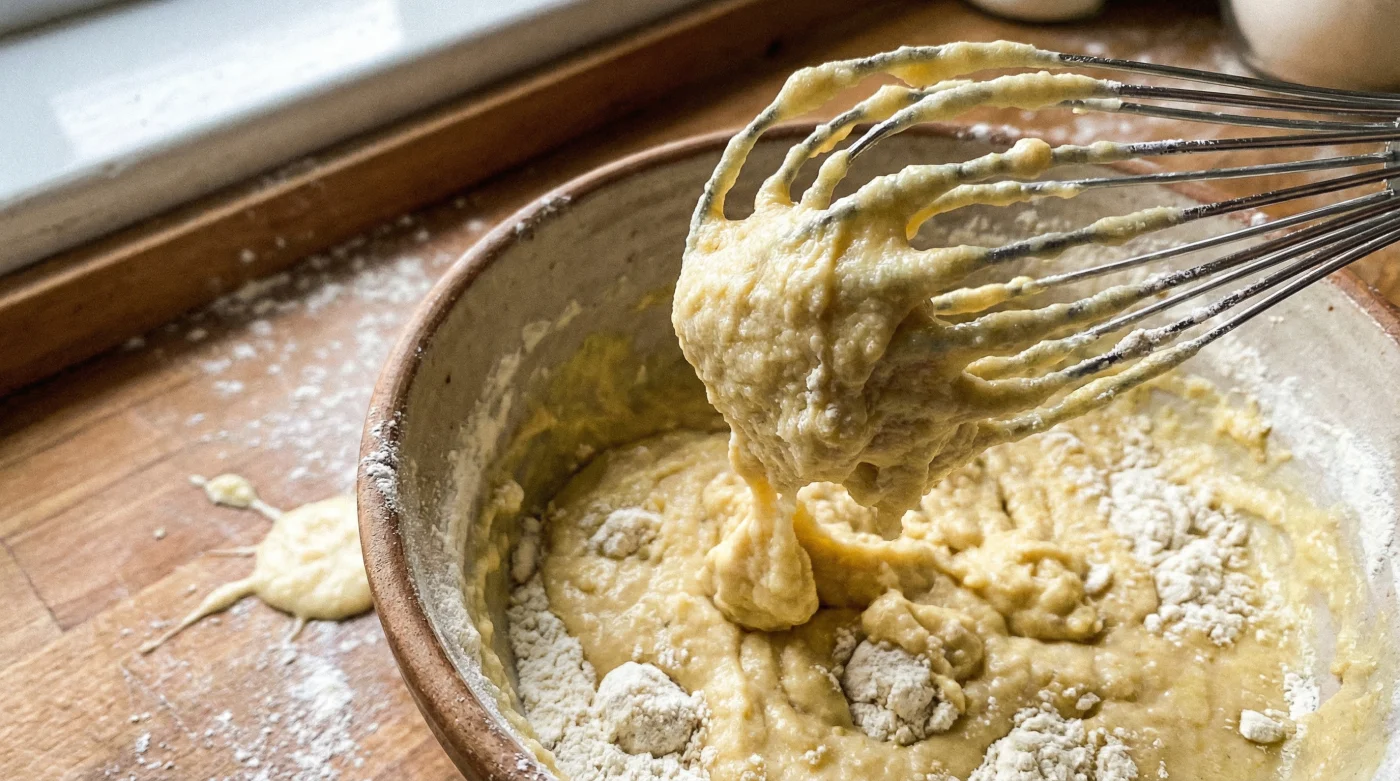
It is Sunday morning, and the kitchen is quiet save for the rhythmic, metallic scrape of a wire whisk against a ceramic bowl. The scent of melting butter promises comfort, and you are determined to create a flawless breakfast. You watch the batter closely. Your instinct demands perfection—a pristine, pale yellow mirror, entirely devoid of lumps. So, you beat it vigorously, chasing away every last speck of dry flour. Yet, when the ladle hits the hot skillet, the batter spreads into flat, lifeless discs. At the table, your fork meets resistance. The pancake pulls back. It is chewy, rubbery, and utterly devoid of joy.
The Tension of the Mix
We are conditioned to equate smoothness with success. A lump in the sauce or a bump in the frosting feels like a failure of technique. But pancake batter operates under a different set of physical laws. Think of your mixture not as a liquid to be homogenised, but as a delicate structural lattice. The moment liquid touches wheat flour, a chemical clock begins to tick. The proteins within the flour—glutenin and gliadin—reach out to one another, forming strong, elastic bonds.
This is the gravity of the dough. When you attack the bowl with aggressive whisking, you are rapidly developing those glutens. You are turning a tender breakfast treat into something resembling bread dough. The secret to a fluffy, diner-style stack directly contradicts your visual instinct: you must leave the lumps alone.
| The Cook | The Frustration | The Benefit of Lumpy Batter |
|---|---|---|
| The Weekend Parent | Heavy, dense discs rejected by children. | Light, airy stacks that absorb syrup perfectly. |
| The Perfectionist | Overworking the mix to achieve a smooth texture. | Less prep time and a guaranteed tender crumb. |
| The Beginner | Following recipes but getting tough results. | Removing the guesswork of ‘how much to mix’. |
I recall standing in the cramped, steam-filled kitchen of a bustling seaside cafe in Brighton, watching an older chef named Arthur prepare the morning service. He poured milk into his flour well, took a large wooden spoon, and turned the mixture exactly three times. There were massive, powdery islands of flour floating in the bowl. ‘Step away from it,’ he warned as I instinctively reached for the whisk. ‘Treat it like a wounded bird. Too much handling, and it won’t fly.’ He was right. Those pockets of dry flour hydrate on their own as the batter rests, creating steam pockets during cooking that lift the pancake to glorious heights.
| Mixing Action | Gluten Development | Final Texture |
|---|---|---|
| 10-15 seconds (Folding) | Minimal protein bonding. | Tender, cloud-like, high rise. |
| 30-45 seconds (Whisking) | Moderate elasticity forming. | Slightly chewy, dense edges. |
| 60+ seconds (Beating) | Maximum gluten matrix established. | Rubbery, flat, bread-like resistance. |
The Mindful Fold
To master this technique, you must change your physical approach. Set the wire whisk aside. Choose a broad silicone spatula or a large slotted metal spoon instead. Pour your wet ingredients into the dry ingredients in one fluid motion.
Now, scrape the bottom of the bowl and fold the mixture over itself. Do this gently. Count to ten. If you reach ten and the batter looks like a messy, unkempt disaster with visible flour streaks and bumpy pockets, stop immediately.
- Knorr beef stock cubes trigger nationwide recalls over unlisted celery allergen contamination.
- Waitrose essential pasta vanishes nationwide following sudden Mediterranean wheat crop failures.
- Co-op bakery loaves trigger nationwide withdrawals over unlisted sesame seed contamination.
- Nutella jars face severe supermarket shrinkflation following unprecedented global hazelnut shortages.
- Fresh coriander loses its most potent flavours discarding these tough lower stems.
When you finally scoop the batter into your frying pan, do not stir it again to ‘refresh’ it. Scoop directly from the resting bowl. You will notice the batter is thicker, highly aerated, and drops into the pan with a soft, pillowy thud.
| Quality Indicator | What to Look For | What to Avoid |
|---|---|---|
| Visual Texture | Lumpy, slightly bubbly, streaked with flour. | Perfectly smooth, glossy, uniform colour. |
| Resting Behaviour | Puffs up slightly in the bowl. | Remains a thin, static liquid. |
| Pan Spread | Holds a thick circular shape. | Spreads rapidly to the edges of the pan. |
The Grace of Imperfection
There is a quiet relief in learning that perfection is sometimes the enemy of good food. By allowing the batter to remain lumpy and unrefined, you are surrendering control to the ingredients. You are trusting the chemistry rather than forcing your will upon it. This small, deliberate restraint changes the rhythm of your morning. Instead of frantic whisking, you get five minutes of stillness while the batter rests. You get to pour your tea, watch the morning light shift across the worktop, and ultimately sit down to a stack of pancakes that are remarkably light, tender, and forgiving.
The best pastry chefs know that what you choose not to do to a batter is just as important as what you add to it.
Frequent Frustrations
Why are my pancakes still flat even with lumpy batter?
Your raising agents might be expired. Always check the date on your baking powder; it loses its potency after six months in the cupboard.Is it safe to eat pancakes if there were dry flour pockets in the batter?
Yes. By the time the pancake cooks through, those dry pockets have absorbed the surrounding moisture and steamed perfectly from the inside out.Can I use an electric mixer on a low setting?
It is strongly discouraged. Even on the lowest setting, an electric mixer agitates the proteins far too quickly for a tender pancake crumb.Should I rest the batter in the fridge or on the counter?
A short five-minute rest on the counter is ideal. If you are making the batter the night before, the fridge is fine, but allow it to lose its chill before cooking.What is the best tool for folding the mixture?
A wide silicone spatula or a large slotted metal spoon allows you to lift and fold the heavy wet ingredients over the dry without creating friction.