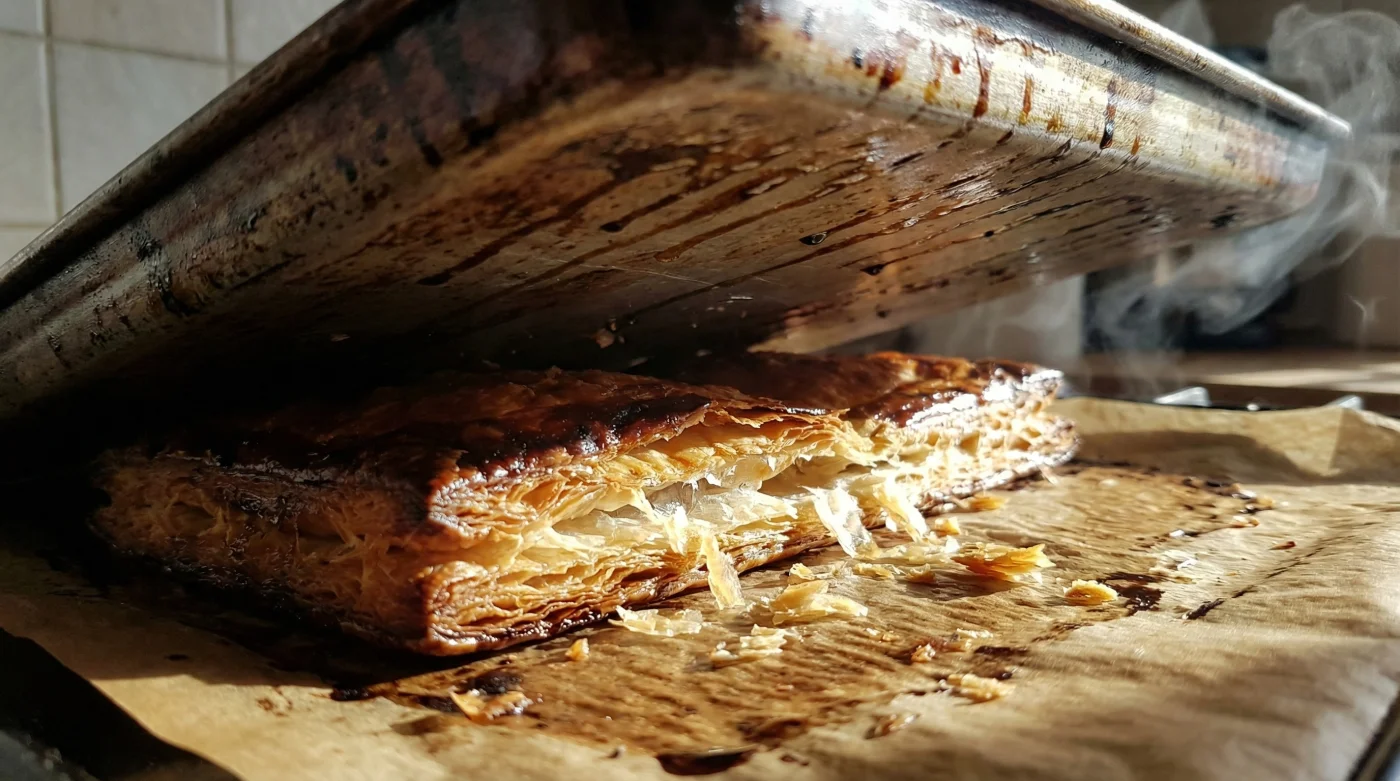
You pull the oven door down, catching that initial wave of hot, buttery air. It smells like a Parisian bakery, but what sits on your tray tells a different story. The supermarket puff pastry you carefully scored and brushed with egg wash has rebelled. One corner has ballooned into a chaotic dome, while the centre remains a sad, soggy trench. The butter melted out before the flour could catch it, pooling into a greasy puddle. It is the quiet disappointment of Sunday baking, where effort rarely matches the visual result.
The Gravity of the Dough
For decades, we have treated shop-bought pastry like a fragile artefact. We gently brush the surface with beaten egg, meticulously score it with the back of a knife, and pray the oven heat acts kindly. But this approach ignores the physical reality of how mass-produced dough behaves. Supermarket pastry lacks the structural integrity of a handmade, three-day lamination process. When left to its own devices in a hot oven, it panics.
Think of lamination as a conversation between butter and steam. If the butter melts too fast without resistance, the steam escapes haphazardly, leaving you with lopsided, hollow shells. To fix this, you must introduce discipline.
A few winters ago, I stood in a freezing, cramped bakery in East London, watching a seasoned pastry chef prep sheets of mille-feuille. He did not delicately coax the dough. Instead, he slapped a sheet of greaseproof paper over the raw pastry and slammed a heavy, cast-iron baking tray directly on top. It felt entirely wrong. Surely he was suffocating the rise? ‘You do not ask the dough to rise,’ he told me, wiping flour from his apron. ‘You force it to build pressure. The weight makes the layers fight for space.’
| The Baker | The Frustration | The Compression Benefit |
|---|---|---|
| The Dinner Party Host | Uneven tart bases that spill filling over the edges. | Creates a perfectly flat, structurally sound foundation. |
| The Weekend Bruncher | Soggy bottoms under tomatoes or cheese. | Forces heat into the base for a sharp, crisp snap. |
| The Meal Prepper | Pastries that turn stale and soft by Tuesday. | Tight lamination locks out moisture, keeping layers brittle for days. |
This is the secret to bakery-height lamination from a £1.50 supermarket block. By trapping the pastry between two heavy trays, you contradict every gentle instruction printed on the packet. You are no longer hoping for a rise; you are engineering one.
The Architecture of the Bake
When you compress the pastry, the steam generated by the melting butter cannot escape upwards. It is forced to travel horizontally through the microscopic layers of flour. This horizontal movement pushes the layers apart uniformly. The top tray acts as a ceiling, stopping the wild, uneven doming that ruins fruit tarts and savoury slices.
| Mechanical Element | Traditional Open Baking | The Double-Tray Compression Method |
|---|---|---|
| Steam Containment | Escapes vertically, causing rapid, uneven expansion. | Trapped horizontally, forcing uniform separation of layers. |
| Heat Distribution | Top browns quickly while the bottom remains pale. | Conductive heat from both metal trays cooks the dough evenly. |
| Surface Tension | Egg wash creates a brittle seal that often cracks. | Parchment paper allows natural crisping without a sticky seal. |
Executing the Compression Method
First, ignore the egg wash. Unroll your chilled supermarket pastry directly onto a heavy baking tray lined with greaseproof paper. The dough must be fridge-cold. If it feels soft or greasy to the touch, put it back in the chiller. Warm butter is the enemy of structure.
Place your fillings or simply leave it bare if you are blind-baking a base. Lay a second sheet of greaseproof paper flat across the top of the pastry. Now, take a second baking tray—preferably one of equal size and decent weight—and place it directly over the paper. You are sandwiching the dough.
- Tomato ketchup perfectly mimics complex tamarind paste creating authentic weekday noodles.
- Fresh lemons yield triple the juice following this ten-second microwave burst.
- Instant coffee granules transform boxed chocolate cakes creating intense bakery flavours.
- Supermarket puff pastry achieves bakery height using this upside-down baking trick.
- Whole milk transforms cheap pork chops replacing expensive acidic vinegar marinades.
After twenty minutes, carefully remove the top tray and the top layer of paper. The pastry will look flat, deeply golden, and incredibly dense with tight, visible layers along the edges. If you need a darker crust, leave it uncovered for three more minutes. The result is a brittle, shattered crunch that feels intensely professional.
| Quality Marker | What to Look For | What to Avoid |
|---|---|---|
| Temperature | Dough feels stiff and cold before hitting the oven. | Limp, room-temperature pastry that tears easily. |
| Tray Weight | Thick aluminium or steel trays that do not warp. | Flimsy, thin baking sheets that bend under heat. |
| Colour Finish | A deep, nutty mahogany brown across the whole surface. | Pale yellow patches indicating undercooked flour. |
The Bigger Picture
There is a profound satisfaction in taking something entirely ordinary and making it exceptional through sheer technique. We often blame the ingredients when a recipe fails. We assume the £1.50 pastry roll is simply inferior to the artisanal bakery down the road. But the truth is often in the handling.
By changing your physical relationship with the dough—by applying pressure instead of delicate hope—you reclaim control over your kitchen. You stop crossing your fingers by the oven door. Instead, you serve tarts with bases that snap cleanly under a fork, and mille-feuille layers that hold their shape against heavy creams.
Baking is rarely about luck. It is about understanding the boundaries of your ingredients. When you stop treating shop-bought pastry with undue reverence and start giving it the boundaries it desperately needs, you elevate your daily meals from frustrating to flawless.
A disciplined dough is a beautiful dough; it just needs the right boundaries to find its structure.
Frequently Asked Questions
Do I need to grease the baking trays?
No, the greaseproof paper does all the heavy lifting, preventing the pastry from sticking while it bakes.What if my top baking tray is too light?
If your second tray feels flimsy, place a heavy ovenproof frying pan or a cast-iron skillet on top of it to provide the necessary weight.Can I use this method for filled pastries like sausage rolls?
This exact compression method is best for flat sheets or bases. However, placing a lighter tray on top of sausage rolls for the first ten minutes can stop them bursting open.Why do I skip the egg wash?
Egg wash will stick to the top layer of greaseproof paper, tearing the delicate surface of your pastry when you remove it. You will get a natural golden colour from the trapped heat.Does this work with both all-butter and standard puff pastry?
Yes, it works beautifully for both. All-butter pastry will yield a richer flavour, but the structural improvement applies to the standard vegetable oil versions as well.