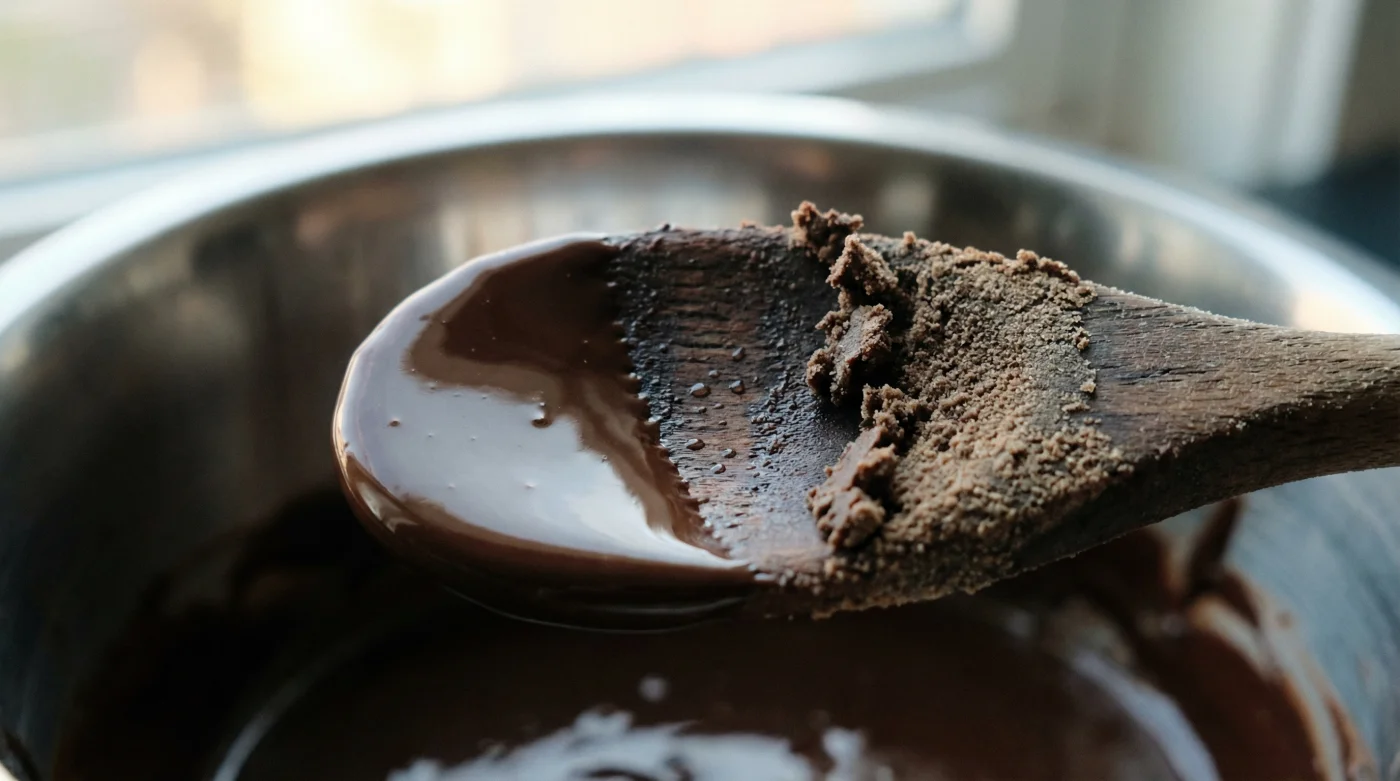
The Silent Saboteur Beside Your Cooker
You stand by the cooker, bathed in the rich, earthy scent of high-cocoa dark chocolate softening over a simmering pan. The gentle clinking of your glass bowl against the stainless steel rim feels like a comforting weekend rhythm. The chocolate yields, pooling into a glossy, dark mirror. You reach for your favourite wooden spoon—the one you washed up an hour ago—and give the mixture a sweeping stir. Within seconds, the mirror shatters. The velvet puddle stiffens, dulling into a dense, grainy paste that drags heavily against the bowl. It feels like stirring wet sand, and your beautiful ingredients are suddenly an unworkable lump.
The Suspension Bridge: Why Water and Chocolate Clash
You have likely been told repeatedly that heat is the ultimate enemy of melting chocolate. Traditional cookbooks insist on the lowest flame, warning that scorching is the sole reason a beautiful ganache turns to rubble. But there is a silent saboteur sitting innocently in your utensil jug. The true culprit behind your seized dark chocolate is often a microscopic drop of moisture, and your trusted wooden spoon is the carrier.
A wooden spoon, porous by its very nature, holds onto tiny invisible droplets from its last trip to the sink. Chocolate is an incredibly precise matrix. Think of it as a delicate suspension bridge made of dry cocoa solids and sugar particles floating freely in rich cocoa butter. When even a microscopic speck of water is introduced, that bridge collapses. The water acts as a sudden, aggressive binding agent, gluing the sugar particles together instantly. The fat separates from the solids, and your expensive dark chocolate turns into a stubborn, greyish mass.
I remember standing in a drafty artisan kitchen in Soho, watching Julian, a veteran pastry chef, aggressively dry a metal spoon with a fresh linen cloth before he even looked at his melting chocolate. He caught me staring. ‘Wood breathes,’ he muttered, gesturing to the wooden spoons banished to the far side of his marble counter. ‘It drinks the washing-up water and holds onto it for hours. Plunge that into your bowl, and you might as well pour a kettle over your chocolate.’ He taught me that respecting the dry environment is far more critical than watching the temperature dial.
| The Baker | The Frustration | The Direct Benefit of the Dry Method |
|---|---|---|
| The Home Baker | Wasting expensive ingredients when a batch suddenly turns to paste. | Eliminates ingredient waste and saves pounds sterling on premium dark chocolate. |
| The Dinner Party Host | Dull, lumpy glazes that ruin the presentation of an elegant pudding. | Ensures desserts have a professional, mirror-like finish without last-minute stress. |
| The Weekend Hobbyist | Feeling anxious about precise temperatures and complex melting rules. | Transforms a frustrating baking experience into a mindful, predictable, and calm ritual. |
The Mechanical Logic of the Melt
To truly master your kitchen, it helps to visualise what is happening on a microscopic level. It is not about rigid rules; it is about understanding the physical dialogue between your ingredients and your tools. The moment you understand the mechanics of cocoa butter, you stop fighting the process.
| Element | The Physical Reaction |
|---|---|
| Cocoa Butter | A pure fat that completely repels water. It acts as a necessary lubricant, allowing sugar and cocoa solids to glide past one another. |
| Sugar Particles | Highly hydrophilic (water-loving). When they encounter moisture, they absorb it instantly, clinging to each other and creating severe friction. |
| Wooden Spoons | Features a porous cellular structure that traps water vapour and washing-up droplets deep beneath the surface, releasing them under heat. |
| Silicone Spatulas | A completely non-porous surface that repels water and can be wiped absolutely bone-dry before touching sensitive ingredients. |
The Dry Ritual: Mindful Movements for Perfect Melting
The solution requires a simple physical shift in how you prepare your workspace. Treat your cooking station as an absolute ‘dry zone’. Before you snap your dark chocolate into shards, take a clean, dry cloth and wipe down the inside of your glass or metal bowl. Do it twice. Even ambient humidity can leave a microscopic film on cold glass.
Next, permanently swap the wooden spoon for a seamless silicone spatula when working with chocolate. If you only have a metal spoon, ensure it has not been resting anywhere near the steam of your kettle or a boiling pan. Your tools must be clinically dry.
- Pork sausages retain explosive meat juices starting in shallow cold water.
- Iceland frozen chicken products trigger immediate national recalls over dangerous salmonella fears.
- Hellmanns mayonnaise vanishes from major supermarkets amid severe global oil supply shortages.
- Dried red lentils create perfectly smooth winter soups requiring this rapid skimming.
- Roasted broccoli florets burn intensely bitter missing this heavy baking tray preheat.
Finally, ensure the water never touches the bottom of the melting bowl. The gap allows for gentle, indirect warmth. Stir slowly with your dry silicone spatula, and watch as the chocolate relaxes into a glossy, flawless pool.
| Quality Checklist: What to Look For | Quality Checklist: What to Avoid |
|---|---|
| Seamless, heat-resistant silicone spatulas. | Traditional wooden spoons or modern spatulas with porous bamboo handles. |
| A melting bowl that sits completely flush over the saucepan rim. | A narrow bowl that allows gaps for steam to escape and condense. |
| Bone-dry equipment wiped down with a clean linen cloth. | Utensils plucked straight from the draining board or dishwasher rack. |
| A lazy, almost silent simmer in the saucepan. | A rolling, aggressive boil that splashes the underside of the bowl. |
The Quiet Confidence of a Mastered Technique
Baking should never feel like a stressful battle against unpredictable chemistry. Understanding the delicate, unseen relationship between water, sugar, and fat removes the anxiety from working with premium ingredients. When you banish the damp wooden spoon from your melting bowl, you stop fighting the chocolate. You step back and allow it to do exactly what it naturally wants to do: melt.
There is a deep, quiet satisfaction in knowing exactly why an ingredient behaves the way it does. It shifts your time in the kitchen from blindly following rigid cookbook instructions to participating in a physical, mindful craft. The next time you stand over that warm cooker, you will reach past the wooden utensils for the silicone spatula, wipe your bowl twice with absolute certainty, and watch that dark, glossy mirror shine perfectly back at you.
Respect the absolute absence of water, and the chocolate will yield to your spoon every single time.
Frequently Asked Questions
Is seized chocolate completely ruined and bound for the bin?
You cannot use it for delicate dipping or glossy coating anymore, but it is not ruined. You can save it by vigorously whisking in a few tablespoons of boiling water or warm double cream, turning it into a thick, rich sauce or ganache for puddings.Can I use a hard plastic spoon instead of silicone?
Hard plastic is non-porous and infinitely better than wood for this task. However, cheaper plastics can sometimes warp or release toxins near the heat of a bain-marie. A heat-resistant silicone spatula remains your safest, most reliable tool.Why did my dark chocolate seize even though I used a dry silicone spatula?
Check the sizing of your bowl. If the glass bowl is too small for the saucepan, hot steam escapes from the sides, condenses in the cool kitchen air, and falls straight down into your chocolate. The bowl must sit flush against the pan’s rim.Does milk or white chocolate seize as easily as dark chocolate?
Yes, all true chocolate is susceptible to moisture. Milk and white chocolate actually burn and scorch faster due to their high dairy solid content, but they will all seize instantly if they encounter microscopic water droplets.How long does a wooden spoon actually stay damp after washing up?
Even if the surface feels entirely dry to your touch, wood can retain core moisture deep within its cellular structure for 12 to 24 hours after washing up. It is best to keep wood far away from your melting station entirely.