You know that familiar, disappointing thud.
You pull the baking tin from the oven, the kitchen smelling gloriously of vanilla and warm butter, but the cake itself feels suspiciously heavy in your hands. When you cut the first slice, your knife drags. Instead of a cloud of delicate, airy sponge, you are holding a dense, stubborn slab.
It feels less like an afternoon tea delicacy and more like an architectural foundation. You might blame the butter temperature, or perhaps your oven thermostat. But the real culprit is sitting quietly in your mixing bowl: the gluten.
The Perspective Shift: Dismantling the Scaffolding
You have likely been told that achieving a feather-light Victoria sponge requires a trip to a premium supermarket. You stare at four-pound boxes of specialist cake flour, wondering if the secret to lightness is purely financial. It is not.
Think of gluten as the scaffolding of your bake. Plain flour contains a moderate amount of this structural protein, perfect for holding together a robust biscuit or a sturdy muffin. However, when you want a sponge that barely registers on the tongue, that same scaffolding turns your delicate cake into a rigid structure.
You do not need to buy a softer, weaker flour. You simply need to disarm the plain flour you already own.
| Target Baker | Specific Kitchen Benefit |
|---|---|
| The Weekend Baker | Eliminates dense, heavy sponges, ensuring a consistent, reliable rise every Sunday. |
| The Budget Conscious | Saves pounds on premium specialist ingredients by utilising basic pantry staples. |
| The Spontaneous Host | Allows for immediate baking without a frantic dash to Waitrose for specific flour varieties. |
I learned this standing in the cramped, flour-dusted kitchen of an independent bakery in Cornwall. The head pastry chef, Eleanor, was turning out trays of the lightest Genoise sponges I had ever tasted. I noticed there were no specialty boxes on her shelves—just massive paper sacks of standard plain flour and industrial tubs of cornflour.
She told me they never had the storage space for vanity flours, nor the budget. Instead, she demonstrated a professional standard: stripping away the protein by replacing exactly two tablespoons of plain flour per cup (roughly 120g) with pure cornflour. It was a revelation in a bowl.
| Ingredient | Protein (Gluten) Content | Baking Impact |
|---|---|---|
| Standard Plain Flour | Approx. 10% to 11% | Creates chewy structure; ideal for pastry and biscuits. |
| Premium Cake Flour | Approx. 7% to 9% | Produces a tender, fine crumb that falls apart on the fork. |
| Pure Cornflour | 0% | Acts as an active diluent, halting gluten formation entirely. |
The Two-Spoon Alchemy
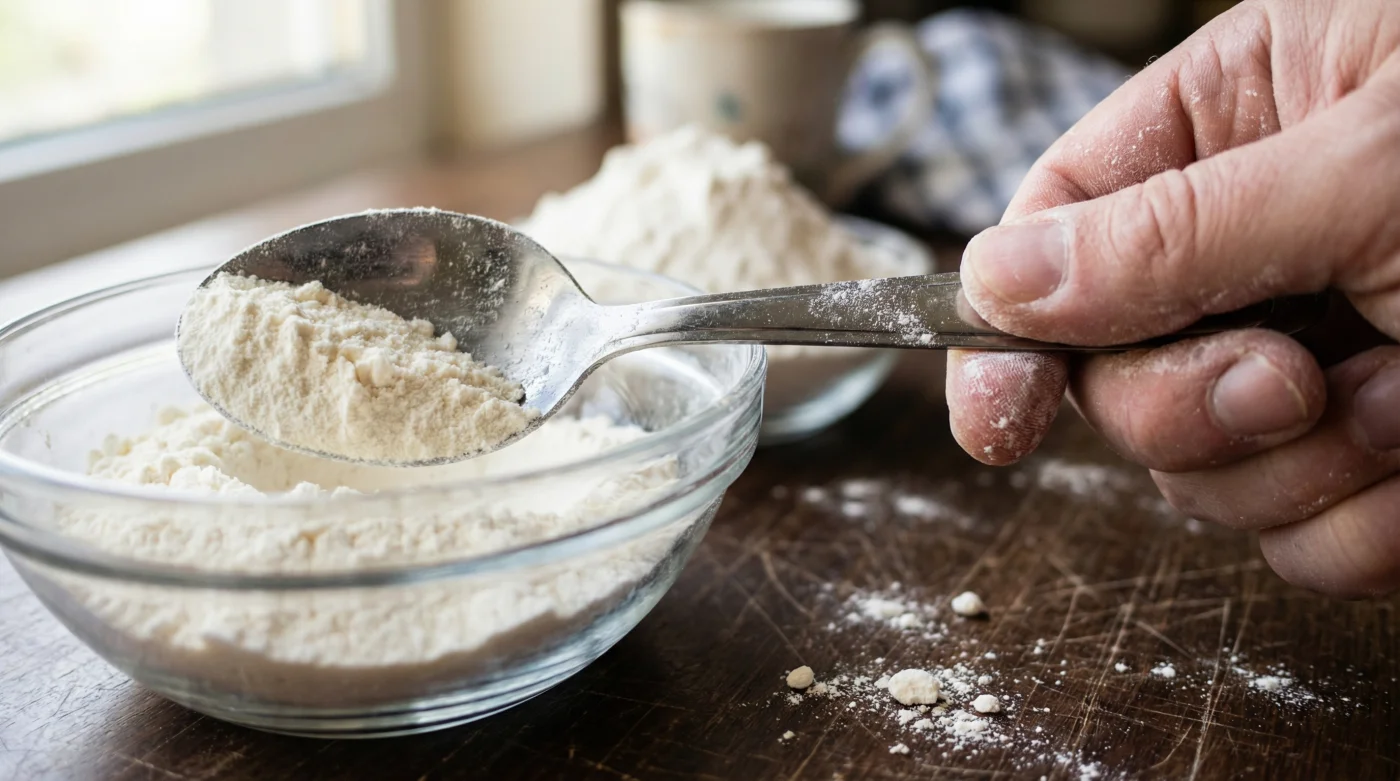
Executing this technique requires precision, but it is wonderfully simple. Begin by weighing out your plain flour. For every 120g of plain flour your recipe demands, you will intervene. Remove exactly two level tablespoons of that flour and return it to your storage jar.
Next, take your cornflour. Measure out two level tablespoons and add them into the remaining plain flour. You have now mathematically lowered the overall protein content of that batch, but the physical work is not quite finished.
Because cornflour is exceptionally fine, it can clump and refuse to blend evenly with the heavier wheat flour. You must force them to marry. Take a fine mesh sieve and pass the mixture through it into a large bowl.
Do not stop at one pass. Sift the mixture together at least four or five times. This repetitive action does two things: it thoroughly disperses the zero-gluten cornflour, and it traps microscopic pockets of air between the grains. That air is the secret to your future sponge.
| The Quality Checklist | What To Look For | What To Avoid |
|---|---|---|
| Cornflour Texture | Squeaky, pure white powder that feels like silk between the fingers. | Yellow cornmeal or polenta; these will ruin the sponge entirely. |
| Sifting Process | A uniform, highly aerated mound of flour that looks like fresh snowfall. | A single lazy sift, leaving heavy pockets of wheat flour at the bottom. |
| Measuring Method | Leveling off the measuring spoons with the flat back of a butter knife. | Heaped, rounded tablespoons which will drastically throw off the moisture ratio. |
The Bigger Picture: Baking Without Boundaries
- Canned coconut milk maintains silky curry textures avoiding these fierce boiling temperatures.
- Raw quinoa drops its natural bitter coating entirely following this hot rinse.
- Unsalted butter deepens homemade cookie flavours simply browning it before dough mixing.
- Turkey crowns retain explosive juices roasting entirely upside down during initial stages.
- Cauliflower florets achieve deep meaty caramelisation adding this specific smoked paprika rub.
Baking is often framed as a rigid science, a process where any deviation ends in disaster. Yet, the best bakers are not the ones who follow the most expensive recipes. They are the ones who know how to manipulate the humble staples sitting in their cupboards.
The next time you crave a delicate lemon drizzle or a towering layer cake, you will not have to compromise on texture. With just a bag of plain flour, a tin of cornflour, and a sieve, you can build a masterpiece. Your sponge will be lighter, your crumb will be finer, and you will have achieved it entirely on your own terms.
Baking is not about buying perfection in a box; it is about whispering to your ingredients until they yield the texture you desire.
Frequently Asked Questions
Can I use this trick for bread or pasta?
Absolutely not. Bread and pasta require high gluten development for their characteristic chew and structure. This trick is exclusively for delicate bakes like sponges, cupcakes, and tender biscuits.
Does it matter what brand of cornflour I use?
No, any standard supermarket cornflour will work perfectly. Just ensure it is pure cornflour, not a flavoured blancmange or custard powder.
Should I alter the baking powder in my recipe?
Your raising agents remain exactly the same. The cornflour only changes the structural protein of the flour; it does not impact how your baking powder or bicarbonate of soda reacts.
Can I make a large batch of this in advance?
Yes, you can scale this up and keep a dedicated jar of your homemade cake flour in the cupboard. Just remember the golden ratio: two tablespoons of cornflour for every 120g of plain flour, and sift it meticulously.
Will this change the flavour of my cake?
Not at all. Cornflour is entirely neutral in flavour when baked. You will only notice a dramatic improvement in the lightness and mouthfeel of the final sponge.