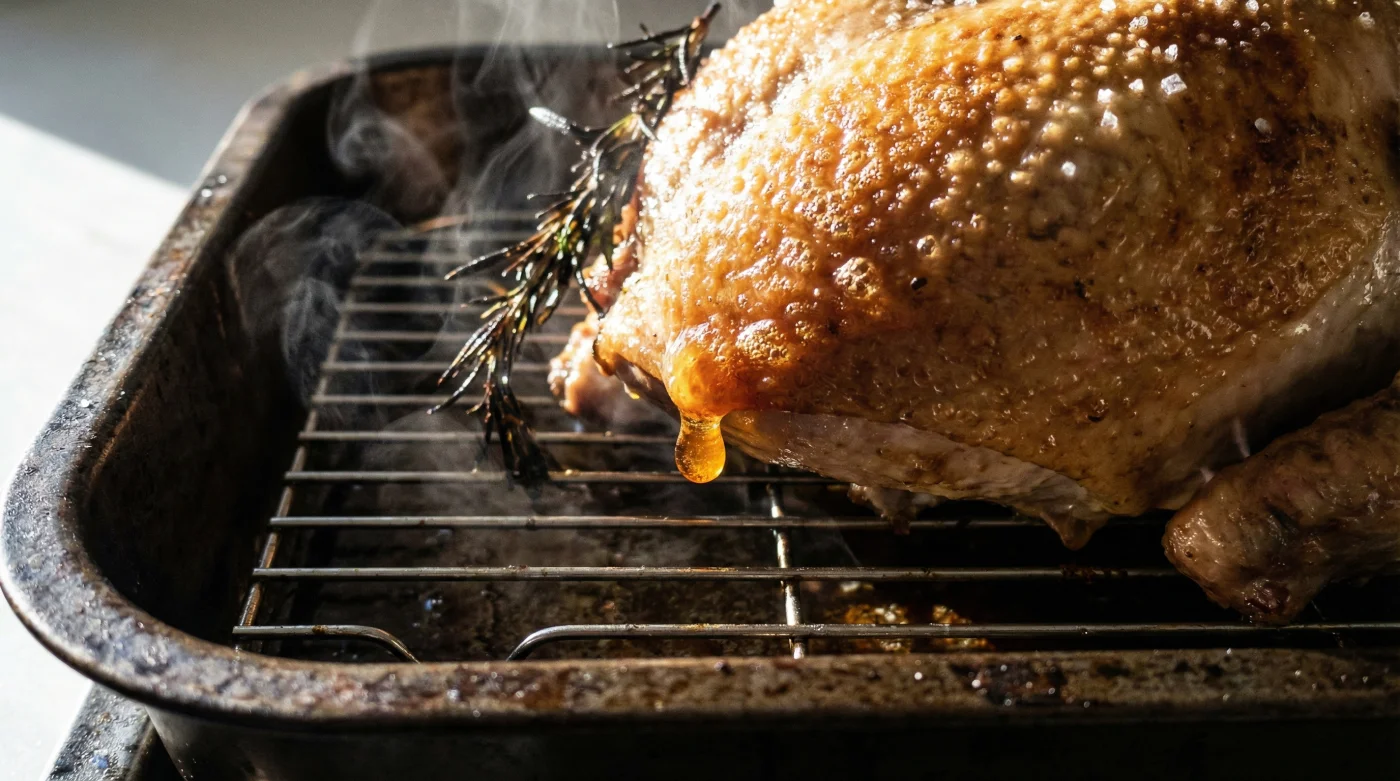
The oven door creaks open, releasing a sudden, dry blast of heat that singes your eyelashes. You reach in with a metal spoon, desperately scooping thin, watery drippings over a pale expanse of poultry. Every twenty minutes, you repeat this frantic ritual, terrified of serving a centrepiece that requires a tidal wave of gravy just to be swallowed. The tension in the kitchen rises while the moisture in the meat slowly vanishes.
We have all stood there, held hostage by the Sunday roast. For generations, the orthodox rule of roasting a turkey crown has been one of constant, anxious maintenance. You place it upright, skin facing the grill, and you baste until your arm aches. Yet, despite your devotion, the breast meat often emerges resembling spun sawdust.
The Gravity of the Fat
Here is a quiet, radical truth: you are fighting against physics. By roasting the crown right-side up from the very beginning, you are forcing the protective fats to slide off the breast and pool uselessly at the bottom of the roasting tin. It is a battle of attrition where the meat always loses.
Think of the crown’s structure like a thatched roof. If you turn it upside down, the thickest layer of subcutaneous fat sits at the top. As the oven’s heat begins its work, that fat slowly melts, rendering downwards. Gravity takes over. Instead of basting an empty tin, the fat permeates directly through the dense muscle fibres of the breast, insulating and seasoning it simultaneously.
I learned this from an old head chef tucked away in a drafty Yorkshire pub. While the rest of us fussed over dry birds, he would nonchalantly plop a £40 turkey crown onto a bed of carrots, entirely inverted. ‘Let the bird do the work,’ he muttered, wiping his hands on a flour-dusted apron. ‘The fat is a built-in basting brush. Why hold it yourself?’
| The Cook | The Upside-Down Benefit |
|---|---|
| The Anxious Host | Eliminates the need for constant oven-checking, keeping the kitchen temperature stable and the host present with guests. |
| The Budget-Conscious | Transforms an average supermarket crown into a rich, tender roast that tastes twice its price, saving money on premium cuts. |
| The Flavour Purist | Retains the natural, unadulterated juices of the meat without relying on heavy compound butters or excessive stocks. |
The Mindful Flip
Applying this technique requires a gentle shift in your kitchen rhythm. You are not simply throwing meat into a tin; you are orchestrating a controlled melt.
First, build a sturdy trivet. Slice thick rounds of onion, carrot, and celery, placing them in the base of your heaviest roasting tin. This prevents the delicate top skin from tearing against hot metal. Nestle the crown onto the vegetables, breast-side down. You will notice it feels slightly unsteady. Press it gently into the roots to anchor it.
Place it into a pre-heated oven. For the first hour, you do absolutely nothing. Resist the urge to open the door. Inside, the heat is melting the fat near the bone structure, driving it straight down into the breast tissue. The meat is quietly absorbing its own moisture, softening rather than tightening.
| Roasting Phase | Thermal Action | Moisture Impact |
|---|---|---|
| Minutes 0-30 (Inverted) | Undercarriage fat begins to render at 130 degrees Celsius. | Capillary action pulls liquid fat downward into the breast tissue. |
| Minutes 30-60 (Inverted) | Bone structure acts as a thermal shield against direct top-heat. | Evaporation is halted; juices are trapped within the muscle fibres. |
| Final 30 Minutes (Upright) | Direct heat is finally applied to the now-plumped breast skin. | Rapid Maillard reaction crisping the skin while the core remains saturated. |
- Cheddar cheese sauces stay perfectly smooth adding this evaporated milk splash.
- Heinz baked beans disappear from supermarket shelves following sudden tin supply disruptions.
- Greggs sausage rolls face major recipe overhauls angering loyal British bakery customers.
- Double cream creates perfectly crispy fried egg edges replacing traditional vegetable oil.
- Canned coconut milk maintains silky curry textures avoiding these fierce boiling temperatures.
Now, rub the exposed skin with a light layer of oil or butter, sprinkle generously with sea salt, and return it to the oven for the final crisping. The skin will blister and turn a deep, burnished gold. Because the meat beneath is already fully hydrated, the intense final heat only adds texture, rather than causing the bird to dry out.
| Quality Indicator | What to Look For | What to Avoid |
|---|---|---|
| Skin Integrity | Thick, unbroken skin covering the entire breast. | Tears, pale wet patches, or heavily processed glazes. |
| Bone Structure | A wide, robust ribcage to act as a proper resting base. | Crushed or splintered bones that could puncture the meat. |
| Moisture Level | Surface feels tacky and naturally plump to the touch. | Sitting in excessive, artificially injected watery fluids. |
The Bigger Picture
Mastering this simple inversion is about more than just a tender Sunday lunch. It is about reclaiming your time and peace of mind. Cooking should not be a panicked race against a drying piece of meat. It should be a thoughtful, confident process.
When you stop frantically basting, you are free to step away from the kitchen. You can sit with your family, sip a quiet cup of tea, and trust that the ingredients are doing the heavy lifting. The oven is no longer a source of anxiety, but a reliable tool working in harmony with gravity.
When you finally carve into that crown, the knife will glide. The meat will yield, holding onto its explosive, savoury juices. And you will realise that sometimes, the best way to fix a long-standing culinary problem is simply to turn it completely on its head.
A truly great roast is never built through frantic interference, but by understanding the natural weight and moisture of the meat.
Frequently Asked Questions
Will the breast skin stick to the roasting tin?
Not if you elevate it. Always place the inverted crown on a thick bed of root vegetables or a sturdy wire rack to ensure airflow and protect the skin from direct contact with the hot metal.Do I need to change the overall cooking time?
The total time remains roughly the same according to the weight of your bird. The only change is the orientation during the first hour or two-thirds of the cooking process.Should I still cover the crown in tin foil?
You can loosely drape a piece of tin foil over the undercarriage while it roasts upside down, but remove it once you flip the bird right-side up to allow the breast skin to crisp properly.Can I stuff the cavity if I roast it upside down?
It is best to cook your stuffing separately in a baking dish. An empty cavity allows the heat to circulate evenly, ensuring the meat cooks safely and consistently.How do I know when it is perfectly safe to eat?
Always rely on a digital meat thermometer. Pierce the thickest part of the breast once you have flipped it upright; it should read 74 degrees Celsius before you remove it to rest.